
You are using an outdated browser and your browsing experience will not be optimal. Please update to the latest version of Microsoft Edge, Google Chrome or Mozilla Firefox. Install Microsoft Edge

March 13, 2025

Funding Cuts and Mass Layoffs Due to Financial Stress in Cambodia

The recent freeze on US foreign aid has led to the suspension of billions of dollars in foreign assistance as well as widespread layoffs at contracting organizations around the world. Under this situation, USAID-funded offices in all jurisdictions, including Cambodia, may face the challenge of determining whether they need to lay off their employees.

Employers in Cambodia may take different steps in response to this and other instances of sudden financial stress in order to manage their workforce in accordance with Cambodian laws and regulations.

Suspension

Cambodia’s Labor Law allows employers to suspend employment contracts due to a major economic or material issue or any unexpected difficulty that results in the suspension of operations. To impose this employment contract suspension, the employer must initially submit a suspension request to the Ministry of Labor and Vocational Training (MLVT), detailing the reasons for the requested suspension.

If the reasons are deemed valid and the request is approved, the suspension period cannot exceed two months. During the suspension period, the employer must continue providing accommodation for employees if this benefit is already being provided. In some circumstances, the suspension period can be extended if necessary (as happened during the COVID-19 pandemic).

However, financial difficulties alone may not be a valid reason for extension. The decision is at the discretion of the MLVT labor inspectors on a case-by-case basis. Therefore, given the uncertain timeline of financial difficulties that may significantly impact the employer’s budget, suspending employment contracts might be ineffective.

Mass Layoffs

Under Cambodia’s Labor Law, mass layoffs due to a significant reduction in an establishment’s operation or an internal reorganization foreseen by the employer are permissible.

The layoff order must be based on professional qualifications, seniority period, and family burdens of the employees. The first employees to be laid off must be those with the least professional ability, followed by those with the least seniority. For seniority calculations, married employees must be given an additional year, as well as an additional year for each dependent child.

In addition, employers must inform the employees’ representatives in writing to solicit their suggestions, primarily on measures for announcing employee reductions in advance and minimizing the effects on affected workers.

The mass layoffs procedure is subject to the MLVT’s review and approval. Upon receipt of the request, an MLVT labor inspector may conduct a hearing to examine the impact of the proposed layoffs and measures to be taken to minimize their effects.

Termination

If an employment contract is not terminated by mutual agreement, due to serious misconduct by either party, or force majeure as defined under the Labor Law, the termination must have a valid reason.

Under the Labor Law, “valid reason” may refer to an employee’s aptitude or behavior, based on the requirements of the operation of the establishment. However, if employers face financial difficulties, they may consider declaring bankruptcy.

Declaring bankruptcy can be considered a valid reason and exempts employers from paying damages, as it does not impact an employee’s dignity or cause the public to question their behavior, abilities, or performance. However, declaring bankruptcy has legal implications, as it is governed by the Law on Insolvency and requires court proceedings.

The process involves filing an insolvency complaint with the court, which will review the complaint to determine if the employer is indeed insolvent. In addition, the employer must notify employees about the insolvency proceedings, their rights, and any potential layoffs. Employees can file claims for unpaid wages and other compensation, which are prioritized over other unsecured debts under both the Law on Insolvency and the Labor Law. Employers’ assets can be sold to pay off creditors, with employees being among the first to receive payment.

Damages and Statutory Payments

According to the Notification on Compensation for Terminating an Employment Contract, dated March 21, 2024, employers that terminate an employment contract without a valid reason must pay damages to the employees as follows:

  • For employees under a fixed-duration contract, the damages must be at least equal to the wages the employee would have received if they had completed the original term of the contract.
  • For employees under an unspecified-duration contract, the damages are equal to the seniority payment received during the employment contract.

These damages are in addition to required statutory payments that employees must receive after their contract is terminated, detailed in the table below.
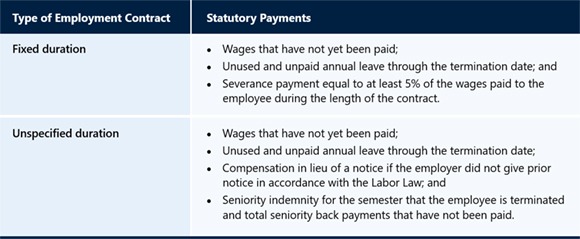
The requirements regarding statutory payments and other compensation dues to employees upon termination of employment were significantly clarified by a notification in March 2024.

Compliance

Organizations forced to consider mass layoffs should consult with legal counsel to ensure compliance with the March 2024 notification and other relevant labor regulations before proceeding with any workforce reduction measures. Proactive communication with both the MLVT and employee representatives will be crucial throughout this process. Furthermore, employers should consider developing contingency plans that account for various timelines of financial recovery, as each approach—whether suspension, mass layoffs, or termination—carries distinct legal obligations and financial implications that extend beyond the immediate crisis period. Organizations that approach these difficult decisions with careful planning and legal diligence will be better positioned to maintain operational stability while fulfilling their obligations to employees during this period of economic uncertainty.


RELATED INSIGHTS​ 

September 2, 2025
On August 26, 2025, the Thai cabinet approved a one-year postponement of mandatory contributions to the Employee Welfare Fund. Originally scheduled to take effect on October 1, 2025, the enforcement date has been deferred to October 1, 2026. The decision to delay the implementation stems from ongoing economic uncertainties in Thailand, driven by several external and domestic factors. These include increased trade tariffs imposed by the United States, the recent rise in the national minimum wage, and continued geopolitical tensions resulting from unresolved disputes with neighboring countries. These challenges have placed significant pressure on both businesses and the labor market, prompting the government to offer temporary relief through this deferral. As a result of the postponement, the following regulations will now come into effect on October 1, 2026: Royal Decree determining the Commencement Period for Savings and Contributions to the Employee Welfare Fund; Ministerial Notification specifying the Rates of Savings and Contributions; and Ministerial Notification outlining the Criteria and Procedures for Employers to Provide Assistance in Cases of Termination of Employment or Death. The Labour Welfare Fund Committee has formally endorsed the postponement. Contribution Rates Unchanged Although the implementation has been delayed, the contribution rates remain unchanged: October 1, 2026–September 30, 2031: Employers and employees each contribute 0.25% of the employee’s wage to the fund. From October 1, 2031, onward: Contributions increase to 0.5% of the employee’s wage for both parties. All other rules and conditions concerning the Employee Welfare Fund remain in full effect.
August 29, 2025
On August 15, 2025, Laos’ Immigration Police Department introduced a pilot online arrival registration system for foreign passport holders entering the country. Under the new system, visitors to Laos will be able to register their arrival online up to three days in advance and will be exempt from filling out paper forms at the border. Starting September 1, 2025, online registrations will be accepted at four major international border checkpoints: Wattay International Airport in Vientiane, Luang Prabang International Airport, Pakse International Airport in Champasak Province, and the First Lao-Thai Friendship Bridge linking Vientiane and Nong Khai Province in Thailand. Foreign passport holders arriving in Laos from this date onward will be able to complete the online registration via the official website of the Department of Immigration: http://www.immigration.gov.la/. Upon successful registration, travelers will receive a QR code valid for three days, which must be presented to border authorities upon arrival to verify the registration. During the pilot phase, which is expected to run until early 2026, travelers who have not registered online will still have the option to complete a paper form at the checkpoint. After the pilot phase, the online registration system will become mandatory nationwide, and paper forms will no longer be accepted. This initiative marks a significant step toward modernizing Laos’ immigration procedures. Transitioning from traditional paper-based entry forms to a streamlined digital system will greatly enhance efficiency at border checkpoints. The submission of traveler information ahead of arrival is expected to drastically reduce processing times and alleviate congestion at arrival counters, especially during peak travel periods.
August 20, 2025
On August 7, 2025, the government of Vietnam promulgated Decree No. 219/2025/ND-CP on foreign workers working in Vietnam (Decree 219), introducing substantial reforms to the management of foreign employees. Taking immediate effect upon issuance, and superseding earlier regulations on foreign employees under Decree No. 152/2020/ND-CP as amended by Decree No. 70/2023/ND-CP (collectively referred to as “Decree 152”), Decree 219 sets out clear timeframes and application requirements for work permit issuance, while adopting more flexible policies to support business operations. The key new provisions are as follows: 1. Relaxed Requirements Regarding Job-Posting Under Decree 152, employers were required to follow a complex process to apply for work permits or work permit exemption certificates for foreign employees. This included posting an advertisement for any position the employer wished to fill with a foreign employee on a designated online portal for a given amount of time, to demonstrate that the company tried, but failed, to find a suitable Vietnamese candidate for the position. This job-posting step now only applies when the foreigner will work in Vietnam under a local labor contract. Foreigners coming to Vietnam as intra-corporate transferees (i.e., as secondees) or working under service contracts are exempt. The job-posting period is also reduced from 15 calendar days to five business days. Employers may also now post the advertisements on multiple websites instead of only the online portal of the Ministry of Labor, Invalids and Social Affairs (now the Ministry of Home Affairs after government restructuring) or the provincial-level employment service center. 2. Work Permit Application Dossier Previously, employers were required to complete a preapproval step, whereby they had to submit a dossier explaining their foreign labor demand that required approval from the labor authority. Once approval for the foreign labor demand was granted, the approval dossier was an integral part of
August 20, 2025
With the shift in US policy to discourage DEI programs among government and private-sector employers, some companies have been cutting back. But US companies should be cautious in eliminating their DEI programs globally, as some elements of these programs are obligations under local laws in Vietnam, Thailand, and Cambodia.