The recent freeze on US foreign aid has led to the suspension of billions of dollars in foreign assistance as well as widespread layoffs at contracting organizations around the world. Under this situation, USAID-funded offices in all jurisdictions, including Cambodia, may face the challenge of determining whether they need to lay off their employees.
Employers in Cambodia may take different steps in response to this and other instances of sudden financial stress in order to manage their workforce in accordance with Cambodian laws and regulations.
Suspension
Cambodia’s Labor Law allows employers to suspend employment contracts due to a major economic or material issue or any unexpected difficulty that results in the suspension of operations. To impose this employment contract suspension, the employer must initially submit a suspension request to the Ministry of Labor and Vocational Training (MLVT), detailing the reasons for the requested suspension.
If the reasons are deemed valid and the request is approved, the suspension period cannot exceed two months. During the suspension period, the employer must continue providing accommodation for employees if this benefit is already being provided. In some circumstances, the suspension period can be extended if necessary (as happened during the COVID-19 pandemic).
However, financial difficulties alone may not be a valid reason for extension. The decision is at the discretion of the MLVT labor inspectors on a case-by-case basis. Therefore, given the uncertain timeline of financial difficulties that may significantly impact the employer’s budget, suspending employment contracts might be ineffective.
Mass Layoffs
Under Cambodia’s Labor Law, mass layoffs due to a significant reduction in an establishment’s operation or an internal reorganization foreseen by the employer are permissible.
The layoff order must be based on professional qualifications, seniority period, and family burdens of the employees. The first employees to be laid off must be those with the least professional ability, followed by those with the least seniority. For seniority calculations, married employees must be given an additional year, as well as an additional year for each dependent child.
In addition, employers must inform the employees’ representatives in writing to solicit their suggestions, primarily on measures for announcing employee reductions in advance and minimizing the effects on affected workers.
The mass layoffs procedure is subject to the MLVT’s review and approval. Upon receipt of the request, an MLVT labor inspector may conduct a hearing to examine the impact of the proposed layoffs and measures to be taken to minimize their effects.
Termination
If an employment contract is not terminated by mutual agreement, due to serious misconduct by either party, or force majeure as defined under the Labor Law, the termination must have a valid reason.
Under the Labor Law, “valid reason” may refer to an employee’s aptitude or behavior, based on the requirements of the operation of the establishment. However, if employers face financial difficulties, they may consider declaring bankruptcy.
Declaring bankruptcy can be considered a valid reason and exempts employers from paying damages, as it does not impact an employee’s dignity or cause the public to question their behavior, abilities, or performance. However, declaring bankruptcy has legal implications, as it is governed by the Law on Insolvency and requires court proceedings.
The process involves filing an insolvency complaint with the court, which will review the complaint to determine if the employer is indeed insolvent. In addition, the employer must notify employees about the insolvency proceedings, their rights, and any potential layoffs. Employees can file claims for unpaid wages and other compensation, which are prioritized over other unsecured debts under both the Law on Insolvency and the Labor Law. Employers’ assets can be sold to pay off creditors, with employees being among the first to receive payment.
Damages and Statutory Payments
According to the Notification on Compensation for Terminating an Employment Contract, dated March 21, 2024, employers that terminate an employment contract without a valid reason must pay damages to the employees as follows:
- For employees under a fixed-duration contract, the damages must be at least equal to the wages the employee would have received if they had completed the original term of the contract.
- For employees under an unspecified-duration contract, the damages are equal to the seniority payment received during the employment contract.
These damages are in addition to required statutory payments that employees must receive after their contract is terminated, detailed in the table below.
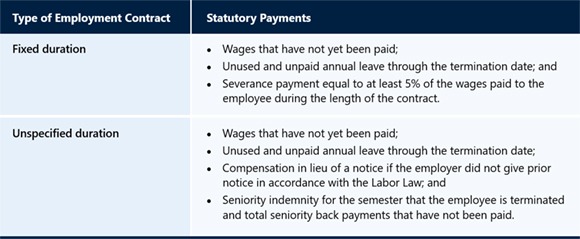
The requirements regarding statutory payments and other compensation dues to employees upon termination of employment were significantly clarified by a notification in March 2024.
Compliance
Organizations forced to consider mass layoffs should consult with legal counsel to ensure compliance with the March 2024 notification and other relevant labor regulations before proceeding with any workforce reduction measures. Proactive communication with both the MLVT and employee representatives will be crucial throughout this process. Furthermore, employers should consider developing contingency plans that account for various timelines of financial recovery, as each approach—whether suspension, mass layoffs, or termination—carries distinct legal obligations and financial implications that extend beyond the immediate crisis period. Organizations that approach these difficult decisions with careful planning and legal diligence will be better positioned to maintain operational stability while fulfilling their obligations to employees during this period of economic uncertainty.