
You are using an outdated browser and your browsing experience will not be optimal. Please update to the latest version of Microsoft Edge, Google Chrome or Mozilla Firefox. Install Microsoft Edge

March 13, 2025

Funding Cuts and Mass Layoffs Due to Financial Stress in Cambodia

The recent freeze on US foreign aid has led to the suspension of billions of dollars in foreign assistance as well as widespread layoffs at contracting organizations around the world. Under this situation, USAID-funded offices in all jurisdictions, including Cambodia, may face the challenge of determining whether they need to lay off their employees.

Employers in Cambodia may take different steps in response to this and other instances of sudden financial stress in order to manage their workforce in accordance with Cambodian laws and regulations.

Suspension

Cambodia’s Labor Law allows employers to suspend employment contracts due to a major economic or material issue or any unexpected difficulty that results in the suspension of operations. To impose this employment contract suspension, the employer must initially submit a suspension request to the Ministry of Labor and Vocational Training (MLVT), detailing the reasons for the requested suspension.

If the reasons are deemed valid and the request is approved, the suspension period cannot exceed two months. During the suspension period, the employer must continue providing accommodation for employees if this benefit is already being provided. In some circumstances, the suspension period can be extended if necessary (as happened during the COVID-19 pandemic).

However, financial difficulties alone may not be a valid reason for extension. The decision is at the discretion of the MLVT labor inspectors on a case-by-case basis. Therefore, given the uncertain timeline of financial difficulties that may significantly impact the employer’s budget, suspending employment contracts might be ineffective.

Mass Layoffs

Under Cambodia’s Labor Law, mass layoffs due to a significant reduction in an establishment’s operation or an internal reorganization foreseen by the employer are permissible.

The layoff order must be based on professional qualifications, seniority period, and family burdens of the employees. The first employees to be laid off must be those with the least professional ability, followed by those with the least seniority. For seniority calculations, married employees must be given an additional year, as well as an additional year for each dependent child.

In addition, employers must inform the employees’ representatives in writing to solicit their suggestions, primarily on measures for announcing employee reductions in advance and minimizing the effects on affected workers.

The mass layoffs procedure is subject to the MLVT’s review and approval. Upon receipt of the request, an MLVT labor inspector may conduct a hearing to examine the impact of the proposed layoffs and measures to be taken to minimize their effects.

Termination

If an employment contract is not terminated by mutual agreement, due to serious misconduct by either party, or force majeure as defined under the Labor Law, the termination must have a valid reason.

Under the Labor Law, “valid reason” may refer to an employee’s aptitude or behavior, based on the requirements of the operation of the establishment. However, if employers face financial difficulties, they may consider declaring bankruptcy.

Declaring bankruptcy can be considered a valid reason and exempts employers from paying damages, as it does not impact an employee’s dignity or cause the public to question their behavior, abilities, or performance. However, declaring bankruptcy has legal implications, as it is governed by the Law on Insolvency and requires court proceedings.

The process involves filing an insolvency complaint with the court, which will review the complaint to determine if the employer is indeed insolvent. In addition, the employer must notify employees about the insolvency proceedings, their rights, and any potential layoffs. Employees can file claims for unpaid wages and other compensation, which are prioritized over other unsecured debts under both the Law on Insolvency and the Labor Law. Employers’ assets can be sold to pay off creditors, with employees being among the first to receive payment.

Damages and Statutory Payments

According to the Notification on Compensation for Terminating an Employment Contract, dated March 21, 2024, employers that terminate an employment contract without a valid reason must pay damages to the employees as follows:

  • For employees under a fixed-duration contract, the damages must be at least equal to the wages the employee would have received if they had completed the original term of the contract.
  • For employees under an unspecified-duration contract, the damages are equal to the seniority payment received during the employment contract.

These damages are in addition to required statutory payments that employees must receive after their contract is terminated, detailed in the table below.
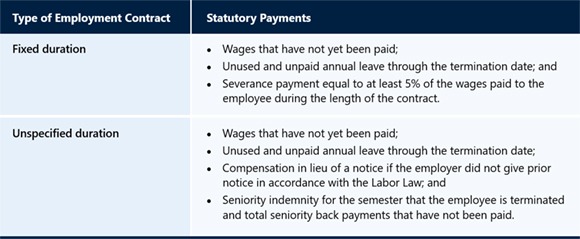
The requirements regarding statutory payments and other compensation dues to employees upon termination of employment were significantly clarified by a notification in March 2024.

Compliance

Organizations forced to consider mass layoffs should consult with legal counsel to ensure compliance with the March 2024 notification and other relevant labor regulations before proceeding with any workforce reduction measures. Proactive communication with both the MLVT and employee representatives will be crucial throughout this process. Furthermore, employers should consider developing contingency plans that account for various timelines of financial recovery, as each approach—whether suspension, mass layoffs, or termination—carries distinct legal obligations and financial implications that extend beyond the immediate crisis period. Organizations that approach these difficult decisions with careful planning and legal diligence will be better positioned to maintain operational stability while fulfilling their obligations to employees during this period of economic uncertainty.


RELATED INSIGHTS​ 

August 18, 2023
On August 16, 2023, Laos’ Prime Minister’s Office issued Notice No. 1502/PMO, which increases the minimum wage for all workers in Laos. This increase is a continuation of the stepped increases in the minimum wage that began in mid-2022. The recent notice increases the minimum monthly wage from LAK 1,300,000 (approx. USD 66) to LAK 1,600,000 (approx. USD 82), in accordance with an agreement reached in the government’s ordinary session in July 2023. The new minimum wage rate will take effect on October 1, 2023. This is the third minimum wage increase in Laos since June 2022. Two of the main factors responsible for this heightened frequency of minimum wage increases are the depreciation of the Lao kip against foreign currencies and inflation in the price of goods for daily consumption. These stepped increases also show the government’s proactive approach toward addressing the cost-of-living crisis in Laos and its effect on low-wage workers. For more details on the new minimum wage, or on any other labor and employment matters in Laos, please contact Dino Santaniello at [email protected] or +856 21 262 355.
July 7, 2023
Tilleke & Gibbins is pleased to announce the release of Employment Law Basics in Southeast Asia. This publication serves as an indispensable resource for businesses navigating the complex landscape of employment law in Cambodia, Laos, Myanmar, Thailand, and Vietnam. Authored by Tilleke & Gibbins’ regional team of employment law specialists, the guide provides a detailed overview of key employment law topics essential for businesses operating or planning to expand their operations in Southeast Asia. From employment contracts to termination procedures, each topic is examined in depth to ensure businesses are well-equipped to comply with local regulations and protect their interests. Key topics covered in the guide include: Employment contracts Probationary period Minimum wage Social security and statutory payments Working hours Leave and holidays Work rules Termination Foreign employees Data protection Remote work AI and automation Our guide offers multinational corporations establishing a presence in the region and local enterprises alike practical insights and actionable advice tailored to the unique regulatory environments in Cambodia, Laos, Myanmar, Thailand, and Vietnam. To access the full guide, please download the PDF below.
April 28, 2023
Instead of the typical dystopian scene of flames, wastelands of shattered buildings, and robotic overlords policing the remaining humans, our actual dystopian future may be a workplace filled only with men named Jared who once played lacrosse in high school. This may sound far-fetched, but one resume-screening tool was found to be using an algorithm that concluded two factors were most determinative of job performance: the name Jared and a history of playing lacrosse in high school. The frailties of artificial intelligence (AI) systems in recruitment and hiring could transform our workforces in unpredictable ways. If employers blindly follow AI outcomes without a deeper examination of how the algorithmic decision is reached, hiring outcomes may be not only ridiculous but also discriminatory. Risks of AI-Reliant Hiring Some employers have enthusiastically embraced AI as a way to reduce costs and replace human bias in the recruitment process. Human recruiters do not have a great track record; for example, in France, discrimination in recruitment has posed such a serious problem that the government submits false work biographies with ethnic names to identify and punish employers that unreasonably reject qualified ethnic applicants. Unfortunately, AI is modeled on human thinking, so it may amplify our own prejudices and errant conclusions while giving the appearance of providing a fair and clean process. AI typically learns inductively by training on examples and historical data. Factors such as exclusion of certain groups from educational or career opportunities has often shaped this data, so AI’s decisions may amplify this past prejudice. For instance, Amazon experimented with mechanized recruitment in 2014, but abandoned these efforts prior to implementation after the AI tool selected a predominantly male workforce. The AI learned by analyzing patterns in resumes submitted to the company over the last 10 years. Since over this period
April 3, 2023
Most employers know that terminating employees for poor job performance is not easy. But it is actually legally possible—if employers have the right approach and take specific precautionary measures. However, failing to take these precautions can mean that an employer is either stuck with an incompetent employee or on the losing end of a lawsuit for unfair termination. This article will lay out some essential considerations for employers in Thailand regarding termination of employment for poor performance. First, understand that “poor work performance” is a lack of performance or ability, or an inability to work with other employees. It does not constitute a violation of work rules or regulations. In some cases, however, an employee’s failure to act in accordance with lawful instructions or commands of the employer, resulting in poor work performance, could also be considered a violation of work rules or regulations. This may be the case if the work rules or regulations clearly state that an employee must strictly comply with the employer’s instructions or commands. Second, an employer can, in fact, terminate an employee due to poor work performance. For example, this may be possible in the following scenarios: Records show that an employee’s work performance has fallen below the employer’s required standards, and the employee has not tried to improve his or her work performance for three consecutive years. In addition, it does not appear that the employer was biased when giving ratings or scores for the employee’s work performance. The job description of the employee includes coordination with employees in other departments, but the employee has not been able to do so. Therefore, the employee was reassigned to a new job function, but the employee still did not improve. This suggests that the employee has a lack of interpersonal skills and is not