You are using an outdated browser and your browsing experience will not be optimal. Please update to the latest version of Microsoft Edge, Google Chrome or Mozilla Firefox. Install Microsoft Edge

September 7, 2021

Legal Options in Thailand When a Debtor Can’t (or Won’t) Pay Up

COVID-19 and the resulting lockdown measures to limit outbreaks in Thailand have caused significant financial difficulties for many business operators, large and small. Whether a business is a creditor or debtor, there is a high likelihood they have faced or will face a default caused by the pandemic. This article identifies three legal options available when a party defaults—civil cases, bankruptcy actions, and business rehabilitation actions—and compares key elements associated with each option. For context, those three options are defined as follows:

  • Civil case. A legal proceeding in which a creditor files a civil lawsuit (or arbitration claim) against a debtor for debt collection. If a debtor fails to settle a debt in accordance with a judgment, the creditor can ask the court to enforce the judgment by seizure and sale of the debtor’s assets through public auction.
  • Bankruptcy action. A legal proceeding under the Bankruptcy Act in which a government authority can collect a debtor’s assets, sell the assets by public auction, and distribute the net proceeds among creditors. In bankruptcy proceedings, the creditors will receive repayment in proportion to the size of the outstanding debts.
  • Business rehabilitation action. A legal proceeding under the Bankruptcy Act aimed at helping a debtor recover from insolvency and continue its business. Debtors are given debt relief and a “new start” through business rehabilitation, while creditors are able to collect a higher percentage of outstanding debt under rehabilitation than they would under a bankruptcy action.

In short, a civil case is a claim in court for repayment of a specific debt, a bankruptcy action results in distribution of the debtor’s assets among the creditors, and a business rehabilitation action aims to enable the debtor to stay in business while repaying their debts to some degree.

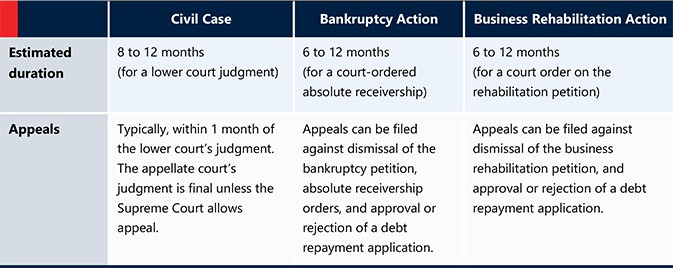
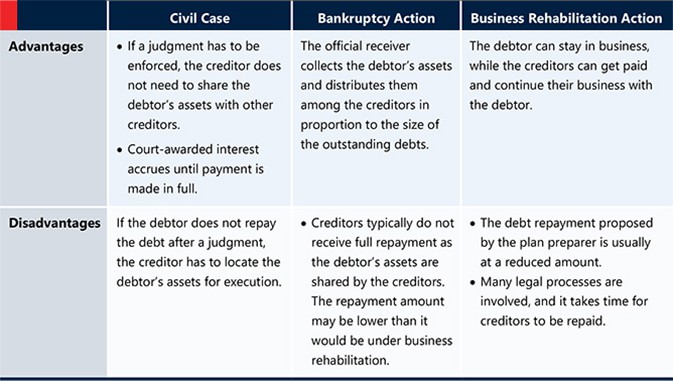
A civil case may be appropriate when the debtor defaults on debt repayment and is indebted to only the creditor bringing the action. A bankruptcy action should be considered when the debtor’s liabilities are greater than its assets, and its business cannot continue. Business rehabilitation may be a good option when there is still a reasonable chance of reforming and rebuilding the debtor’s business. The three options also differ in a number of other ways, as laid out below.


Legal Particulars
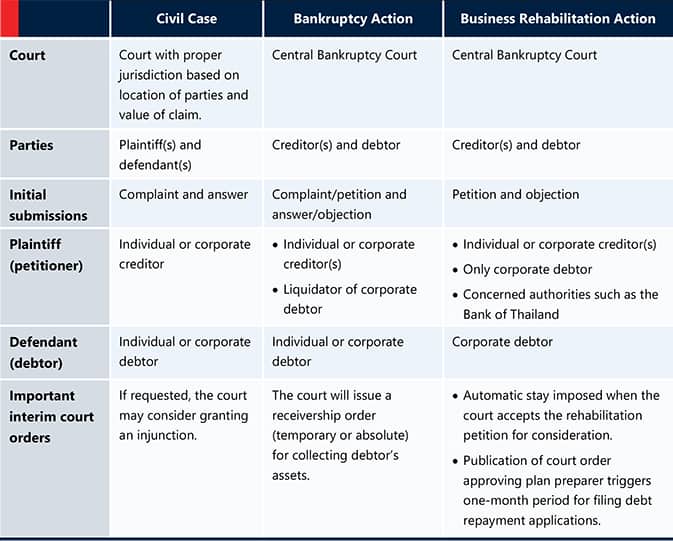
 

Requirements for Initiating Action
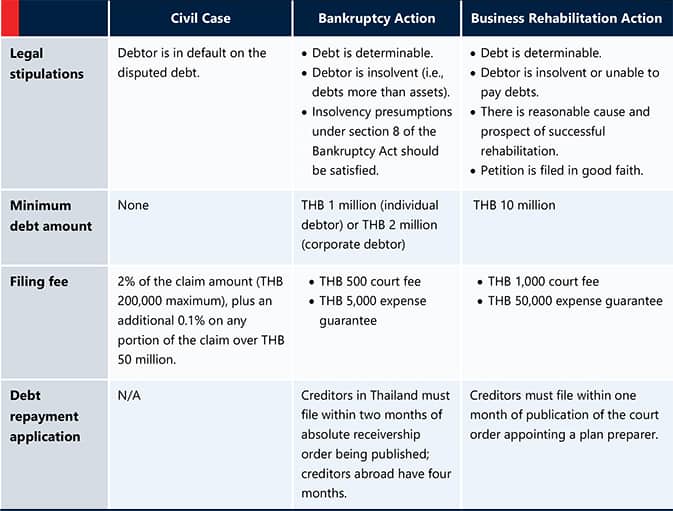
 

Proceedings
 

Advantages and Disadvantages
 

Conclusion

An essential step in pursuing any of these actions is retaining experienced local counsel who can offer tailored advice. Creditors should consider which of these three legal actions in Thailand best suits their needs and circumstances, and chart their course with the help of their legal advisor in Thailand. As noted above, a civil case might be the right option for a single creditor pursuing repayment, while bankruptcy actions and business rehabilitation are more far-reaching options that may be appropriate when there are serious underlying financial or structural issues affecting the debtor. With the aid of a specialist in debt recovery, bankruptcy, and business rehabilitation in Thailand, the creditor can consider the specific circumstances, lay out and execute a winning strategy, and resolve their debt recovery problems efficiently and cost-effectively.


RELATED INSIGHTS​ 

February 25, 2026
Tilleke & Gibbins has updated the Vietnam chapter in the newly released Licensing 2026 guide, published by Lexology Panoramic. The comparative guide provides companies and other interested readers with information on licensing law and practice in various countries around the world. Licensing 2026 provides detailed information on the following topics: Restrictions, laws and licensing arrangements Intellectual property issues: Paris Convention for the Protection of Industrial Property, contesting the validity of licensor’s IP rights, invalidity and expiry of IP rights, security interests, proceedings against third parties, sublicensing, jointly owned IP, first to file, scope of patent protection, trade secrets, copyright Software licensing: Perpetual licensing, legal requirements, user restrictions Royalties and payments, currency conversion, and taxes: Relevant legislation, restrictions, taxation of foreign licensors Competition law issues: Restrictions on trade, legal restrictions, and IP-related court rulings Indemnification, disclaimers, and damages: Prevalence and enforceability of indemnity provisions and contractual waivers of damages Termination: Right to terminate, impact of termination Bankruptcy: Impact of licensee or licensor bankruptcy Dispute resolution: Governing law, arbitration, enforceability, injunctive relief, contractual waivers The Vietnam chapter is available below as a PDF. Readers can gain 30 days of complementary access to the full Licensing 2026 guide and the rest of Lexology Panoramic’s varied offerings through this link.
February 20, 2026
Thailand’s Supreme Administrative Court has issued a decisive ruling annulling the Ministry of Labor’s notification that had granted an exemption for foreign pilots to fly domestic routes under wet‑lease arrangements. A wet lease is a leasing arrangement in which the aircraft is provided together with its foreign flight crew, including pilots, and related operational support, rather than the airline supplying its own pilots. The judgment, delivered on November 17, 2025, and published in the Government Gazette on January 30, 2026, follows a legal challenge brought by the Thai Pilots Association, which argued that the exemption unlawfully enabled foreign workers to assume a role traditionally reserved for Thai nationals. The notification in question, dated December 13, 2024, authorized foreign pilots who came as part of wet‑leased aircraft to fly domestic routes. The Thai Pilots Association disputed the legality of this rationale, asserting that the exemption was triggered by a private airline’s request rather than by any statutory necessity. The Ministry of Labor justified this measure by relying on aircraft‑specific approvals issued by the Ministry of Transport and by enabling the Department of Employment to issue corresponding work permits. Arguments Presented in the Case The Thai Pilots Association argued that the exemption undermined the interests of domestic pilots and conflicted with the policy intent of Thailand’s foreign‑worker regulatory framework. The lawsuit emphasized that the notification arose directly from a private airline company’s request to operate two A320 aircraft under a wet lease and that the measure had the practical effect of displacing Thai pilots who remained unemployed. Meanwhile, the Ministry of Labor defended the exemption as a temporary and necessary response to industry shortages and part of national efforts to support tourism and restore aviation capacity. Legal Framework Thai law establishes a general prohibition against foreign nationals piloting domestic aircraft. Section
February 19, 2026
Thailand’s Securities and Exchange Commission (SEC) has overhauled its approach to related-party transactions (RPTs) by issuing new rules that simplify approval processes while expanding oversight. Capital Market Supervisory Board Notification No. TorJor. 46/2568 will replace the longstanding Notification No. TorJor. 21/2551, which has governed RPT compliance for over a decade. The new regulation takes effect on July 1, 2026. Any RPT matters approved by a company’s board of directors or approved for shareholders’ approval before that date remain subject to Notification No. TorJor. 21/2551. The new RPT rules will introduce significant changes that market participants should carefully consider. Consolidated Definitions Under the previous framework, key definitions relevant to RPT compliance were dispersed across multiple sources, including SEC notifications, Stock Exchange of Thailand (SET) regulations, and provisions of the Securities and Exchange Act (before amendments). The new regulation consolidates these definitions into a single notification. Concepts such as “related party” and “connected person,” as well as relevant transaction categories, are now more systematically organized and written in greater detail. The SET has yet to issue corresponding regulations, which should include more detailed related disclosure requirements. Unified Threshold and Mandatory Board Approval The most significant change under the new regulation is the elimination of the multitiered approval framework based on transaction type. Instead of various categories, transactions are now classified as either (1) financial assistance provided to related persons, or (2) other RPTs in order to determine the level of corporate approvals and disclosures for each transaction size in these categories, but the concept remains the same. Under the previous regulation, RPTs were divided into small, medium, and large transactions, with differing approval requirements. The new regulation effectively merges the small and medium categories. As a result, all RPTs must now be approved by the board of directors as a baseline
February 19, 2026
Thailand’s Securities and Exchange Commission (SEC) has issued a new regulation on material transactions (MTs) to govern asset acquisitions and disposals by listed companies and their subsidiaries. The new notification on MT criteria (No. TorJor. 45/2568) from the Capital Market Supervisory Board replaces the long-standing notification (No. TorJor. 20/2551) that has governed such matters. The SEC has also introduced parallel amendments to the country’s related-party transaction rules. The new regulation will take effect on July 1, 2026. Any MT matters approved by a company’s board of directors for shareholders’ approval before that date remain subject to Notification No. TorJor. 20/2551. Following that date, the new MT rules will introduce several significant changes that market participants should carefully consider. Expanded Scope of Material Transactions One of the key changes under the new regulation is the expansion of the definition of MTs, which now expressly covers financial assistance and certain lease and business lease arrangements that are not in the ordinary course of business of the listed company or its subsidiaries. For financial assistance, this includes lending, granting credit, providing guarantees, or entering into any arrangement that increases the company’s financial obligations, particularly where the recipient is facing liquidity issues or unable to repay debts. Other forms of financial support also fall within scope. However, whether the provision of collateral for others qualifies as an MT remains somewhat unclear, since no disposal of assets occurs for the provider of collateral. This issue remains to be carefully considered. For lease-related transactions, the MT rules now specifically include the lease or hire-purchase of all or part of a business or assets operated by or belonging to a listed company or its subsidiaries. New Exemptions The new regulation introduces clearer exemptions for transactions between a listed company and its subsidiaries or among subsidiaries, which