You are using an outdated browser and your browsing experience will not be optimal. Please update to the latest version of Microsoft Edge, Google Chrome or Mozilla Firefox. Install Microsoft Edge

September 7, 2021

Legal Options in Thailand When a Debtor Can’t (or Won’t) Pay Up

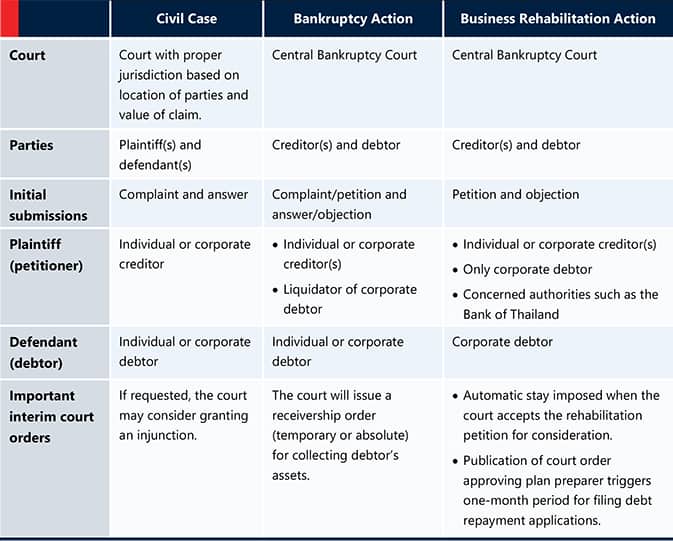
COVID-19 and the resulting lockdown measures to limit outbreaks in Thailand have caused significant financial difficulties for many business operators, large and small. Whether a business is a creditor or debtor, there is a high likelihood they have faced or will face a default caused by the pandemic. This article identifies three legal options available when a party defaults—civil cases, bankruptcy actions, and business rehabilitation actions—and compares key elements associated with each option. For context, those three options are defined as follows:

  • Civil case. A legal proceeding in which a creditor files a civil lawsuit (or arbitration claim) against a debtor for debt collection. If a debtor fails to settle a debt in accordance with a judgment, the creditor can ask the court to enforce the judgment by seizure and sale of the debtor’s assets through public auction.
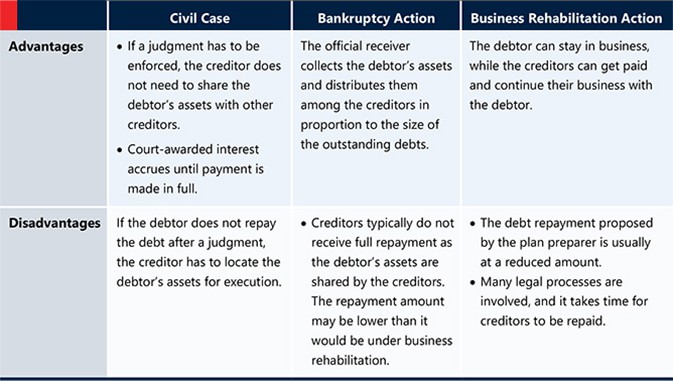
  • Bankruptcy action. A legal proceeding under the Bankruptcy Act in which a government authority can collect a debtor’s assets, sell the assets by public auction, and distribute the net proceeds among creditors. In bankruptcy proceedings, the creditors will receive repayment in proportion to the size of the outstanding debts.
  • Business rehabilitation action. A legal proceeding under the Bankruptcy Act aimed at helping a debtor recover from insolvency and continue its business. Debtors are given debt relief and a “new start” through business rehabilitation, while creditors are able to collect a higher percentage of outstanding debt under rehabilitation than they would under a bankruptcy action.

In short, a civil case is a claim in court for repayment of a specific debt, a bankruptcy action results in distribution of the debtor’s assets among the creditors, and a business rehabilitation action aims to enable the debtor to stay in business while repaying their debts to some degree.

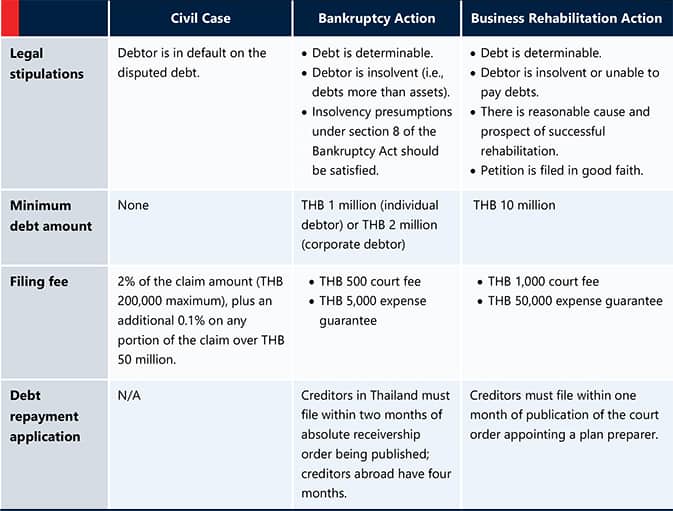
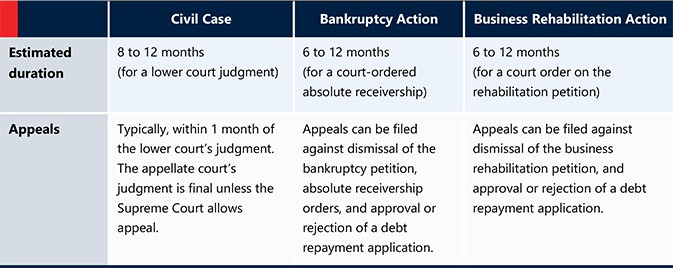
A civil case may be appropriate when the debtor defaults on debt repayment and is indebted to only the creditor bringing the action. A bankruptcy action should be considered when the debtor’s liabilities are greater than its assets, and its business cannot continue. Business rehabilitation may be a good option when there is still a reasonable chance of reforming and rebuilding the debtor’s business. The three options also differ in a number of other ways, as laid out below.


Legal Particulars
 

Requirements for Initiating Action
 

Proceedings
 

Advantages and Disadvantages
 

Conclusion

An essential step in pursuing any of these actions is retaining experienced local counsel who can offer tailored advice. Creditors should consider which of these three legal actions in Thailand best suits their needs and circumstances, and chart their course with the help of their legal advisor in Thailand. As noted above, a civil case might be the right option for a single creditor pursuing repayment, while bankruptcy actions and business rehabilitation are more far-reaching options that may be appropriate when there are serious underlying financial or structural issues affecting the debtor. With the aid of a specialist in debt recovery, bankruptcy, and business rehabilitation in Thailand, the creditor can consider the specific circumstances, lay out and execute a winning strategy, and resolve their debt recovery problems efficiently and cost-effectively.


RELATED INSIGHTS​ 

February 10, 2026
Data center and cloud investments are forming a major focus of private-sector investment in Thailand, with tech giants like Amazon, Google, Microsoft, and TikTok, as well as numerous telecom and data center companies, committing significant outlays to data center and cloud development. The country’s Board of Investment (BOI) approved projects worth THB 1.87 trillion in 2025, and THB 746 billion of this was from planned data center investments—by far the largest amount from any single industry. Thailand’s swift rise as a regional data center hub is fueled by surging demand for cloud, AI, and digital services, as well as large-scale investments from global tech firms. The country’s strategic location, competitive power costs, robust fiber infrastructure, expanding IT talent, and supportive government policies—including BOI incentives and streamlined approvals—have made it an attractive destination for scalable and sustainable digital infrastructure investments. The BOI’s proactive approach in updating promoted categories and providing both tax and non-tax incentives further ensures Thailand’s continued growth in this sector. 2025 BOI Changes for Data Centers In the middle of 2025, the BOI responded to the remarkable trend by updating investment‑promotion categories across various sectors (e.g., machinery and electrical equipment, public utilities, digital and innovative industries) to accommodate growing investment in data‑center projects. Before the change, which was detailed in a notification that has applied to investment promotion applications submitted from July 1, 2025, onward, data‑center projects under BOI promotion were granted a single A1 incentive (an eight‑year corporate income‑tax exemption) and subject to one uniform set of conditions. The July 2025 notification restructured promotion for data centers into two categories based on power‑usage efficiency: high‑efficiency data centers and other data centers. Under these rules, qualified high‑efficiency data centers are eligible for an eight‑year corporate income tax (CIT) exemption, while for other data centers this exemption is
February 9, 2026
When unauthorized credit card transactions occur, who bears responsibility—the cardholder or the issuing bank? In Thailand, a landmark 2025 ruling by the country’s Supreme Court has clarified this question, establishing a stricter standard for banks in fraud disputes and significantly strengthening consumer protections. The case centered on disputed charges where a customer claimed their credit card had been used without authorization. The bank sued to recover the amount, and both the court of first instance and the Court of Appeal ruled in favor of the bank. However, the Supreme Court overruled their judgments and decided that the customer did not need to pay for the unauthorized transactions, placing liability squarely on the bank. This ruling was based on three key findings, which are outlined below. Finding 1: Insufficient Expert Testimony In this case, the bank bore the burden of proving matters related to the credit card system’s manufacture, design, security, and operation, as required under the Consumer Case Procedure Act B.E. 2551 (2008). To meet this requirement, the bank presented testimony from two employees in its credit card department regarding ’security measures and issuance procedures. However, the Supreme Court found these witnesses unqualified as experts, as they did not present technical or academic evidence and did not possess specialized expertise in credit card technology. As a result, their testimony failed to establish that the bank’s credit card technology was sufficiently secure against fraudulent misuse. Finding 2: Contradictory Terms and Conditions The bank’s own credit card terms and conditions included a provision acknowledging that despite the card’s EMV security standards, cardholders must still exercise caution to prevent unauthorized access. The Supreme Court interpreted this clause as an explicit admission that credit card systems remain vulnerable to hacking and fraud, even with high-level security measures in place. This acknowledgment undermined the
February 3, 2026
Thailand’s alternative dispute resolution (ADR) landscape has evolved significantly over the past decade. Legislative reforms such as the Dispute Mediation Act and expanded court‑annexed mediation have strengthened non‑litigious options, while institutional choices have broadened. Parties can now choose between the Thai Arbitration Institute (TAI), the Thailand Arbitration Center (THAC), and a growing number of sector‑specific dispute forums. For businesses, these choices matter. Each forum has different rules, administration, costs, speed, and enforcement mechanisms. These factors can directly impact commercial leverage, recovery outcomes, and business continuity. Choosing the right forum and drafting an effective dispute resolution clause can materially influence how a dispute is resolved. This article outlines the practical differences between Thailand’s leading alternative dispute resolution forums, explains when each is likely to deliver the most value, and offers drafting and strategy tips to embed those advantages into your dispute resolution clauses. Why ADR Is Gaining Traction in Thailand Thai policy increasingly supports the resolution of civil and commercial disputes through ADR. Recent amendments to the Civil Procedure Code now provide for court-supervised pre-action and in-case mediation. This type of mediation has its advantages: it suspends limitation periods, involves no court fees, and can conclude with a consent judgment that is immediately enforceable and subject to only limited grounds of appeal. In parallel, the Mediation Act supports out‑of‑court mediation for qualifying disputes within defined subject‑matter and monetary thresholds. Valid settlement agreements reached under this law may be enforced through a streamlined court process. Thailand’s arbitration framework has also matured into a reliable, pro‑enforcement framework under the Arbitration Act, which closely follows the UNCITRAL Model Law and applies to both domestic and international cases, so cross‑border users see familiar rules. As Thailand is a signatory to the New York Convention, Thai courts generally recognize and enforce foreign awards subject only
January 29, 2026
Following the recent enactment of a comprehensive legal framework addressing sexual harassment, Thailand has launched a fast-track judicial process enabling victims of online sexual harassment to obtain court orders suspending and removing obscene content from the internet. On January 26, 2026, the Office of the Judiciary introduced the “Take It Down” procedure through the Court Integral Online Service (CIOS) platform, providing victims with their first direct, expedited pathway to halt the spread of online content that violates the new legal provisions against sexual harassment. This new remedy stems from section 284/4 of the Penal Code, introduced through the Act Amending the Penal Code (No. 30) B.E. 2568, which took effect on December 30, 2025. Under section 284/4, an injured person or a competent official may petition the court to suspend dissemination of violating data and remove the data from computer systems within a court-specified period. The court may also direct system controllers, service providers, or competent authorities to carry out the order and report back within 15 days. Filing through the CIOS Platform The CIOS platform serves as the primary electronic channel for these petitions. Key features include: Individuals can file online without appearing in person and may submit petitions at any time the system is available. Users must complete digital identity verification via the ThaID application to access the CIOS. Petitions under section 284/4 are limited to requests to suspend or remove violating content. Claims for monetary damages must be pursued separately, including via separate proceedings or prefiling mediation. Streamlined Review Process The submission workflow is end-to-end electronic, and the system provides step-by-step guidance. After submission, court staff review the petition before presenting it to a judge for consideration. The court may conduct an online inquiry to obtain additional information, and in-person attendance is required only if deemed