You are using an outdated browser and your browsing experience will not be optimal. Please update to the latest version of Microsoft Edge, Google Chrome or Mozilla Firefox. Install Microsoft Edge

September 7, 2021

Legal Options in Thailand When a Debtor Can’t (or Won’t) Pay Up

COVID-19 and the resulting lockdown measures to limit outbreaks in Thailand have caused significant financial difficulties for many business operators, large and small. Whether a business is a creditor or debtor, there is a high likelihood they have faced or will face a default caused by the pandemic. This article identifies three legal options available when a party defaults—civil cases, bankruptcy actions, and business rehabilitation actions—and compares key elements associated with each option. For context, those three options are defined as follows:

  • Civil case. A legal proceeding in which a creditor files a civil lawsuit (or arbitration claim) against a debtor for debt collection. If a debtor fails to settle a debt in accordance with a judgment, the creditor can ask the court to enforce the judgment by seizure and sale of the debtor’s assets through public auction.
  • Bankruptcy action. A legal proceeding under the Bankruptcy Act in which a government authority can collect a debtor’s assets, sell the assets by public auction, and distribute the net proceeds among creditors. In bankruptcy proceedings, the creditors will receive repayment in proportion to the size of the outstanding debts.
  • Business rehabilitation action. A legal proceeding under the Bankruptcy Act aimed at helping a debtor recover from insolvency and continue its business. Debtors are given debt relief and a “new start” through business rehabilitation, while creditors are able to collect a higher percentage of outstanding debt under rehabilitation than they would under a bankruptcy action.

In short, a civil case is a claim in court for repayment of a specific debt, a bankruptcy action results in distribution of the debtor’s assets among the creditors, and a business rehabilitation action aims to enable the debtor to stay in business while repaying their debts to some degree.

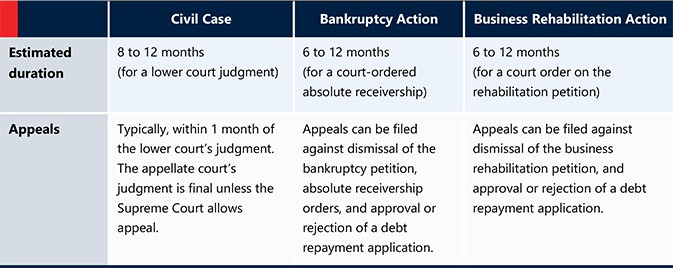
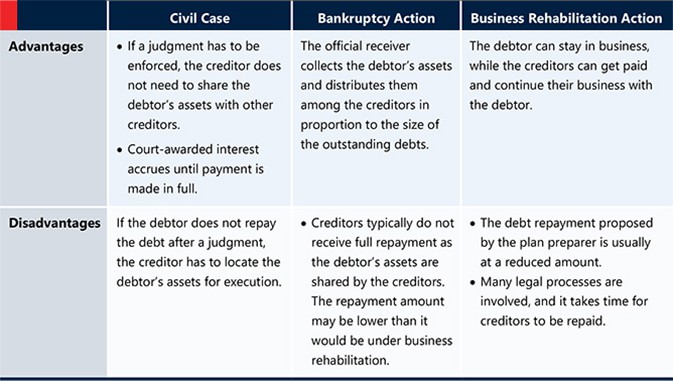
A civil case may be appropriate when the debtor defaults on debt repayment and is indebted to only the creditor bringing the action. A bankruptcy action should be considered when the debtor’s liabilities are greater than its assets, and its business cannot continue. Business rehabilitation may be a good option when there is still a reasonable chance of reforming and rebuilding the debtor’s business. The three options also differ in a number of other ways, as laid out below.


Legal Particulars
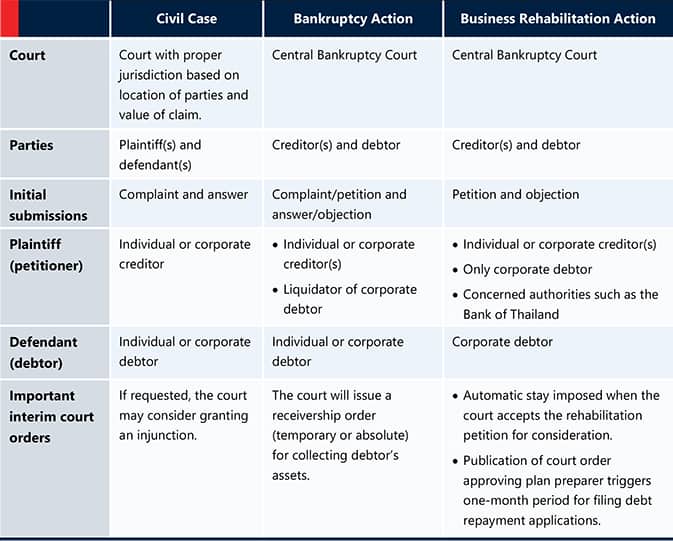
 

Requirements for Initiating Action
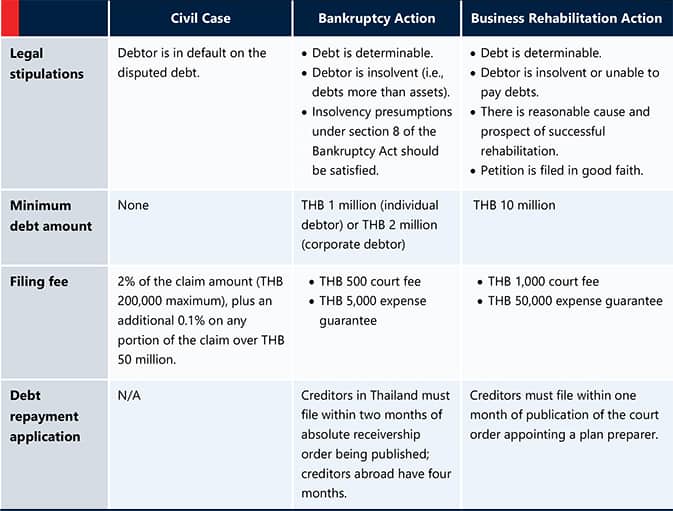
 

Proceedings
 

Advantages and Disadvantages
 

Conclusion

An essential step in pursuing any of these actions is retaining experienced local counsel who can offer tailored advice. Creditors should consider which of these three legal actions in Thailand best suits their needs and circumstances, and chart their course with the help of their legal advisor in Thailand. As noted above, a civil case might be the right option for a single creditor pursuing repayment, while bankruptcy actions and business rehabilitation are more far-reaching options that may be appropriate when there are serious underlying financial or structural issues affecting the debtor. With the aid of a specialist in debt recovery, bankruptcy, and business rehabilitation in Thailand, the creditor can consider the specific circumstances, lay out and execute a winning strategy, and resolve their debt recovery problems efficiently and cost-effectively.


RELATED INSIGHTS​ 

January 14, 2026
Employers operating in Thailand can enforce post-employment noncompete covenants, but success depends on precise drafting and strong evidentiary support. Thai courts will uphold restraints that protect legitimate employer interests and are fair and reasonable in duration, geographic reach, and substantive scope. Overbroad covenants, however, draw judicial skepticism and may fail unless they are drafted in severable, defensible components tied to the employee’s actual role. This article synthesizes recent trends in Thai case practice, explains how Thai courts assess reasonableness in employment restraints, and provides a practical litigation-focused framework for drafting enforceable covenants, preparing evidence, and pursuing relief through the Labor Court. The Legal Framework and Its Practical Implications Thai courts evaluate noncompete covenants under general principles of contract enforceability and public policy, with particular focus on whether a restraint is necessary to protect a legitimate employer interest and proportionate to that objective. In employment matters, this analysis is shaped by the employee-protective tenor of Thai labor law and by the Labor Court’s equitable discretion in determining appropriate remedies. The practical takeaway is that standardized or broadly drafted covenants rarely survive scrutiny. Courts look for a demonstrable nexus between the employee’s actual exposure to confidential information, trade secrets, or customer relationships and the scope of the restraint. Where that nexus is weak or the restraint operates as a blanket prohibition, courts are inclined to decline enforcement or limit relief to a narrowly tailored prohibition. The employer interests most commonly recognized as legitimate in Thai practice include the protection of trade secrets, confidential business information, and goodwill tied to identifiable customer segments or territories. Courts are more likely to enforce restraints where employers can clearly document what information is at risk, why particular customer relationships matter, and how the employee was involved with those assets. Judges also look closely at the
January 8, 2026
Doing business in Thailand means operating under a strict regulatory framework. From time to time, companies may receive unexpected administrative orders from government authorities that restrict their operations, impose new compliance obligations, or levy fines and penalties. When this happens, a business may challenge the order under Thailand’s administrative law system. The primary concern in pursuing administrative litigation is timing, as strict statutory deadlines apply and missing them can permanently affect a company’s rights. First Step: Administrative Appeal Many companies assume the first step is to immediately bring the matter before the Administrative Court to seek revocation or suspension of the order. Some even attempt to request an interim injunction to stop the order from taking effect. However, Thai law generally requires that the company first challenge the order through an administrative appeal with the same agency that issued it. Only after this process is complete can the matter be taken to court. Seeking an interim injunction at this stage is also not possible. This is because Thai law does not allow a standalone application for an interim injunction; an injunction can only be requested together with the underlying complaint filed with the Administrative Court. Since a court complaint cannot be filed until the administrative appeal process has been exhausted, an injunction is usually not available at the early stage. What Are the Timeframes for Administrative Appeal? Thailand applies a two-stage administrative appeal process. The appeal must first be submitted to the same authority that issued the order, which will review its own decision. If that authority affirms its decision, the appeal is then escalated to the relevant higher authority for further review. In most cases, both stages must be completed before a company is allowed to proceed to court. The timeframe for filing an administrative appeal is very
January 6, 2026
Thailand is developing new legislation on responsible business conduct that would impose statutory obligations on large enterprises to manage human rights and environmental risks throughout their operations and supply chains. The Draft Act on the Promotion of Responsible Business Conduct, commonly referred to as the Human Rights and Environmental Due Diligence (HRDD) Bill, has been developed through extensive consultation involving a wide range of stakeholders, with the Ministry of Justice playing a leading role. If enacted, the HRDD bill would reshape how certain large businesses operate and manage their supply chains, reflecting a recognition of international standards and global concerns regarding human rights and environmental protection. By introducing legally binding due diligence obligations, the draft aims to ensure that businesses operating in Thailand are held accountable for adverse impacts throughout their operations and supply chains, in line with emerging global legal frameworks. Who Will Have to Comply? The HRDD bill primarily targets large enterprises based on their annual revenue thresholds: Manufacturing businesses with annual revenue exceeding THB 500 million Wholesale, retail, or service businesses with annual revenue exceeding THB 300 million The draft would also cover state-owned enterprises and foreign businesses operating in Thailand if their operations meet the applicable revenue thresholds. What Does Human Rights and Environmental Due Diligence Involve? Under the HRDD bill, due diligence is not a one-time checklist but an ongoing process with several key requirements: Adopt and publicly disclose a sustainability policy. Businesses must commit publicly to respecting human rights and protecting the environment, and must integrate this policy into corporate governance and risk management systems. Identify and assess risks. Companies must identify and assess risks of human rights violations and environmental harm across their operations and value chains. Prevent or reduce risks. Businesses must implement effective and proportionate measures to prevent or mitigate
December 30, 2025
On December 17, 2025, Laos’ Ministry of Industry and Commerce (MOIC) issued a notice introducing a new digital system that allows e-commerce businesses to obtain required certificates and licenses through an online, application-based platform. Notice No. 3988, which will take effect on February 1, 2026, introduces the E-Trust platform, a downloadable application that allows e-commerce businesses to remotely obtain acknowledgement certificates and business operating licenses. New Digital Registration Options Under the previous framework established by the Decree on E-commerce (2021), businesses were required to complete registration exclusively through paper-based submissions. The new system now offers businesses two registration options: Traditional paper-based process at the Division of E-commerce Management within the MOIC; or Electronic registration and renewal through the E-Trust platform. This change is expected to streamline procedures, reduce administrative burdens, and enhance accessibility for businesses operating outside Vientiane. The E-Trust platform facilitates compliance for both individuals and legal entities required to submit applications and renewals for required certificates and licenses. The development is particularly beneficial for businesses located in remote provinces, as it eliminates the need for physical travel and significantly accelerates processing times. Compliance Requirements and Penalties Businesses must obtain or renew the required certificates and licenses to avoid sanctions under the Decision on Fines and Other Measures for Violation of the Decree and Regulations on E-commerce (No. 2828/MOIC, dated November 11, 2025). Penalties for noncompliance may include monetary fines and other enforcement measures.