You are using an outdated browser and your browsing experience will not be optimal. Please update to the latest version of Microsoft Edge, Google Chrome or Mozilla Firefox. Install Microsoft Edge

September 7, 2021

Legal Options in Thailand When a Debtor Can’t (or Won’t) Pay Up

COVID-19 and the resulting lockdown measures to limit outbreaks in Thailand have caused significant financial difficulties for many business operators, large and small. Whether a business is a creditor or debtor, there is a high likelihood they have faced or will face a default caused by the pandemic. This article identifies three legal options available when a party defaults—civil cases, bankruptcy actions, and business rehabilitation actions—and compares key elements associated with each option. For context, those three options are defined as follows:

  • Civil case. A legal proceeding in which a creditor files a civil lawsuit (or arbitration claim) against a debtor for debt collection. If a debtor fails to settle a debt in accordance with a judgment, the creditor can ask the court to enforce the judgment by seizure and sale of the debtor’s assets through public auction.
  • Bankruptcy action. A legal proceeding under the Bankruptcy Act in which a government authority can collect a debtor’s assets, sell the assets by public auction, and distribute the net proceeds among creditors. In bankruptcy proceedings, the creditors will receive repayment in proportion to the size of the outstanding debts.
  • Business rehabilitation action. A legal proceeding under the Bankruptcy Act aimed at helping a debtor recover from insolvency and continue its business. Debtors are given debt relief and a “new start” through business rehabilitation, while creditors are able to collect a higher percentage of outstanding debt under rehabilitation than they would under a bankruptcy action.

In short, a civil case is a claim in court for repayment of a specific debt, a bankruptcy action results in distribution of the debtor’s assets among the creditors, and a business rehabilitation action aims to enable the debtor to stay in business while repaying their debts to some degree.

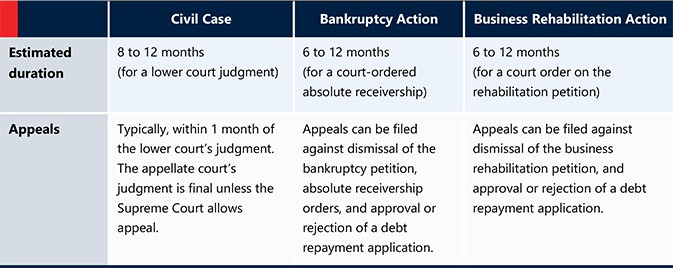
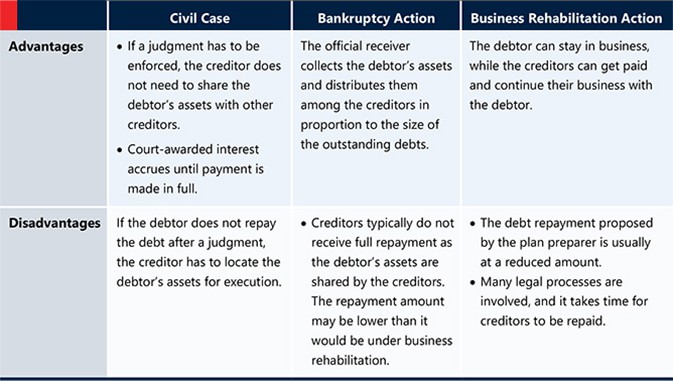
A civil case may be appropriate when the debtor defaults on debt repayment and is indebted to only the creditor bringing the action. A bankruptcy action should be considered when the debtor’s liabilities are greater than its assets, and its business cannot continue. Business rehabilitation may be a good option when there is still a reasonable chance of reforming and rebuilding the debtor’s business. The three options also differ in a number of other ways, as laid out below.


Legal Particulars
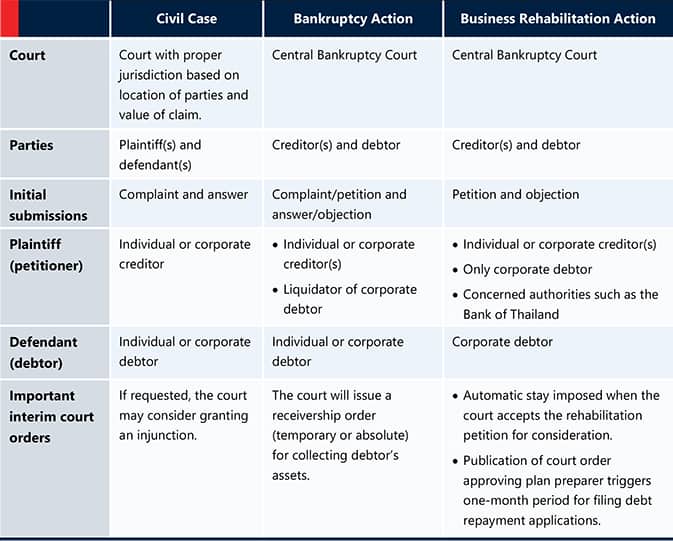
 

Requirements for Initiating Action
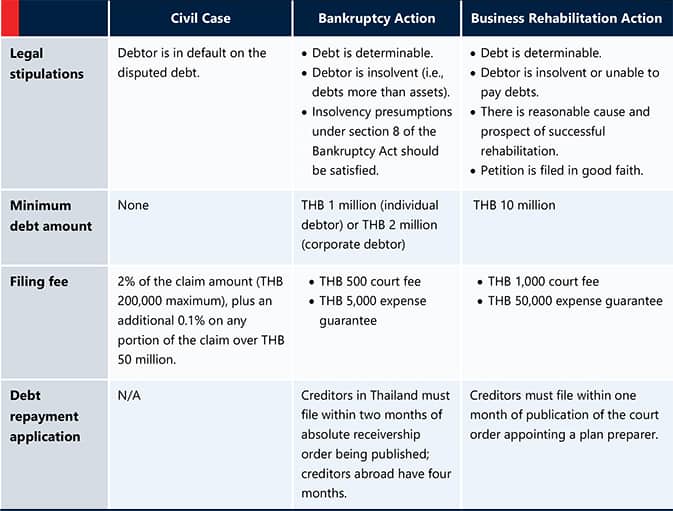
 

Proceedings
 

Advantages and Disadvantages
 

Conclusion

An essential step in pursuing any of these actions is retaining experienced local counsel who can offer tailored advice. Creditors should consider which of these three legal actions in Thailand best suits their needs and circumstances, and chart their course with the help of their legal advisor in Thailand. As noted above, a civil case might be the right option for a single creditor pursuing repayment, while bankruptcy actions and business rehabilitation are more far-reaching options that may be appropriate when there are serious underlying financial or structural issues affecting the debtor. With the aid of a specialist in debt recovery, bankruptcy, and business rehabilitation in Thailand, the creditor can consider the specific circumstances, lay out and execute a winning strategy, and resolve their debt recovery problems efficiently and cost-effectively.


RELATED INSIGHTS​ 

December 19, 2025
Prior to the dissolution of the House of Representatives, Thailand’s cabinet approved a draft amendment to the Administrative Procedure Act, following review by the Council of State. If enacted, this reform will fundamentally change how state agencies process business applications and appeals by imposing enforceable timelines and legal consequences for inaction. The draft directly targets a longstanding commercial frustration: applications and appeals that vanish into administrative silence, stalling investment and foreclosing judicial review across sectors ranging from real estate and manufacturing to healthcare and finance. The “Silence Means Yes” Rule for Applications At the core of the reform is a new automatic “approval by implication” for applications subject to statutory processing deadlines. If an official fails to notify an applicant of a decision within the legally prescribed period, the application will be deemed approved as a matter of law. This presumption shifts the costs of delay from businesses to the bureaucracy and gives applicants a definitive legal position once time expires. The mechanism applies to routine licensing and registration matters governed by explicit consideration periods in existing statutes or ministerial regulations. Officials may extend the decision period by up to thirty days, but only if they notify the applicant before the original deadline and substantiate that the delay arises from genuinely exceptional circumstances beyond their control. Certain sensitive applications are expressly excluded from automatic approval, including those that may significantly affect national security or defense, public safety and health, the environment or natural resources, or national cultural heritage. Once the deadline passes without a decision, businesses can proceed with deployment of capital and operations—construction, hiring, procurement, and market entry—without waiting for formal permission that may never arrive. For time-sensitive projects, this materially reduces regulatory timing risk. The “Deemed Rejection” Rule for Appeals The draft introduces a parallel “deemed rejection”
December 15, 2025
Thailand is taking steps to energize its startup scene by drafting the Startup Promotion Law. This draft law aims to remove obstacles, open new funding opportunities, and provide coordinated government support. The goal is to make it easier for Thailand-based startups to grow and compete on a global stage. Why Is This Law Needed? For many years, Thai startups have operated under traditional company law frameworks that were not designed with high-growth businesses or with fundraising opportunities in mind. Restrictions on issuing bonds, offering shares to outside investors, and repurchasing shares for employee incentive programs made it challenging for emerging companies to access capital and accelerate their growth. The draft Startup Promotion Act seeks to remove these obstacles and foster a more competitive, entrepreneur-friendly environment in Thailand. Who’s in Charge? Two main organizations will oversee the startup ecosystem: Startup Promotion Committee: This group, to be appointed by the National Science, Research, and Innovation Policy Council, will set national strategies, policies, and budget; design promotional campaign and incentives; and propose further legislative amendments to promote startups. National Innovation Agency (NIA): Under the draft act, the NIA will be the main contact for startups and will serve as the secretariat office of the Startup Promotion Committee, coordinating data, advising startups, maintaining the public registry, and providing funding and investment (grants, repayable grants, loans, and equity) under committee criteria and, where applicable, cabinet approval. What Startups Are Eligible for Benefits? To be officially recognized and access benefits, a company must: Be a private limited company less than 10 years old at the time of application. Existing companies that already exceed the 10-year threshold may still apply for startup statues within one year of the law’s enactment, as long as they otherwise still qualify for the new regime. Have average annual revenue not
December 12, 2025
Similar to other types of corporate disputes, tax-related conflicts often begin with an earnest attempt to resolve matters outside the courtroom. The prospect of engaging in tax litigation can be daunting, given the potential strain on commercial relationships, the legal expenses, and the uncertainty surrounding its resolution. However, there are instances when tax litigation becomes the sole avenue for seeking redress. For individuals and entities contemplating the pursuit of tax-related legal remedies, the Thai legal system offers an accessible, impartial, and equitable platform for dispute resolution. Tilleke & Gibbins’ latest update to Tax Litigation in Thailand provides an outline for navigating tax-related disputes within the Thai legal framework. It aims to equip readers with a fundamental understanding of procedures and practices within the Thai tax litigation landscape. The full guide is available through the button below.
December 12, 2025
Cross-border disputes often end with a judgment or arbitral award issued outside Thailand. When a party has assets or operations in Thailand, the key question becomes simple: will a Thai court enforce it? Thai law treats foreign court judgments and foreign arbitral awards very differently. Foreign court judgments cannot be recognized or enforced directly and must effectively be re-litigated. Foreign arbitral awards, however, benefit from a clear recognition and enforcement process under the New York Convention and Thailand’s Arbitration Act. Thailand’s Overall Approach Thailand does not have a general law or treaty that allows automatic enforcement of foreign court judgments. To rely on a foreign judgment, a party must initiate a new lawsuit in a Thai court, plead the claim under Thai law, and prove the case again. The foreign judgment can be used as evidence, but it is not binding, and the Thai court retains full discretion to reassess both the facts and the law. Foreign arbitral awards are treated more favorably. Thailand is a longstanding member of the New York Convention and has implemented it through the Arbitration Act. The act provides a straightforward process for asking a Thai court to recognize and enforce a qualifying award, without retrying the dispute, and subject only to limited refusal grounds. Foreign Court Judgments: Persuasive but Not Binding Although Thai courts do not recognize or enforce foreign court judgments, they may rely on them as persuasive evidence under certain conditions. Courts generally give more weight to judgments that are final on the merits, issued by a court with proper jurisdiction, and reached after proper notice and an opportunity for the defendant to be heard. Default judgments or rulings based primarily on procedural grounds carry less weight, and the ultimate relevance and weight are left to the court’s discretion. In practical