
You are using an outdated browser and your browsing experience will not be optimal. Please update to the latest version of Microsoft Edge, Google Chrome or Mozilla Firefox. Install Microsoft Edge

June 7, 2024

Laos Regulates Management of Foreign Currency from Exports

On March 7, 2024, Laos moved to regulate the management of foreign-currency income from the exportation of goods and services. Effective March 29, 2024, Decision No. 333 (formally the Decision on Management of Income in Foreign Currency from Exportation of Goods and Services No. 333/BOL) from the Bank of Lao PDR (BOL) aims to incentivize the inflow of such foreign currency into Laos and its sale to licensed commercial banks.

Decision No. 333 sets minimum required proportions for importing income in foreign currency derived from the exportation of goods and services, as well as the timeframe for doing so. It also stipulates the requirements for selling such foreign currency to commercial banks in Laos and the minimum proportions that must be sold.

Importing Foreign-Currency Income

Exporters must receive payments from abroad via bank transfer into a dedicated bank account designated for import-export business activities within the timeline specified in the sale-purchase agreement, but not exceeding 180 days from the date of export. Each sector must import income in foreign currency into the Lao PDR according to the minimum proportion of currency to be imported, and it must be done within the required timeframes, as specified in the table below.
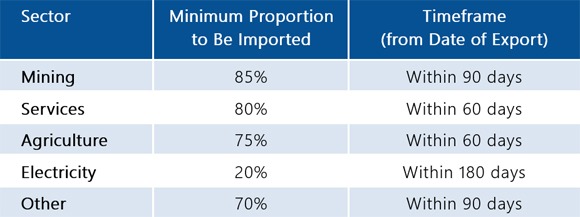
The ratios and timeframes are subject to change depending on the circumstances. If exporters cannot comply with the required ratio and timeline, exporters must provide relevant explanatory documents for the BOL’s consideration.

Selling Foreign-Currency Income

Exporters of goods and services must sell at least the minimum required proportion of their foreign-currency income (see table below) to a commercial bank in Laos. This foreign currency exchange must occur within three working days of receiving the foreign currency into the dedicated bank account in Laos. The selling rate will be determined by the prevailing rate of the commercial bank on the day of the transaction.
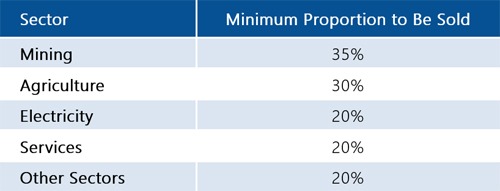
In conducting these transactions, commercial banks are required to carefully consider and manage their reserves and overall liquidity to ensure that they can meet public demand.

If an exporter does not sell at least the minimum required amount of foreign currency within three working days, the relevant commercial bank must proceed with the minimum required exchange and notify the exporter that they are doing so.

These requirements do not apply to re-exporters, such as importers of unprocessed raw materials for re-export to other countries, as determined by the Department of Foreign Currency Management (DFCM).

After selling the minimum required amount to a commercial bank, the remaining foreign-currency income must be used for foreign-currency exchange purposes, such as payments to parties in foreign countries, fulfilling obligations to the state, and so on.

Exporters can sell foreign currency to the BOL by notifying it of the need to sell the foreign currency to the DFCM in the BOL, after which they can sell the currency to the BOL through a commercial bank.

Registration

Decision No. 333 requires service exporters to register as importers and exporters to bring in income generated from exporting services. Although it doesn’t specify the types of service businesses that need to register, a March 2024 notice from the Ministry of Industry and Commerce offers examples of such businesses, including those in international transport, insurance, tourism and hotels, construction, and consulting.

Violations

First-time violations of Decision No. 333 that do not cause damage are subject to training on the importance of complying with Lao law or a warning. If the violation persists after the training or warning, the violator will face suspension of its ability to export goods and services.

For more information on Decision No. 333, or on any aspect of foreign currency management in Laos, please contact Tilleke & Gibbins at [email protected].

RELATED INSIGHTS​ 

February 3, 2021
On January 20, 2021, the Securities and Exchange Commission of Thailand (SEC) and the Securities & Futures Commission of Hong Kong (SFC) entered into a memorandum of understanding (MOU) on mutual recognition of funds. The MOU aims to facilitate the process for eligible funds set up in one country to be marketed and offered to investors in the other country by streamlining qualifications and processes for registration with the regulators. The key elements of the MOU are outlined below. Covered Funds The MOU generally only covers funds in the form of collective investment schemes (CIS), set up in Thailand or Hong Kong and managed by a covered management company that is authorized or licensed in its home country, (i.e., Thailand or Hong Kong) that is seeking approval to offer these funds to the public in the other country (the “host country”). Apart from the regulatory requirements prescribed by the regulator of the home country, the covered funds must also meet certain eligibility requirements, dependent on the type of fund offering, set by the regulator of the inbound jurisdiction (i.e. the SEC or the SFC). These funds must fall within one or more fund types specified in the MOU, including general equity funds, bond funds, mixed funds, feeder funds, unlisted index funds, and exchange-traded funds. Note that the SEC has agreed to expedite approval for Thai feeder funds that invest in Hong Kong master funds by streamlining certain processes. Covered Management Companies Generally, an asset management company that is authorized in its home jurisdiction (i.e., Thailand or Hong Kong) will be able to conduct cross-border marketing and fund offering activities under this MOU. Requirements for Fund Offerings Apart from meeting certain qualifications prescribed by the host country, fund offerings must be conducted in accordance with the host country’s requirements. In
January 28, 2021
On January 26, 2021, the Central Bank of Myanmar (CBM) published Notification 1/2021 in relation to non-banking financial institutions (NBFIs). This notification, which took immediate effect and has far-reaching implications for NBFI operations in Myanmar, applies to NBFIs wishing to conduct finance company business, leasing business, or factoring business, which are defined in the Financial Institutions Law (2016) (FIL) as follows: Finance company business is “business engaging primarily in financing the purchase of goods or services with funding other than deposits from the public.” Interest would be charged on such finance. Leasing business is “the business of letting or sub-letting movable property on hire, regardless whether the letting is with or without an option to purchase the property.” An obvious example would be vehicle leasing. Factoring business is “the business of financing accounts receivables.” This is when a business sells its accounts receivable at a discount. The key provisions of the notification are summarized below. NBFI Registration To conduct any of the above businesses, an individual or company must apply for a registration certificate from the CBM by submitting the documents specified in the notification. The registration certificate may come with terms and conditions prescribed by the CBM on a case-by-case basis. It seems likely that these terms and conditions could include minimum capital requirements, but this remains to be seen. Trading as an NBFI without a CBM certificate is punishable by two to five years imprisonment and a fine of MMK 500 million (approx. USD 375,000). NBFI Certificate Revocation The CBM has extensive powers to revoke the NBFI certificate in certain circumstances, including failure to comply with the terms and conditions of the registration certificate; conducting non-NBFI business; conducting business in a manner detrimental to the interests of consumers; failure to comply with anti-money laundering or counter terrorism
January 14, 2021
On November 26, 2020, the Notification of the Ministry of Finance Re: Addition to Other Business Relating to Digital Assets B.E. 2563 (2020) (the Digital Asset Business Notification) and the Notification of the Ministry of Finance Re: Licensing of Digital Asset Business No. 2 B.E. 2563 (2020) (the Digital Asset Business Licensing Notification) were published in the Thai Government Gazette. Additional Digital Asset Businesses The new Digital Assets Business Notification adds two new categories of digital assets business to the list prescribed in the Royal Decree on Digital Asset Businesses B.E. 2561 (2018). Digital Asset Fund Manager is defined as a person who manages funds from digital assets for another person for benefits, or holds themselves out to the general public as being ready to do so, in the ordinary course of business. It does not include the management of digital assets as prescribed by the Securities and Exchange Commission (SEC). Digital Asset Advisory Service is defined as a person who provides consultations to other people, directly or indirectly, regarding the value of digital assets; the suitability of investment in digital assets; or the buying, selling, or exchanging of any digital assets in the ordinary course of business in return for service fees or other compensation. However, this does not include consultations as a part of or relating to a digital asset exchange, digital asset broker, digital asset dealer, digital asset fund manager, or other personal consultation as prescribed by the SEC. Additional Digital Asset Licensing Requirements The Digital Asset Business Licensing Notification amends the definition of “License Applicant” to include cryptocurrency exchanges, digital token exchanges, cryptocurrency brokers, digital token brokers, cryptocurrency dealers, digital token dealers, cryptocurrency fund managers, digital token fund managers, cryptocurrency advisory services, and digital token advisory services. Additional requirements for granting licenses have also been added
December 9, 2020
Thailand’s Trade Competition Commission (TCC) has issued new rules governing business relations between food delivery platform operators and the restaurants operating through those platforms. The guidelines identify various arrangements, that are sometimes imposed upon restaurants by digital platforms, as unfair and damaging to restaurant operators, and restrict them accordingly. This is the fourth time that the TCC has deemed it necessary to intervene in a specific industry by restricting certain unfair trade practices in accordance with the Trade Competition Act B.E. 2560 (2017) (TCA), and is indicative of the TCC’s greater drive to quell unfair practices using its powers under the TCA. It also shows their willingness to react quickly to new developments in the market—in this case, the substantial increase in restaurant operators selling their products through online platforms in recent months. The Guidelines on Unfair Trade Practices between Digital Platform Operators for Food Delivery and Restaurants were published in the Government Gazette on November 23, 2020, and take effect on December 23, 2020. Key Definitions Digital platforms mean online services which establish a trade linkage between restaurant businesses, food deliverers, and consumers—in other words, applications or websites that allow consumers to use restaurants via food deliverers. Digital platform operators for food delivery means the business operators that provide digital platform services, acting as an intermediary to accept the purchase order and deliver food between restaurant operators, food delivery service providers, and consumers; or between restaurant operators and consumers in accepting the purchase order for food. Put simply, they are the companies operating food delivery platforms. Unfair Conduct  The main principle set forth in the TCC’s food delivery guidelines is that business conduct between food delivery platform operators and restaurant operators must respect the freedom of each party; must be fair, noncompulsory, and nondiscriminatory; and must not obstruct another