
You are using an outdated browser and your browsing experience will not be optimal. Please update to the latest version of Microsoft Edge, Google Chrome or Mozilla Firefox. Install Microsoft Edge

June 7, 2024

Laos Regulates Management of Foreign Currency from Exports

On March 7, 2024, Laos moved to regulate the management of foreign-currency income from the exportation of goods and services. Effective March 29, 2024, Decision No. 333 (formally the Decision on Management of Income in Foreign Currency from Exportation of Goods and Services No. 333/BOL) from the Bank of Lao PDR (BOL) aims to incentivize the inflow of such foreign currency into Laos and its sale to licensed commercial banks.

Decision No. 333 sets minimum required proportions for importing income in foreign currency derived from the exportation of goods and services, as well as the timeframe for doing so. It also stipulates the requirements for selling such foreign currency to commercial banks in Laos and the minimum proportions that must be sold.

Importing Foreign-Currency Income

Exporters must receive payments from abroad via bank transfer into a dedicated bank account designated for import-export business activities within the timeline specified in the sale-purchase agreement, but not exceeding 180 days from the date of export. Each sector must import income in foreign currency into the Lao PDR according to the minimum proportion of currency to be imported, and it must be done within the required timeframes, as specified in the table below.
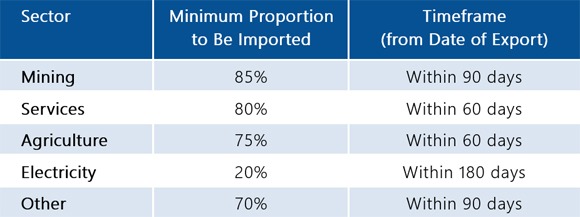
The ratios and timeframes are subject to change depending on the circumstances. If exporters cannot comply with the required ratio and timeline, exporters must provide relevant explanatory documents for the BOL’s consideration.

Selling Foreign-Currency Income

Exporters of goods and services must sell at least the minimum required proportion of their foreign-currency income (see table below) to a commercial bank in Laos. This foreign currency exchange must occur within three working days of receiving the foreign currency into the dedicated bank account in Laos. The selling rate will be determined by the prevailing rate of the commercial bank on the day of the transaction.
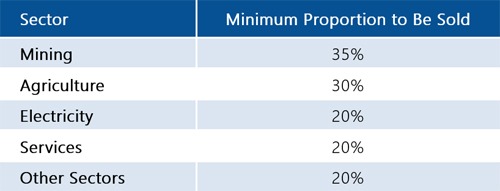
In conducting these transactions, commercial banks are required to carefully consider and manage their reserves and overall liquidity to ensure that they can meet public demand.

If an exporter does not sell at least the minimum required amount of foreign currency within three working days, the relevant commercial bank must proceed with the minimum required exchange and notify the exporter that they are doing so.

These requirements do not apply to re-exporters, such as importers of unprocessed raw materials for re-export to other countries, as determined by the Department of Foreign Currency Management (DFCM).

After selling the minimum required amount to a commercial bank, the remaining foreign-currency income must be used for foreign-currency exchange purposes, such as payments to parties in foreign countries, fulfilling obligations to the state, and so on.

Exporters can sell foreign currency to the BOL by notifying it of the need to sell the foreign currency to the DFCM in the BOL, after which they can sell the currency to the BOL through a commercial bank.

Registration

Decision No. 333 requires service exporters to register as importers and exporters to bring in income generated from exporting services. Although it doesn’t specify the types of service businesses that need to register, a March 2024 notice from the Ministry of Industry and Commerce offers examples of such businesses, including those in international transport, insurance, tourism and hotels, construction, and consulting.

Violations

First-time violations of Decision No. 333 that do not cause damage are subject to training on the importance of complying with Lao law or a warning. If the violation persists after the training or warning, the violator will face suspension of its ability to export goods and services.

For more information on Decision No. 333, or on any aspect of foreign currency management in Laos, please contact Tilleke & Gibbins at [email protected].

RELATED INSIGHTS​ 

December 7, 2020
With technological advancements, business operators are able to access more varieties of data than ever before, and are able to use that data to assess the terms on which loans are provided. This means that they can provide services to consumers more efficiently and with lower operating costs. More importantly, however, it allows them to provide financial services to a broader range of consumers who would otherwise not be able to access vital funds. To facilitate this, on September 15, 2020, the Bank of Thailand (BOT) introduced a new type of personal loan—the digital personal loan—under BOT Circular Re: Rules, Procedures and Conditions for the Undertaking of Digital Personal Loan Business. Sometimes known as “quick loans” or “easy loans” in other jurisdictions, this new type of loan instrument is intended to promote Under the circular, a digital personal loan is defined as a personal loan for which business operators utilize digital technology and alternative data (e.g., utility and mobile phone bill payment records) to assess the borrower’s ability and willingness to repay. The digital personal loans do not include loans for which car registration is used as collateral. The key requirements for undertaking a digital personal loan business are as follows: Business operators are expected to use technology and alternative data to determine the customer’s risk profile, based on their ability or willingness to repay. The alternative data that is used must be from a trusted source and use a sensible hypothesis in assessing the customer’s credit profile. Such business operators may comply with the BOT’s information-based lending guidelines. Business operators must use electronic channels for both the provision and repayment of the loans. This may include disbursing and repaying by bank transfer, direct debit, or e-money to create a digital footprint in the financial sector for the customers.
December 7, 2020
Thailand’s legal framework for preventing transactions that are deliberately designed to conceal the unlawful origin of funds is primarily contained within the Anti-Money Laundering Act B.E. 2542 (1999) (AMLA), as amended. As international money laundering practices evolve and emerge over time, prevention measures must evolve with them. Therefore the Financial Action Task Force (FATF) recently recommended amendments to the AMLA, along with the Counter Terrorism and Proliferation of Weapons of Mass Destruction Financing Act B.E. 2559 (2016) (CFTA), in order to be consistent with the latest international standards. The amendments passed through the public hearing stage on June 15, 2020, and the laws will now continue through the cabinet and parliament. Key Draft Amendments to the AMLA The definition of “financial institution” is expanded to include operators of many financial technology services, including: asset management and digital asset businesses; trustees in capital market trusts; derivatives businesses; authorized juristic persons under foreign exchange controls; personal loan businesses; nano- and pico-finance businesses; peer-to-peer lending businesses; crowdfunding platforms; regulated e-payment systems and services; non-bank credit card service providers; and additional businesses related to financial services or financial technology services at risk for money laundering (by further announcement in ministerial regulations). The definition of “professions” (formerly known as “section-16 professions”) is expanded to include additional occupations and businesses, such as accounting, auditing, auto trading and leasing, legal consulting, and additional professions at risk for money laundering (by further announcement in ministerial regulations). For cash transactions exceeding the prescribed threshold, parties in the listed professions are assigned recordkeeping duties in addition to their current reporting duties. The authority and power of the Anti-Money Laundering Office are expanded to include acting as a central financial intelligence agency to regulate, check, and rate the operations of companies and branches both within and outside of Thailand. Key
November 4, 2020
On November 2, 2020, it was widely reported by Thai media that Thailand’s Department of Business Development (DBD) has drafted ministerial regulations that would remove telecommunications, treasury center activities, and software development businesses from List 3 of the  Foreign Business Act (FBA). If enacted, these regulations would effectively mean that foreign entities (such as a foreign-majority-owned company) would no longer need to obtain permission from the DBD’s director-general and the Foreign Business Commission before engaging in these activities.
October 22, 2020
On 27 June 2020, Cambodia issued the new Law on Anti-Money Laundering and Combating the Financing of Terrorism (‘the 2020 AML/CFT Law’), that abrogates both the 2007 law of the same name and the 2013 sub-decree that accompanied the former law. All other laws relevant to AML will remain in effect. Jay Cohen, Sochanmalisphoung Vannavuth, and Robin Spiess, of Tilleke & Gibbins International Ltd., provide an overview of the 2020 AML/CFT Law, and how it differs from the 2007 in areas such as definitions and penalities.