
You are using an outdated browser and your browsing experience will not be optimal. Please update to the latest version of Microsoft Edge, Google Chrome or Mozilla Firefox. Install Microsoft Edge

June 7, 2024

Laos Regulates Management of Foreign Currency from Exports

On March 7, 2024, Laos moved to regulate the management of foreign-currency income from the exportation of goods and services. Effective March 29, 2024, Decision No. 333 (formally the Decision on Management of Income in Foreign Currency from Exportation of Goods and Services No. 333/BOL) from the Bank of Lao PDR (BOL) aims to incentivize the inflow of such foreign currency into Laos and its sale to licensed commercial banks.

Decision No. 333 sets minimum required proportions for importing income in foreign currency derived from the exportation of goods and services, as well as the timeframe for doing so. It also stipulates the requirements for selling such foreign currency to commercial banks in Laos and the minimum proportions that must be sold.

Importing Foreign-Currency Income

Exporters must receive payments from abroad via bank transfer into a dedicated bank account designated for import-export business activities within the timeline specified in the sale-purchase agreement, but not exceeding 180 days from the date of export. Each sector must import income in foreign currency into the Lao PDR according to the minimum proportion of currency to be imported, and it must be done within the required timeframes, as specified in the table below.
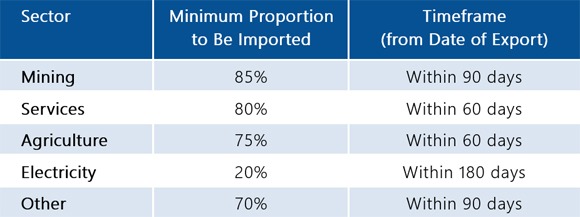
The ratios and timeframes are subject to change depending on the circumstances. If exporters cannot comply with the required ratio and timeline, exporters must provide relevant explanatory documents for the BOL’s consideration.

Selling Foreign-Currency Income

Exporters of goods and services must sell at least the minimum required proportion of their foreign-currency income (see table below) to a commercial bank in Laos. This foreign currency exchange must occur within three working days of receiving the foreign currency into the dedicated bank account in Laos. The selling rate will be determined by the prevailing rate of the commercial bank on the day of the transaction.
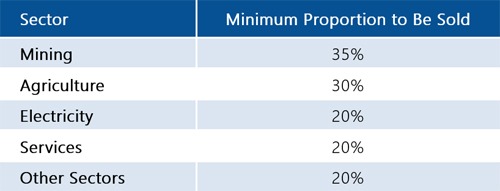
In conducting these transactions, commercial banks are required to carefully consider and manage their reserves and overall liquidity to ensure that they can meet public demand.

If an exporter does not sell at least the minimum required amount of foreign currency within three working days, the relevant commercial bank must proceed with the minimum required exchange and notify the exporter that they are doing so.

These requirements do not apply to re-exporters, such as importers of unprocessed raw materials for re-export to other countries, as determined by the Department of Foreign Currency Management (DFCM).

After selling the minimum required amount to a commercial bank, the remaining foreign-currency income must be used for foreign-currency exchange purposes, such as payments to parties in foreign countries, fulfilling obligations to the state, and so on.

Exporters can sell foreign currency to the BOL by notifying it of the need to sell the foreign currency to the DFCM in the BOL, after which they can sell the currency to the BOL through a commercial bank.

Registration

Decision No. 333 requires service exporters to register as importers and exporters to bring in income generated from exporting services. Although it doesn’t specify the types of service businesses that need to register, a March 2024 notice from the Ministry of Industry and Commerce offers examples of such businesses, including those in international transport, insurance, tourism and hotels, construction, and consulting.

Violations

First-time violations of Decision No. 333 that do not cause damage are subject to training on the importance of complying with Lao law or a warning. If the violation persists after the training or warning, the violator will face suspension of its ability to export goods and services.

For more information on Decision No. 333, or on any aspect of foreign currency management in Laos, please contact Tilleke & Gibbins at [email protected].

RELATED INSIGHTS​ 

October 7, 2021
The fast and efficient movement of goods is a hallmark of the modern global supply chain. In fact, it is often an expectation, with contractual commitments dependent on the timely and problem-free delivery of goods to the destination country. If unexpected costs or unreasonable delays occur, importers can find themselves liable to customers or beneficiaries, resulting in reduction or even elimination of anticipated revenue. One area of particular importance for importers is the customs clearance and assessment process, which is often one of the last but most critical phases of the global supply chain. Importers, regardless of their experience or sophistication, have a duty to understand and comply with all applicable laws and regulations for the importation and classification of goods sent from other countries. While Thailand, like many countries, is a member of the World Trade Organization (WTO) and is obliged to adhere to WTO guidelines for the valuation and classification of goods. It also has its own regulations, policies, and customs laws that provide a legal framework for customs assessment challenges by importers. Often, importers or their agents can effectively process and clear goods with the assigned customs officials without encountering any issues. However, disputes do inevitably arise, often relating to origin, classification, and duty assessment. If not addressed early, a dispute can escalate, leading to seizure of goods, posts of guarantees, final assessments by customs authorities, and even allegations of civil or criminal wrongdoing. At such an advanced stage, it may be too late to engage in consultation to achieve a dispute settlement. Instead of risking such a predicament, importers seeking to resolve disputes with customs officials should explore pre-assessment consultation opportunities. At this stage, there remains flexibility in approach and time to consult with customs officials, make submissions, and consider a flexible settlement. If this
September 24, 2021
On September 15, 2021, Thailand’s Securities and Exchange Commission (SEC) announced a prospective new scheme that will enable small and medium enterprises (SMEs) and startups in Thailand to raise funds through public offerings. The SEC regulations to implement this new scheme are expected by the first quarter of 2022. Since 2019, the SEC has allowed SMEs and startups in Thailand to raise funds via private placements or crowdfunding. The new SEC scheme will allow SMEs and startups to raise funds on a larger scale via a new type of public offering (the so-called SME-PO). The SEC also plans to establish the “SME Board,” a secondary market for trading the stocks of SMEs. Under the new SEC scheme, SMEs and startups that wish to proceed with an SME-PO must be structured as public companies with investor protection mechanisms in accordance with the Public Company Act B.E. 2535 (1992). Although SEC representatives have previously indicated that SME-POs would be subject to an information-based approach instead of the normal approval process for public offerings, the September 15 announcement does not detail this further, beyond noting that the SEC may deem it appropriate in future to relax certain requirements such as filing for approval, appointment of an independent financial advisor, and fees. Investors in public offerings for SMEs and startups must be sophisticated investors who are risk-tolerant and well capitalized, such as institutional investors, private equity or venture capital firms, angel investors, or an SMEs’ own directors, employees, or affiliates. Tilleke & Gibbins will continue to follow the development of regulations for SME-POs, as the rules and criteria described here are still subject to change. For more information on fundraising alternatives for SMEs and startups, or on any aspect of capital markets regulations in Thailand, please contact Onunya Chanpen at [email protected] or Kobkit Thienpreecha
August 18, 2021
Sensitive to the difficulties many business entities and individuals are experiencing during the COVID-19 pandemic, the Thai Customs Department recently implemented an important measure providing importers and exporters with the opportunity to temporarily stay pending customs duty obligations. This measure, which addresses procedures and conditions for requests to stay outstanding duty payments during the COVID-19 pandemic, was included in Announcement of Customs Department No. 103/2564, dated July 1, 2021, issued under sections 37 and 38 of the Customs Act B.E. 2560 (2017). Background Under the Customs Act, importers and exporters have the right to petition the Customs Department for a stay of duty payments at various stages of the customs consideration process. For example, this right extends both to petitioners who are in the process of appealing a customs duty assessment, and to those who have filed claims in the Thai courts challenging a Customs Board of Appeals decision. On December 29, 2017, Main Announcement of the Customs Act on Principal, Methods and Conditions for Requesting a Stay of Outstanding Duty Payments No. 189/2560 was issued, stipulating that a party who appealed to the Customs Board of Appeals regarding customs duty assessment (or submitted a further complaint with the Thai courts challenging the board’s decision) can request a stay of payment of outstanding duties within thirty days from the date of filing an appeal regarding customs duty assessment. In mid-2020, the Customs Department responded to the pressures of the COVID-19 pandemic by issuing relief measures—first a short-term easing of certain documentation requirements, followed by a longer-lasting (until September 30, 2021) extension of the deadline for requesting review of import duty penalties, fines, and surcharges on outstanding import duty amounts. Relief for Payment of Customs Duty With the pandemic still being acutely felt in Thailand in 2021, the Customs Department