
You are using an outdated browser and your browsing experience will not be optimal. Please update to the latest version of Microsoft Edge, Google Chrome or Mozilla Firefox. Install Microsoft Edge

June 7, 2024

Laos Regulates Management of Foreign Currency from Exports

On March 7, 2024, Laos moved to regulate the management of foreign-currency income from the exportation of goods and services. Effective March 29, 2024, Decision No. 333 (formally the Decision on Management of Income in Foreign Currency from Exportation of Goods and Services No. 333/BOL) from the Bank of Lao PDR (BOL) aims to incentivize the inflow of such foreign currency into Laos and its sale to licensed commercial banks.

Decision No. 333 sets minimum required proportions for importing income in foreign currency derived from the exportation of goods and services, as well as the timeframe for doing so. It also stipulates the requirements for selling such foreign currency to commercial banks in Laos and the minimum proportions that must be sold.

Importing Foreign-Currency Income

Exporters must receive payments from abroad via bank transfer into a dedicated bank account designated for import-export business activities within the timeline specified in the sale-purchase agreement, but not exceeding 180 days from the date of export. Each sector must import income in foreign currency into the Lao PDR according to the minimum proportion of currency to be imported, and it must be done within the required timeframes, as specified in the table below.
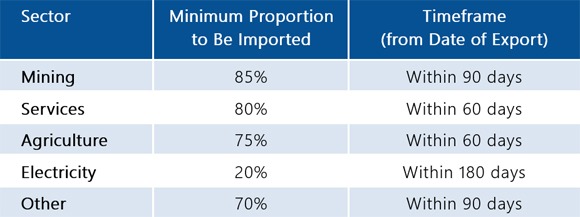
The ratios and timeframes are subject to change depending on the circumstances. If exporters cannot comply with the required ratio and timeline, exporters must provide relevant explanatory documents for the BOL’s consideration.

Selling Foreign-Currency Income

Exporters of goods and services must sell at least the minimum required proportion of their foreign-currency income (see table below) to a commercial bank in Laos. This foreign currency exchange must occur within three working days of receiving the foreign currency into the dedicated bank account in Laos. The selling rate will be determined by the prevailing rate of the commercial bank on the day of the transaction.
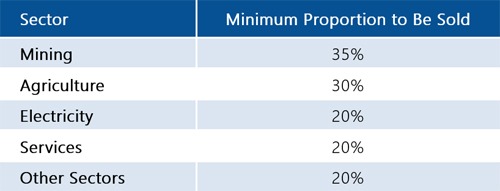
In conducting these transactions, commercial banks are required to carefully consider and manage their reserves and overall liquidity to ensure that they can meet public demand.

If an exporter does not sell at least the minimum required amount of foreign currency within three working days, the relevant commercial bank must proceed with the minimum required exchange and notify the exporter that they are doing so.

These requirements do not apply to re-exporters, such as importers of unprocessed raw materials for re-export to other countries, as determined by the Department of Foreign Currency Management (DFCM).

After selling the minimum required amount to a commercial bank, the remaining foreign-currency income must be used for foreign-currency exchange purposes, such as payments to parties in foreign countries, fulfilling obligations to the state, and so on.

Exporters can sell foreign currency to the BOL by notifying it of the need to sell the foreign currency to the DFCM in the BOL, after which they can sell the currency to the BOL through a commercial bank.

Registration

Decision No. 333 requires service exporters to register as importers and exporters to bring in income generated from exporting services. Although it doesn’t specify the types of service businesses that need to register, a March 2024 notice from the Ministry of Industry and Commerce offers examples of such businesses, including those in international transport, insurance, tourism and hotels, construction, and consulting.

Violations

First-time violations of Decision No. 333 that do not cause damage are subject to training on the importance of complying with Lao law or a warning. If the violation persists after the training or warning, the violator will face suspension of its ability to export goods and services.

For more information on Decision No. 333, or on any aspect of foreign currency management in Laos, please contact Tilleke & Gibbins at [email protected].

RELATED INSIGHTS​ 

August 2, 2021
Lawyers from Tilleke & Gibbins’ Bangkok office have authored the Thailand chapter of the 2021 edition of Chambers & Partners Aviation Finance & Leasing Guide. John Frangos, partner and deputy director of Tilleke & Gibbins’ dispute resolution practice; Santhapat Periera, partner in the firm’s corporate and commercial department; and Nuanchun Somboonvinij, senior associate in the firm’s dispute resolution group, provided the Thailand update for the publication, which covers the most important legal developments affecting aircraft lessors, lessees, and financiers in 32 jurisdictions worldwide. The guide provides in-depth details on the legal regimes affecting all aspects of aircraft sale and purchase, aircraft and engine leasing, and aircraft debt finance, including sale and lease agreement terms; taxation; lease registration and enforcement; lease assignment/novation; insurance and reinsurance; debt structuring; securities; liens; and many others that affect the day-to-day operations of leading players in the aviation industry. Chambers and Partners’ Global Practice Guides provide in-house counsel with expert legal commentary focusing on practical legal issues affecting business, and enable readers to compare legislation and relevant procedures across a range of key jurisdictions. The full Chambers & Partners Aviation Finance & Leasing Guide—including the Thailand chapter—is available for free on the Chambers and Partners website, and the Thailand chapter be downloaded as a stand-alone PDF through the button below.
May 20, 2021
The Republic of the Philippines became the latest signatory to the ASEAN collective investment scheme (CIS) Framework on May 11, 2021, moving Southeast Asian capital markets one step closer to integration and potentially increasing the investment options that fund managers in the Philippines, Malaysia, Singapore, and Thailand and other signatory countries will be able to offer to retail investors in future. The signatory countries’ capital markets regulators—the Securities and Exchange Commission of the Philippines, the Securities Commission Malaysia, the Monetary Authority of Singapore, and the SEC of Thailand (leader of the framework’s working group)—announced the successful expansion of the CIS grouping simultaneously on May 11, 2021, after the four regulators signed a supplemental memorandum of understanding to formally admit the Philippines to the framework. The ASEAN CIS Framework was first implemented in 2014 to streamline the process for local regulators to approve foreign CIS units in the region that are authorized in their home countries. The original signatories of the framework were Malaysia, Singapore, and Thailand. Now that the Philippines has joined the grouping, the four signatories’ capital markets regulators will continue to implement the framework’s harmonization of regulations and criteria for asset management firms, fund managers, and mutual funds that are permitted to offer units for sale across the member jurisdictions. This cooperation enabled by the framework eases the bureaucratic red tape associated with the domestic approval process and improve investment protection, thereby resulting in greater opportunities for cross-border fund distributions, product access, investment diversification, and alternatives for retail investors. The Thai SEC has already issued regulations that enable the offering of qualifying funds through the ASEAN CIS Framework, as well as through the Asia Region Funds Passport or foreign exchange-traded funds. Funds that fall under one of these schemes must file registration statements and draft prospectuses to