
You are using an outdated browser and your browsing experience will not be optimal. Please update to the latest version of Microsoft Edge, Google Chrome or Mozilla Firefox. Install Microsoft Edge

June 7, 2024

Laos Regulates Management of Foreign Currency from Exports

On March 7, 2024, Laos moved to regulate the management of foreign-currency income from the exportation of goods and services. Effective March 29, 2024, Decision No. 333 (formally the Decision on Management of Income in Foreign Currency from Exportation of Goods and Services No. 333/BOL) from the Bank of Lao PDR (BOL) aims to incentivize the inflow of such foreign currency into Laos and its sale to licensed commercial banks.

Decision No. 333 sets minimum required proportions for importing income in foreign currency derived from the exportation of goods and services, as well as the timeframe for doing so. It also stipulates the requirements for selling such foreign currency to commercial banks in Laos and the minimum proportions that must be sold.

Importing Foreign-Currency Income

Exporters must receive payments from abroad via bank transfer into a dedicated bank account designated for import-export business activities within the timeline specified in the sale-purchase agreement, but not exceeding 180 days from the date of export. Each sector must import income in foreign currency into the Lao PDR according to the minimum proportion of currency to be imported, and it must be done within the required timeframes, as specified in the table below.
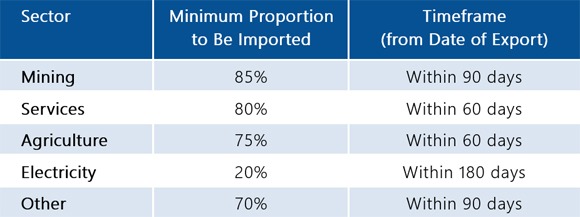
The ratios and timeframes are subject to change depending on the circumstances. If exporters cannot comply with the required ratio and timeline, exporters must provide relevant explanatory documents for the BOL’s consideration.

Selling Foreign-Currency Income

Exporters of goods and services must sell at least the minimum required proportion of their foreign-currency income (see table below) to a commercial bank in Laos. This foreign currency exchange must occur within three working days of receiving the foreign currency into the dedicated bank account in Laos. The selling rate will be determined by the prevailing rate of the commercial bank on the day of the transaction.
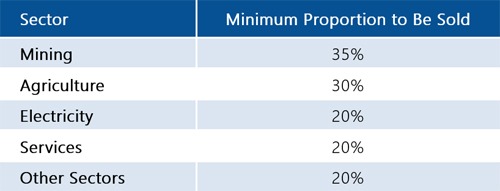
In conducting these transactions, commercial banks are required to carefully consider and manage their reserves and overall liquidity to ensure that they can meet public demand.

If an exporter does not sell at least the minimum required amount of foreign currency within three working days, the relevant commercial bank must proceed with the minimum required exchange and notify the exporter that they are doing so.

These requirements do not apply to re-exporters, such as importers of unprocessed raw materials for re-export to other countries, as determined by the Department of Foreign Currency Management (DFCM).

After selling the minimum required amount to a commercial bank, the remaining foreign-currency income must be used for foreign-currency exchange purposes, such as payments to parties in foreign countries, fulfilling obligations to the state, and so on.

Exporters can sell foreign currency to the BOL by notifying it of the need to sell the foreign currency to the DFCM in the BOL, after which they can sell the currency to the BOL through a commercial bank.

Registration

Decision No. 333 requires service exporters to register as importers and exporters to bring in income generated from exporting services. Although it doesn’t specify the types of service businesses that need to register, a March 2024 notice from the Ministry of Industry and Commerce offers examples of such businesses, including those in international transport, insurance, tourism and hotels, construction, and consulting.

Violations

First-time violations of Decision No. 333 that do not cause damage are subject to training on the importance of complying with Lao law or a warning. If the violation persists after the training or warning, the violator will face suspension of its ability to export goods and services.

For more information on Decision No. 333, or on any aspect of foreign currency management in Laos, please contact Tilleke & Gibbins at [email protected].

RELATED INSIGHTS​ 

October 25, 2021
Michael Ramirez, a counsel in Tilleke & Gibbins’ dispute resolution group in Bangkok, has updated the firm’s contribution to the Global Attorney-Client Privilege Guide, published by Lex Mundi. The newly expanded guide provides information on what constitutes attorney-client privilege in over 70 countries around the world. The Thailand section of the guide contains in-depth information on the function and applications of attorney-client privilege in Thailand (or, as explained in the guide, an equivalent concept enshrined in Thai law), including coverage of the following topics: Privilege in corporations Common interest doctrine Litigation funding Crime-fraud exception Work product doctrine/litigation privilege Other privileges including mediation, accountant-client and settlement negotiation The interactive guide features expert contributions by Lex Mundi member firms from jurisdictions worldwide. Readers can browse the contributions, generate country-specific reports, and compare attorney-client privilege in multiple jurisdictions. For more information, please visit the Lex Mundi website.
October 19, 2021
On September 9, 2021, Laos announced a new pilot program to allow the mining and trading of cryptocurrency. Notification No. 1158, issued by the Prime Minister’s Office, provides for an electricity sale-purchase agreement with six companies involved in the pilot program. Under the notification, the six companies authorized by the prime minister to mine and trade cryptocurrency in Laos will pay a capped fee for energy they use in data processing or mining cryptocurrency. This effectively establishes a sandbox in which these six companies may mine and trade cryptocurrency—including on international cryptocurrency exchanges. The Ministry of Technology and Communications (MTC) is in charge of coordinating the program, together with the Ministry of Finance, the Bank of the Lao PDR, the Ministry of Planning and Investment, the Ministry of Energy and Mines, the Ministry of Public Security, and Électricité du Laos. The MTC is also charged with drafting the rules of the pilot program and setting the conditions on which the participating companies can mine, sell, and purchase cryptocurrency in Laos. One of the six selected companies will also act as a coordinator for the other companies and report to the government on any benefits of cryptocurrency observed during the pilot program. The next step is for the MTC to compile data analysis from each of the other government agencies and submit the conclusions to a meeting of the prime minister and the deputy prime ministers before the pilot program is implemented. The pilot program was originally scheduled to start in September, but there has not yet been any update on the implementation of the program, which nonetheless is expected to start in the near future.
October 19, 2021
In September 2021, the Bank of Thailand (BOT) issued its Guidelines on Data Governance to provide financial institutions with recommendations on how to ensure that their data governance will be in compliance with accepted international principles. While there are no penalties for noncompliance, financial institutions should view the recommendations as minimum standard expectations for their data governance in Thailand. The BOT guidelines set forth five main data governance principles: Data Governance Policy Financial institutions should set forth their data governance policy in writing in accordance with their business size, business operations, business complexity, and data risk. The policy should cover all types of data, including data related to services from third parties or business partners, as well as provide information on the data governance structure, data lifecycle management, protection of data security and data privacy, and incident management. Financial institutions should inform their employees and other relevant parties of the policy to ensure their compliance. In addition, the data governance policy must be approved by the designated board or committee of the financial institution, and be reviewed and revised in response to significant changes. Data Governance Structure Financial institutions should establish a data governance structure with three lines of defense, supervised by an oversight committee. The first line of defense comprises data management personnel, a data approver, and data users; the second comprises a risk management unit and a compliance unit; and the third is an audit unit. While the chosen data governance structure can be tailored to the characteristics of the institution, the structure should cover all of these roles and duties, and must not contravene the principle of checks and balances. The data governance structure should also be supported by sufficient personnel and equipment, as well as a clear plan—reviewed and revised as necessary—for building awareness at
October 14, 2021
As part of its membership in Lex Mundi, Tilleke & Gibbins has published an updated edition of its Guide to Doing Business in Thailand for 2021. This guide outlines all of the key factors for starting and operating a business in the Thai market. Issues covered include: Investment incentives Financial facilities Exchange controls Import and export regulations Structures for doing business Requirements for the Establishment of a Business Operation of the Business Cessation or Termination of the Business Labor legislation, relations, and supply Tax Immigration requirements This publication is part of Lex Mundi’s Guides to Doing Business series prepared by member firms in more than 100 jurisdictions worldwide. The guides serve as a useful resource when planning an international business strategy or researching a new market.