
You are using an outdated browser and your browsing experience will not be optimal. Please update to the latest version of Microsoft Edge, Google Chrome or Mozilla Firefox. Install Microsoft Edge

June 7, 2024

Laos Regulates Management of Foreign Currency from Exports

On March 7, 2024, Laos moved to regulate the management of foreign-currency income from the exportation of goods and services. Effective March 29, 2024, Decision No. 333 (formally the Decision on Management of Income in Foreign Currency from Exportation of Goods and Services No. 333/BOL) from the Bank of Lao PDR (BOL) aims to incentivize the inflow of such foreign currency into Laos and its sale to licensed commercial banks.

Decision No. 333 sets minimum required proportions for importing income in foreign currency derived from the exportation of goods and services, as well as the timeframe for doing so. It also stipulates the requirements for selling such foreign currency to commercial banks in Laos and the minimum proportions that must be sold.

Importing Foreign-Currency Income

Exporters must receive payments from abroad via bank transfer into a dedicated bank account designated for import-export business activities within the timeline specified in the sale-purchase agreement, but not exceeding 180 days from the date of export. Each sector must import income in foreign currency into the Lao PDR according to the minimum proportion of currency to be imported, and it must be done within the required timeframes, as specified in the table below.
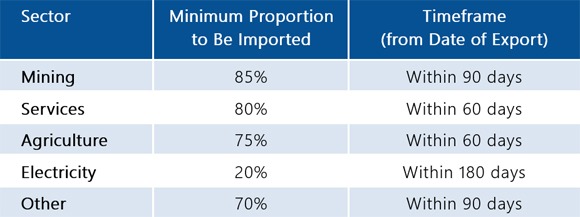
The ratios and timeframes are subject to change depending on the circumstances. If exporters cannot comply with the required ratio and timeline, exporters must provide relevant explanatory documents for the BOL’s consideration.

Selling Foreign-Currency Income

Exporters of goods and services must sell at least the minimum required proportion of their foreign-currency income (see table below) to a commercial bank in Laos. This foreign currency exchange must occur within three working days of receiving the foreign currency into the dedicated bank account in Laos. The selling rate will be determined by the prevailing rate of the commercial bank on the day of the transaction.
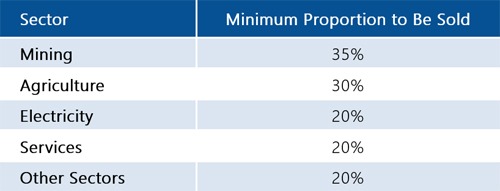
In conducting these transactions, commercial banks are required to carefully consider and manage their reserves and overall liquidity to ensure that they can meet public demand.

If an exporter does not sell at least the minimum required amount of foreign currency within three working days, the relevant commercial bank must proceed with the minimum required exchange and notify the exporter that they are doing so.

These requirements do not apply to re-exporters, such as importers of unprocessed raw materials for re-export to other countries, as determined by the Department of Foreign Currency Management (DFCM).

After selling the minimum required amount to a commercial bank, the remaining foreign-currency income must be used for foreign-currency exchange purposes, such as payments to parties in foreign countries, fulfilling obligations to the state, and so on.

Exporters can sell foreign currency to the BOL by notifying it of the need to sell the foreign currency to the DFCM in the BOL, after which they can sell the currency to the BOL through a commercial bank.

Registration

Decision No. 333 requires service exporters to register as importers and exporters to bring in income generated from exporting services. Although it doesn’t specify the types of service businesses that need to register, a March 2024 notice from the Ministry of Industry and Commerce offers examples of such businesses, including those in international transport, insurance, tourism and hotels, construction, and consulting.

Violations

First-time violations of Decision No. 333 that do not cause damage are subject to training on the importance of complying with Lao law or a warning. If the violation persists after the training or warning, the violator will face suspension of its ability to export goods and services.

For more information on Decision No. 333, or on any aspect of foreign currency management in Laos, please contact Tilleke & Gibbins at [email protected].

RELATED INSIGHTS​ 

July 17, 2023
Cambodia’s new Law on Rules of Origin, which was published on July 5, 2023, is an important legal development that will help the country become a more important trading, manufacturing, and processing hub in the ASEAN region. This legal development accords with the government’s aims to increase consumer protection and clarity on product origin, encourage cross-border trade, position Cambodia as a source for quality manufacturing and processing, and push the “Made in Cambodia” quality label. These new, much clearer rules of origin also bring Cambodia’s legal framework in line with trading obligations set by ASEAN and the WTO. Furthermore, the new rules help clarify the implementation of several multilateral and bilateral trade agreements that Cambodia has concluded in recent years, such as free trade agreements with China and South Korea and the Regional Comprehensive Economic Partnership. Rules of Origin and Cambodia’s Role In international trade, products often make multiple trips before they end up with the consumer—the raw materials may be sourced in one country and processed in another, and then the product may be finished in a third country before the finished product is exported to a different country altogether. Rules of origin determine which country in the production chain qualifies as the country of origin. This is important because the country of origin may be subject to a preferential trading scheme, or there may be legal requirements to declare the correct origin in the country of sale, for example, based on labeling and consumer protection rules. Prior to the new Law on Rules of Origin, ad hoc rules of origin applied in Cambodia, often depending on bilateral agreements, multilateral agreements, or international preferential trading schemes. For example, the EU, US, and Japan have individually adopted preferential trading schemes with selected countries through Generalized Scheme of Preferences (GSP)
July 14, 2023
On July 13, 2023, the Central Bank of Myanmar (CBM) lowered the percentage of export income in foreign currency that must be converted into Myanmar kyat (MMK) within one day of receipt. The changes are contained in CBM Notification No. 15/2023, which took effect immediately. The notification specifies that only 50 percent of export income in foreign currency must be converted into MMK at official CBM rates within one day, in accordance with Myanmar’s requirement to convert foreign currency transfers and balances. The remaining 50 percent of the export earnings must be converted into MMK if the exporter does not use it within 30 days. The 50 percent requirement is a relaxation from the previous rules in CBM Notification No. 36/2022, under which 65 percent of income received from exportation needed to be converted into MMK within one day. Therefore, the new requirement grants a certain amount of flexibility to exporters in Myanmar regarding the currency conversion requirement. For more details on these foreign exchange developments, or on any aspect of financial regulations in Myanmar, please contact Tilleke & Gibbins at [email protected].
July 14, 2023
The Bank of Thailand (BOT) has issued new notifications amending regulations for payment businesses that fall under the Payment Systems Act B.E. 2560 (2017) to promote transparency and good governance in the payment industry. Notification No. SorKorChor 2/2566 (“Notification 2”) increases the required qualifications for applicants seeking a license to provide payment services designated as being under the BOT’s supervision, and Notification No. SorKorChor 4/2566 (“Notification 4”) stipulates additional duties and exemptions for certain types of business operators. The notifications were published in the Government Gazette on July 7, 2023, and came into effect the following day. Additional Qualifications Notification 2 expands the list of prohibited characteristics for business operators applying for a license or registration to engage in a designated payment service, and their directors. For example, applicants must not have been ordered to suspend or cease their operations, and their registration or license to engage in financial business or operate a designated payment system or service must not have been revoked. The notification defines “financial business” as including financial institutions, credit card business, personal loan business, securities business, and so on. In addition, applicants’ directors and management must not have prohibited characteristics, such as being involved in the management of a financial business or designated payment system or service that was ordered to suspend or cease its operations. The applicable registration or license also must not have been revoked. Reporting Requirements During the application process, Notification 2 requires applicants to disclose information on shareholders and related parties (including spouses) who hold an aggregate 10 percent or more of the total paid-up shares. Notification 4 imposes this same reporting duty regarding shareholders and related parties but applies it to licensed operators in an ongoing manner. Existing payment service operators must make their first report of this information to
July 7, 2023
Following Laos’ announcement requiring importers and exporters to register with the Ministry of Industry and Commerce (MOIC), the MOIC has released a comprehensive list of products that are subject to the registration requirement. Traders that import or export goods on the list, which was finalized on June 9, 2023, and made public on June 28 in MOIC Notification No. 1224, must register with the MOIC by August 31, 2023, to obtain a certificate authorizing their import or export activities. The notification specifies four main categories of goods for which importers and exporters must register with the Department of Import and Export (DIMEX) of the MOIC: agricultural products, construction materials, and edible and nonedible consumer goods. The exact products in each category are listed below, along with the corresponding Harmonized System codes from the World Customs Organization: Enterprises engaged in the import and export of the goods listed in the table above must complete registration by August 31, 2023. Imports and exports of the listed goods by any enterprise not registered with the DIMEX will be prohibited after the deadline. The MOIC is also expected to add certain goods to the list in the future, but information on the timing and content of these additions is not yet available. Enterprises that have completed registration must also ask the Bank of Lao PDR (BOL) to certify their accounts held at commercial banks, after which they must ask the relevant commercial banks to convert their current bank accounts into import-export accounts. For more details on Laos’ new registration rules for importers and exporters, or on any aspect of international trade involving Laos, please contact Tilleke & Gibbins at [email protected].