
You are using an outdated browser and your browsing experience will not be optimal. Please update to the latest version of Microsoft Edge, Google Chrome or Mozilla Firefox. Install Microsoft Edge

June 7, 2024

Laos Regulates Management of Foreign Currency from Exports

On March 7, 2024, Laos moved to regulate the management of foreign-currency income from the exportation of goods and services. Effective March 29, 2024, Decision No. 333 (formally the Decision on Management of Income in Foreign Currency from Exportation of Goods and Services No. 333/BOL) from the Bank of Lao PDR (BOL) aims to incentivize the inflow of such foreign currency into Laos and its sale to licensed commercial banks.

Decision No. 333 sets minimum required proportions for importing income in foreign currency derived from the exportation of goods and services, as well as the timeframe for doing so. It also stipulates the requirements for selling such foreign currency to commercial banks in Laos and the minimum proportions that must be sold.

Importing Foreign-Currency Income

Exporters must receive payments from abroad via bank transfer into a dedicated bank account designated for import-export business activities within the timeline specified in the sale-purchase agreement, but not exceeding 180 days from the date of export. Each sector must import income in foreign currency into the Lao PDR according to the minimum proportion of currency to be imported, and it must be done within the required timeframes, as specified in the table below.
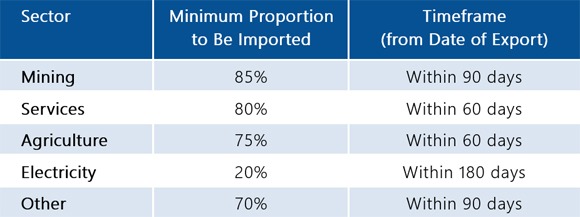
The ratios and timeframes are subject to change depending on the circumstances. If exporters cannot comply with the required ratio and timeline, exporters must provide relevant explanatory documents for the BOL’s consideration.

Selling Foreign-Currency Income

Exporters of goods and services must sell at least the minimum required proportion of their foreign-currency income (see table below) to a commercial bank in Laos. This foreign currency exchange must occur within three working days of receiving the foreign currency into the dedicated bank account in Laos. The selling rate will be determined by the prevailing rate of the commercial bank on the day of the transaction.
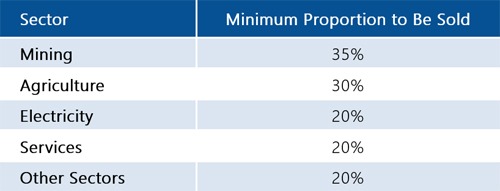
In conducting these transactions, commercial banks are required to carefully consider and manage their reserves and overall liquidity to ensure that they can meet public demand.

If an exporter does not sell at least the minimum required amount of foreign currency within three working days, the relevant commercial bank must proceed with the minimum required exchange and notify the exporter that they are doing so.

These requirements do not apply to re-exporters, such as importers of unprocessed raw materials for re-export to other countries, as determined by the Department of Foreign Currency Management (DFCM).

After selling the minimum required amount to a commercial bank, the remaining foreign-currency income must be used for foreign-currency exchange purposes, such as payments to parties in foreign countries, fulfilling obligations to the state, and so on.

Exporters can sell foreign currency to the BOL by notifying it of the need to sell the foreign currency to the DFCM in the BOL, after which they can sell the currency to the BOL through a commercial bank.

Registration

Decision No. 333 requires service exporters to register as importers and exporters to bring in income generated from exporting services. Although it doesn’t specify the types of service businesses that need to register, a March 2024 notice from the Ministry of Industry and Commerce offers examples of such businesses, including those in international transport, insurance, tourism and hotels, construction, and consulting.

Violations

First-time violations of Decision No. 333 that do not cause damage are subject to training on the importance of complying with Lao law or a warning. If the violation persists after the training or warning, the violator will face suspension of its ability to export goods and services.

For more information on Decision No. 333, or on any aspect of foreign currency management in Laos, please contact Tilleke & Gibbins at [email protected].

RELATED INSIGHTS​ 

July 4, 2023
Practitioners from Tilleke & Gibbins’ Vietnam offices contributed content for the latest edition of the Practical Law Life Sciences Global Guide. The guide provides a comparative overview, in Q&A format, of laws and regulations on pharmaceuticals, medical devices, and other life sciences products in dozens of jurisdictions around the world. The Life Sciences Global Guide is divided into two sections: Regulation (see more details here) and Commercialization, which covers the following topics: Overview of the life sciences sector Pricing, government funding, and reimbursement: National health care system, price regulation and reimbursement Distribution and sale Cross-border trade and parallel imports Advertising to the public and engagement with patient organizations Advertising to healthcare professionals and organizations: Gifts and incentives and transparency and disclosure Patents: Conditions for patentability, registration, length of protection, infringement, international treaties Trademarks: Requirements, registration Competition law issues: Authorities and legislation, commercial contracts and competition law, licensing approvals and formalities Product liability: Regulators, medicinal product liability law, liable partners, defenses, product liability claims, remedies Practical Law, produced by Thomson Reuters, is the world’s leading legal know-how resource for business lawyers, publishing a huge range of guides covering hundreds of jurisdictions and practice areas. The full “Life Sciences Commercialization in Vietnam” section can be found on the Practical Law website.
June 27, 2023
On May 25, 2023, Laos published Decision on the Registration of Importers and Exporters of Goods No. 0752, which requires importers and exporters to register their activities and the related goods with the Ministry of Industry and Commerce (MOIC). The MOIC’s goal is to create a database to monitor imports and exports and collect data on the flow of goods in and out of Laos. The decision also aims to regulate the import and export of goods to and from Laos by foreign traders who do not have a local presence. Once the decision takes effect on July 6, 2023, import and export of goods will be possible only upon registration by the importers or exporters with the MOIC. This registration requirement is in addition to the current mandate that importers and exporters operating in Laos obtain a Business Operating License from the MOIC. Activities Subject to the Decision Under the decision, the obligation to register applies to individuals and entities that import or export goods for which the revenues and payments are controlled by the government as well as “goods that have a quick impact on the lives of the population.” Although it is not yet clear which products the MOIC has in mind, further clarifications are expected. Under the current regulatory framework in Laos, some goods need an import-export permit prior to crossing the Lao border, in accordance with a 2022 regulation listing goods subject to the permitting requirement. It is possible that the goods regulated by the new decision could be the same as those defined in the 2022 list (see here for a Lao-language list)—such as drugs, medical products, land vehicles, petrol, and hazardous chemicals—but further confirmation and clarification will be necessary to determine this. Importers and Exporters Subject to the Decision The decision applies
June 14, 2023
Myanmar’s Customs Department issued an internal order reducing customs duty on imports of semi-knocked-down (SKD) and completely knocked-down (CKD) vehicle systems effective for the period of June 1, 2023, to May 31, 2024. The order follows Ministry of Planning and Finance (MOPF) Notification 37/2023, which reduced customs duty on SKD and CKD vehicles and repealed the similar MOPF notifications issued in 2020 and 2021. The order announced the following new customs duty rates for SKD systems: Passenger vehicles: 5% (reduced from 7.5%) Motorcycles: 1.5% (reduced from 3%) Three-wheeled motorcycles: 3% (reduced from 7.5%) Buses: 3% (reduced from 7.5%) Trucks and trucks for body building: 3% (reduced from 7.5%) The customs duty rates for CKD systems have been set as follows: Passenger vehicles: 3% (reduced from 5%) Motorcycles: 1.5% (reduced from 3%) Three-wheeled motorcycles for transportation of passengers: 1.5% (reduced from 5%) Three-wheeled motorcycles for transportation of goods: 3% (reduced from 5%) Buses: 3% (reduced from 5%) Trucks and trucks for body building: 3% (reduced from 5%) The September 2021 suspension of permits for the import of new completely built-up (CBU) vehicles from abroad is unlikely to be impacted by the announcement. For more details on these customs duty reductions, or on any aspect of Myanmar’s regulations surrounding international trade, please contact Tilleke & Gibbins at [email protected].
June 2, 2023
Efficiency and predictability in the global supply chain are critical for business operations. Whether involved in manufacturing, distribution, logistics, or even in the provision of services, most business operators rely upon problem-free customs clearance in the countries in which they operate. If customs disputes do arise and are not effectively addressed, they can have a profound impact on operations, delaying delivery, creating potential civil and criminal liabilities, or even resulting in the seizure of imported goods. Often, importers or their agents can become complacent, particularly where there has been a period of months or even years of customs clearance without encountering any issues. However, disputes can arise, often relating to origin of goods, classification, and duty assessment. When not addressed early in the dispute process or through settlement, a dispute can escalate, leading to issuance of official letters of assessment by customs authorities. Once Thai customs has issued such a formal letter of assessment to an importer, discretion in settlement is gone and only the full value of the duty assessment can be accepted. At this stage, the only legal avenue for challenge is to accept the duty assessment or to litigate. This article addresses post-assessment litigation options to challenge official customs duty assessments. Customs Board of Appeals Once an official assessment is made, an importer has the right to seek a formal appeal of the customs assessment with the Customs Board of Appeals or to otherwise make payment of the full assessment within 30 days of the date it received the assessment. Extensions of time are not permitted. With few exceptions, the right to appeal does not allow the importer to defer an assessed duty payment. This means that the importer must post security for the assessed duty at the time of filing the appeal. This essentially means