
You are using an outdated browser and your browsing experience will not be optimal. Please update to the latest version of Microsoft Edge, Google Chrome or Mozilla Firefox. Install Microsoft Edge

June 7, 2024

Laos Regulates Management of Foreign Currency from Exports

On March 7, 2024, Laos moved to regulate the management of foreign-currency income from the exportation of goods and services. Effective March 29, 2024, Decision No. 333 (formally the Decision on Management of Income in Foreign Currency from Exportation of Goods and Services No. 333/BOL) from the Bank of Lao PDR (BOL) aims to incentivize the inflow of such foreign currency into Laos and its sale to licensed commercial banks.

Decision No. 333 sets minimum required proportions for importing income in foreign currency derived from the exportation of goods and services, as well as the timeframe for doing so. It also stipulates the requirements for selling such foreign currency to commercial banks in Laos and the minimum proportions that must be sold.

Importing Foreign-Currency Income

Exporters must receive payments from abroad via bank transfer into a dedicated bank account designated for import-export business activities within the timeline specified in the sale-purchase agreement, but not exceeding 180 days from the date of export. Each sector must import income in foreign currency into the Lao PDR according to the minimum proportion of currency to be imported, and it must be done within the required timeframes, as specified in the table below.
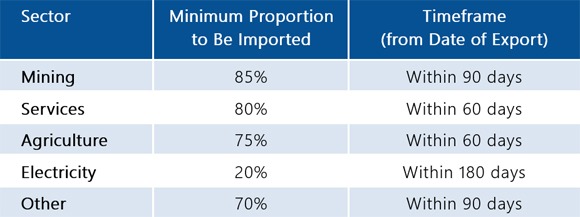
The ratios and timeframes are subject to change depending on the circumstances. If exporters cannot comply with the required ratio and timeline, exporters must provide relevant explanatory documents for the BOL’s consideration.

Selling Foreign-Currency Income

Exporters of goods and services must sell at least the minimum required proportion of their foreign-currency income (see table below) to a commercial bank in Laos. This foreign currency exchange must occur within three working days of receiving the foreign currency into the dedicated bank account in Laos. The selling rate will be determined by the prevailing rate of the commercial bank on the day of the transaction.
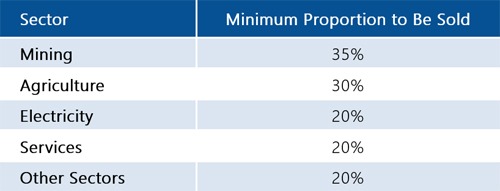
In conducting these transactions, commercial banks are required to carefully consider and manage their reserves and overall liquidity to ensure that they can meet public demand.

If an exporter does not sell at least the minimum required amount of foreign currency within three working days, the relevant commercial bank must proceed with the minimum required exchange and notify the exporter that they are doing so.

These requirements do not apply to re-exporters, such as importers of unprocessed raw materials for re-export to other countries, as determined by the Department of Foreign Currency Management (DFCM).

After selling the minimum required amount to a commercial bank, the remaining foreign-currency income must be used for foreign-currency exchange purposes, such as payments to parties in foreign countries, fulfilling obligations to the state, and so on.

Exporters can sell foreign currency to the BOL by notifying it of the need to sell the foreign currency to the DFCM in the BOL, after which they can sell the currency to the BOL through a commercial bank.

Registration

Decision No. 333 requires service exporters to register as importers and exporters to bring in income generated from exporting services. Although it doesn’t specify the types of service businesses that need to register, a March 2024 notice from the Ministry of Industry and Commerce offers examples of such businesses, including those in international transport, insurance, tourism and hotels, construction, and consulting.

Violations

First-time violations of Decision No. 333 that do not cause damage are subject to training on the importance of complying with Lao law or a warning. If the violation persists after the training or warning, the violator will face suspension of its ability to export goods and services.

For more information on Decision No. 333, or on any aspect of foreign currency management in Laos, please contact Tilleke & Gibbins at [email protected].

RELATED INSIGHTS​ 

June 26, 2024
Tilleke & Gibbins’ Fintech Law in Southeast Asia provides fintech operators and service providers with an overview of relevant regulations across all of our full-service jurisdictions—Cambodia, Laos, Myanmar, Thailand, and Vietnam.
June 19, 2024
Vietnam’s financial landscape is set to further transform on July 1, 2024, when the government’s long-awaited Decree No. 52/2024/ND-CP dated May 15, 2024 (“Decree 52”), will officially replace Decree No. 101/2012/ND-CP dated November 22, 2012, on non-cash payments (“Decree 101”). Decree 52 marks an important milestone by introducing the country’s first-ever legal definition of e-money. In addition, the decree brings forth new updates to regulations governing payment and intermediary payment services, laying the groundwork for more comprehensive guidance that will be provided in draft circulars now being developed by the State Bank of Vietnam (SBV). Non-Cash Payment Instruments The new definition of non-cash payment instruments under Decree 52 expands upon the previous definition in Decree 101. Notably, it clearly specifies the issuing entities as payment service providers, financial companies licensed to issue credit cards, and e-wallet service providers. Additionally, the new definition further clarifies that bank cards include debit, credit, and prepaid cards, and adds e-wallets to the list of non-cash payment instruments. Unlawful non-cash payment instruments are still defined as those that are not otherwise specified. E-Money Prior to Decree 52, the concept of e-money lacked a precise legal definition, despite its growing prevalence in forms like prepaid cards and e-wallets. The absence of a clear framework for e-money led to confusion with terms like “cryptpcurrency” and “virtual currency” and left significant ambiguity on whether e-money includes certain instruments, such as online game cards and mobile money. Decree 52 addresses this issue by clearly defining e-money as value in Vietnamese dong (VND) stored electronically and prepaid by customers to banks, foreign bank branches, and e-wallet service providers. It also specifically designates e-wallets and prepaid cards as types of storage mechanisms for e-money. Non-Cash Payment Services Decree 52 categorizes non-cash payment services into services with and without client payment
June 6, 2024
On May 30, 2024, the Department of Trade (DOT) under Myanmar’s Ministry of Commerce (MOC) issued two measures tightening restrictions on the arrival and storage of imported goods before the necessary import licenses are obtained. Newsletter No. 3/2024 declares that legal enforcement against goods arriving at ports without the requisite import licenses will commence on July 1, 2024, pursuant to the Export-Import Law, and Newsletter No. 2/2024 reduces the types of goods that may be stored in bonded warehouses without an import license. Arrival of Goods at Ports Pending Import Licenses In July 2020, the MOC had issued a notification outlining the regulations for the importation of goods requiring import licenses prior to their arrival at the ports. This notification stated that actions may be taken under the Export-Import Law against importers who deliver goods to ports before obtaining the necessary import licenses from the MOC. Subsequently, the MOC issued a similar warning to importers in 2022 and a more recent announcement dated April 5, 2024. Now with the issuance of Newsletter No. 3/2024, the DOT is preparing to strengthen its enforcement against goods arriving at ports without the necessary import license already having been obtained. Storage of Goods in Customs Warehouses In December 2023, the MOC issued Newsletter No. 16/2023, which permitted 14 categories of goods to be stored in bonded areas without an import license. However, the DOT’s Newsletter No. 2/2024 eliminated most of the items on that product list, leaving only four categories of goods: Medicines, Various electric vehicles and related accessories, Industrial raw materials and chemical raw materials for industry, and Food raw materials. This allowance is only applicable for bonded areas that comply with customs procedures for bonded warehouses. Newsletter No. 2/2024 takes effect on June 7, 2024. Starting on this date, the MOC
June 3, 2024
On May 24, 2024, the Central Bank of Myanmar (“CBM”) issued a public notice warning individuals against participating in the sale, purchase, exchange, or transfer of unregulated digital currencies, as well as unauthorized money transfers. The CBM has indicated its readiness to enforce regulations by closing bank accounts and pursuing legal action, which may result in imprisonment, fines, or both, in accordance with the Central Bank of Myanmar Law, the Anti-Money Laundering Law and the Financial Institutions Law. The CBM is the sole legal entity authorized to issue currency in Myanmar, as stipulated in the Central Bank of Myanmar Law. The CBM does not recognize digital currencies as official currency, nor has it granted permission to financial institutions within Myanmar to trade them. The existing legal framework, comprising the Foreign Exchange Management Law and the Financial Institutions Law, further cements the illegality of cryptocurrency transactions within the nation’s borders. Four years ago, in May 2020, the CBM issued Notification No. 9/2020, prohibiting all persons residing in Myanmar from engaging in the sale, purchase, or exchange of unregulated digital currencies. The list of prohibited currencies includes widely recognized cryptocurrencies such as Bitcoin (BTC), Litecoin (LTD), Ethereum (ETH), and Perfect Money (PM), with a particular emphasis on transactions conducted through personal Facebook accounts and web pages. Before the issuance of the 2020 notification, the CBM had announced that anyone engaging in digital currency transactions did so at their own risk, but no enforcement measures were being taken at the time. However, after the 2020 notification was issued, the CBM has pursued legal action against persons involved in illegal currency conversion and unauthorized hundi money transfers using Tether (USDT). These enforcement measures have included shutting down bank accounts and initiating legal proceedings under the Anti-Money Laundering Law and the Financial Institutions Law.