
You are using an outdated browser and your browsing experience will not be optimal. Please update to the latest version of Microsoft Edge, Google Chrome or Mozilla Firefox. Install Microsoft Edge

June 7, 2024

Laos Regulates Management of Foreign Currency from Exports

On March 7, 2024, Laos moved to regulate the management of foreign-currency income from the exportation of goods and services. Effective March 29, 2024, Decision No. 333 (formally the Decision on Management of Income in Foreign Currency from Exportation of Goods and Services No. 333/BOL) from the Bank of Lao PDR (BOL) aims to incentivize the inflow of such foreign currency into Laos and its sale to licensed commercial banks.

Decision No. 333 sets minimum required proportions for importing income in foreign currency derived from the exportation of goods and services, as well as the timeframe for doing so. It also stipulates the requirements for selling such foreign currency to commercial banks in Laos and the minimum proportions that must be sold.

Importing Foreign-Currency Income

Exporters must receive payments from abroad via bank transfer into a dedicated bank account designated for import-export business activities within the timeline specified in the sale-purchase agreement, but not exceeding 180 days from the date of export. Each sector must import income in foreign currency into the Lao PDR according to the minimum proportion of currency to be imported, and it must be done within the required timeframes, as specified in the table below.
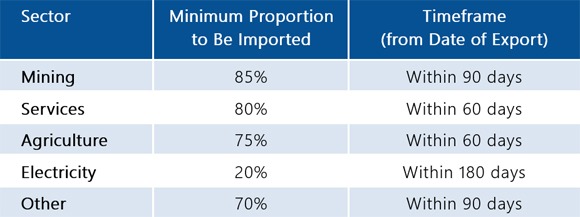
The ratios and timeframes are subject to change depending on the circumstances. If exporters cannot comply with the required ratio and timeline, exporters must provide relevant explanatory documents for the BOL’s consideration.

Selling Foreign-Currency Income

Exporters of goods and services must sell at least the minimum required proportion of their foreign-currency income (see table below) to a commercial bank in Laos. This foreign currency exchange must occur within three working days of receiving the foreign currency into the dedicated bank account in Laos. The selling rate will be determined by the prevailing rate of the commercial bank on the day of the transaction.
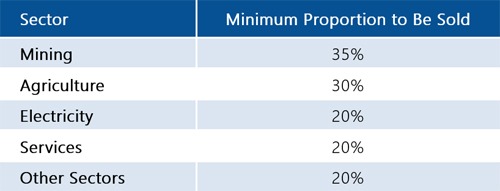
In conducting these transactions, commercial banks are required to carefully consider and manage their reserves and overall liquidity to ensure that they can meet public demand.

If an exporter does not sell at least the minimum required amount of foreign currency within three working days, the relevant commercial bank must proceed with the minimum required exchange and notify the exporter that they are doing so.

These requirements do not apply to re-exporters, such as importers of unprocessed raw materials for re-export to other countries, as determined by the Department of Foreign Currency Management (DFCM).

After selling the minimum required amount to a commercial bank, the remaining foreign-currency income must be used for foreign-currency exchange purposes, such as payments to parties in foreign countries, fulfilling obligations to the state, and so on.

Exporters can sell foreign currency to the BOL by notifying it of the need to sell the foreign currency to the DFCM in the BOL, after which they can sell the currency to the BOL through a commercial bank.

Registration

Decision No. 333 requires service exporters to register as importers and exporters to bring in income generated from exporting services. Although it doesn’t specify the types of service businesses that need to register, a March 2024 notice from the Ministry of Industry and Commerce offers examples of such businesses, including those in international transport, insurance, tourism and hotels, construction, and consulting.

Violations

First-time violations of Decision No. 333 that do not cause damage are subject to training on the importance of complying with Lao law or a warning. If the violation persists after the training or warning, the violator will face suspension of its ability to export goods and services.

For more information on Decision No. 333, or on any aspect of foreign currency management in Laos, please contact Tilleke & Gibbins at [email protected].

RELATED INSIGHTS​ 

May 30, 2024
A bank guarantee or bond is a powerful tool that provides contractual parties with security and assurance. Bank guarantees are commitments made by a bank (as a guarantor) on behalf of a customer (as an obligor) to a beneficiary to ensure that certain contractual obligations will be fulfilled. If the customer fails to comply with these obligations, the bank can compensate the beneficiary up to the amount specified in the bank guarantee. Bank guarantees are widely used in Thailand as a form of security and are common in construction agreements and government procurement contracts, among others. If the beneficiary (e.g., a project owner) concludes that the counterparty in the agreement (e.g., a contractor) has breached the underlying contract in some way, the beneficiary will demand payment from the bank pursuant to the guarantee. Collecting on a Guarantee and Preventing Payment In the context of construction and procurement agreements, there are two types of bank guarantees—conditional and unconditional. A conditional bank guarantee means that the project owner must satisfy certain agreed-upon conditions (e.g., provision of proof of the breach, proof of damages, or even consent from the contractor) to demand payment. An unconditional bank guarantee means that the bank must compensate the project owner for the demanded amount (up to the limit specified in the bank guarantee) without any conditions. When a project owner concludes that a contractor has breached the underlying contract (often for nonperformance or failure to comply with a representation or warranty), the project owner will demand payment from the bank holding the guarantee. Upon receiving such a demand, Thai banks will usually inform the contractor and ask if it has any objections. Even if the bank guarantee is unconditional, in practice, a bank may be reluctant to make payment if the contractor, as the bank’s customer,
May 9, 2024
As non-cash payments continue to surge in Vietnam, the requirement for strong security standards and a clear legislative framework for intermediary payment services (“IPS”) is becoming more and more critical. Recognizing this, the State Bank of Vietnam (“SBV”) has been working on a draft decree to supersede the outdated Decree No. 101/2012/ND-CP dated November 22, 2012, on non-cash payments (“Draft Non-Cash Payment Decree”), which will lay the groundwork for non-cash payments in general and the provision of IPS in particular. Building upon this, the SBV recently issued a draft circular to replace Circular No. 39/2014/TT-NHNN dated December 11, 2014, on IPS (“Circular 39”) (“Draft IPS Circular”), which will offer more detailed guidance on the provision of IPS in Vietnam on top of the Draft Non-Cash Payment Decree. The Draft IPS Circular will be applicable to (i) IPS providers; (ii) foreign organizations providing IPS in Vietnam; and (iii) organizations and individuals involved in the provision of IPS. Some key updates regarding the Draft IPS Circular are as follows: Scope of Application The Draft IPS Circular sets out further guidance for the provision of IPS as listed under the Draft Non-Cash Payment Decree, including: (i) electronic clearing services; (ii) electronic wallet (“e-wallet”) services; (iii) collection and payment support services; (iv) financial switching services; (v) international financial switching services; and (vi) electronic payment gateway services. Notably, the Draft IPS Circular has explicitly excluded from its scope of application the provision of accounts by goods/service providers to their customers solely for the purpose of payment within the systems of such providers (e.g., cards/coupons or service/transaction accounts of online game service providers, transportation service providers, or securities companies, etc.). Requirements on the Provision of IPS Electronic Clearing Services: The Draft IPS Circular introduces regulations to cover certain elements of electronic clearing services that have
March 27, 2024
The Bank of Thailand (BOT) has opened a public comment period on their consultation paper titled “Criteria for Supervising Virtual Banks” from March 19, 2024, to April 17, 2024. The consultation paper reveals that the BOT intends to apply traditional commercial bank supervisory standards to virtual banks. However, the BOT also explains that the wholly digital nature of the services offered by virtual banks necessitates additional regulatory supervision. Additional Supervisory Criteria for Virtual Banks Financial business group: If a virtual bank is within the same financial business group as other financial institutions, its parent company must structure the virtual bank to be under its own sole consolidated financial business group. After the virtual bank has undergone the “restricted phase” in its initial years of operation (see below), other financial institutions within the group are prohibited from extending credit to or engaging in transactions similar to lending activities with the virtual bank. Shareholding structure: If the increase in the financial institution system capital is higher than the actual capital injection resulting from the bank’s shareholding structure, the BOT aims to issue an additional regulation to supervise the capital of the virtual bank and financial institution system to prevent double counting. Operational risk: Virtual banks must not use a trademark or logo that bears resemblance to or implies association with other financial institutions or financial institution groups. Governance: Virtual banks must have at least one director and chief technology officer (CTO) with at least three years of experience in IT or digital service. Additionally, the CTO must work full-time for the virtual bank and may not be an employee of another legal entity. Restriction on related lending and related-party transactions: Virtual banks must obtain prior unanimous approval from their boards of directors before engaging in transactions with major shareholders or businesses
March 25, 2024
Attorneys from Tilleke & Gibbins in Vietnam have provided an updated Vietnam chapter for Fashion Law 2024, a guide to law surrounding the business of fashion in jurisdictions around the world. The guide, which covers 20 key jurisdictions in the global fashion industry, offers insights into local legal frameworks for a range of issues, such as brand enforcement and protection, e-commerce and marketing, and sustainability. The Vietnam chapter of Fashion Law 2024 provides detailed information on the following topics: Main intellectual property rights for fashion products Contractual arrangements in manufacturing, distribution, and advertising Regulations and enforcement of online marketing Unfair competition rules and judicial interpretation Specific regulations on sustainability and ESG in fashion Special import and export rules for fashion products The full Vietnam chapter is available for free through the button below and on the Global Legal Post website. Tilleke & Gibbins also contributed the Thailand chapter to the guide.