
You are using an outdated browser and your browsing experience will not be optimal. Please update to the latest version of Microsoft Edge, Google Chrome or Mozilla Firefox. Install Microsoft Edge

June 7, 2024

Laos Regulates Management of Foreign Currency from Exports

On March 7, 2024, Laos moved to regulate the management of foreign-currency income from the exportation of goods and services. Effective March 29, 2024, Decision No. 333 (formally the Decision on Management of Income in Foreign Currency from Exportation of Goods and Services No. 333/BOL) from the Bank of Lao PDR (BOL) aims to incentivize the inflow of such foreign currency into Laos and its sale to licensed commercial banks.

Decision No. 333 sets minimum required proportions for importing income in foreign currency derived from the exportation of goods and services, as well as the timeframe for doing so. It also stipulates the requirements for selling such foreign currency to commercial banks in Laos and the minimum proportions that must be sold.

Importing Foreign-Currency Income

Exporters must receive payments from abroad via bank transfer into a dedicated bank account designated for import-export business activities within the timeline specified in the sale-purchase agreement, but not exceeding 180 days from the date of export. Each sector must import income in foreign currency into the Lao PDR according to the minimum proportion of currency to be imported, and it must be done within the required timeframes, as specified in the table below.
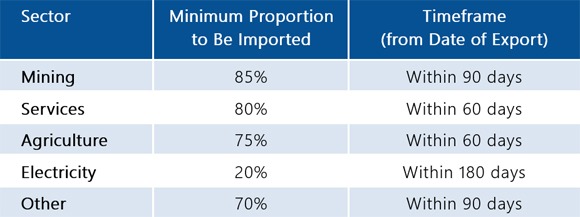
The ratios and timeframes are subject to change depending on the circumstances. If exporters cannot comply with the required ratio and timeline, exporters must provide relevant explanatory documents for the BOL’s consideration.

Selling Foreign-Currency Income

Exporters of goods and services must sell at least the minimum required proportion of their foreign-currency income (see table below) to a commercial bank in Laos. This foreign currency exchange must occur within three working days of receiving the foreign currency into the dedicated bank account in Laos. The selling rate will be determined by the prevailing rate of the commercial bank on the day of the transaction.
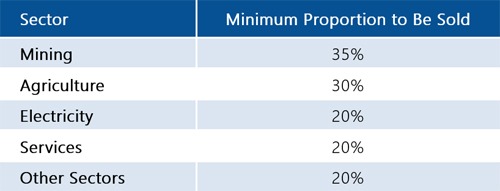
In conducting these transactions, commercial banks are required to carefully consider and manage their reserves and overall liquidity to ensure that they can meet public demand.

If an exporter does not sell at least the minimum required amount of foreign currency within three working days, the relevant commercial bank must proceed with the minimum required exchange and notify the exporter that they are doing so.

These requirements do not apply to re-exporters, such as importers of unprocessed raw materials for re-export to other countries, as determined by the Department of Foreign Currency Management (DFCM).

After selling the minimum required amount to a commercial bank, the remaining foreign-currency income must be used for foreign-currency exchange purposes, such as payments to parties in foreign countries, fulfilling obligations to the state, and so on.

Exporters can sell foreign currency to the BOL by notifying it of the need to sell the foreign currency to the DFCM in the BOL, after which they can sell the currency to the BOL through a commercial bank.

Registration

Decision No. 333 requires service exporters to register as importers and exporters to bring in income generated from exporting services. Although it doesn’t specify the types of service businesses that need to register, a March 2024 notice from the Ministry of Industry and Commerce offers examples of such businesses, including those in international transport, insurance, tourism and hotels, construction, and consulting.

Violations

First-time violations of Decision No. 333 that do not cause damage are subject to training on the importance of complying with Lao law or a warning. If the violation persists after the training or warning, the violator will face suspension of its ability to export goods and services.

For more information on Decision No. 333, or on any aspect of foreign currency management in Laos, please contact Tilleke & Gibbins at [email protected].

RELATED INSIGHTS​ 

August 20, 2024
On June 28, 2024, the State Bank of Vietnam (SBV) issued Circular No. 19/2024/TT-NHNN to amend certain regulations of Circular No. 08/2023/TT-NHNN dated June 30, 2023 (‘Circular 08”), on conditions for foreign loans not guaranteed by the government (“Circular 19”). Circular 19 took effect on July 1, 2024, and provides changes in relation to, among other things, foreign loans to pay for goods import contracts and letters of credit. Foreign Loans to Pay for Goods Import Contracts Circular 08 exempts foreign loans in the form of deferred payment for imported goods (a buyer-seller relationship) from applicable foreign loan conditions. Circular 19 adds provisions regarding foreign loans taken out by non-bank borrowers (a buyer-seller-lender relationship) to make the deferred payments for goods import contracts for the implementation of an investment project, production or business plan, or other project. In this case, the foreign loan’s purpose is determined to be for implementing an investment project, production or business plan, or other project; and the borrower can exclude medium- and long-term foreign loan balances arising from the deferred payment in the import contracts when calculating the foreign loan limit. In addition, the borrower is allowed to borrow from foreign lenders to pay for the goods import contract via letters of credit. However, it is worth noting that other requirements relating to the loans are still applied to the borrower, such as foreign loan agreement, currency, and records/reporting obligations Letters of Credit Following the reclassification of letter of credit (L/C) activities from a “payment service” to “extension of credit” under the Law on Credit Institutions 2024, Circular 19 supplements L/C activities into the current foreign loan regulatory framework, including adding foreign loans between credit institutions and branches of foreign banks (as issuing banks) and non-resident banks (as reimbursing banks) where issuing banks are
July 5, 2024
In April 2024, Vietnam’s Ministry of Finance published a draft circular concerning securities transactions, clearing and settlement of securities transactions, activities of securities companies, and information disclosure on the securities market (the “Draft Circular”) for public feedback. The Draft Circular, if adopted, will amend several regulations impacting public companies and the securities market. Some of the more notable amendments are discussed below. Relaxing Pre-Funding Requirement for Foreign Institutional Investors To place orders to purchase securities, investors are currently required to have sufficient cash in their securities trading accounts to pay 100% of the cost of the transaction, except in cases of: Margin trading (applicable to Vietnamese investors only); and Transactions in which there is a settlement guarantee or confirmation from the custodian bank on accepting the settlement request. The Draft Circular allows foreign institutional investors (“FIIs”) to purchase securities without 100% pre-funding their securities trading accounts, based on a signed agreement with a securities company. However, the State Securities Commission of Vietnam (“SSC”) has the right to temporarily reinstate the 100% pre-funding requirement if measures for securities market stabilization are required. The Draft Circular also specifies that securities companies must (i) assess the capacity of FIIs to determine the pre-funding requirement under relevant agreements signed between them, and (ii) be responsible to settle the shortfall of a securities purchase order through their proprietary trading account(s) if the FIIs are unable to fully pay for such securities purchase order, except in certain circumstances. Further, a securities company cannot directly exempt or authorize other entities to exempt an FII from the 100% pre-funding requirement if the FII purchases securities of (i) such securities company, (ii) a company in which such securities company is a majority shareholder, or (iii) the parent company of such securities company. The 100% pre-funding requirement for FIIs
June 27, 2024
On May 17, 2024, Thailand’s Anti-Money Laundering Office (AMLO) issued an amended Notification Concerning the Rules for Designating or Reviewing the List of High-Risk Customers Who Require Close Monitoring under the Ministerial Regulation on Customer Due Diligence B.E. 2563 (2020). This notification, which took effect the following day, updates the previous version of the notification from 2022 to cover cybercrimes listed under the Emergency Decree on Measures for the Prevention and Suppression of Technological Crimes B.E. 2566 (2023). The amended notification sets out the steps that all financial institutions in Thailand must take to manage money laundering risks and to comply with the AMLO’s mandatory Guidelines on Customer Due Diligence. Under the new notification, account holders suspected of engaging in or facilitating technological crimes, as recorded by the Anti Online Scam Operation Center (AOC), are to be classified as “high-risk persons.” The notification includes provisions for listing high-risk customers under two specific codes: HR-03-1: This code applies to individuals who are the subject of either a petition or a complaint related to a predicate offense accepted by the relevant inquiry officer and recorded as a criminal case. It also covers individuals whose bank accounts are suspected of being used to conduct transactions related to crimes under the Emergency Decree on Measures for the Prevention and Suppression of Technological Crimes B.E. 2566 (2023), with victims seeking prosecution. The names of individuals in this category are received from responsible agencies according to the Criminal Procedure Code or the AOC and are documented in a publicly accessible online notification system. HR-03-2: This code is for individuals involved in the commission of a predicate offense or those whose bank accounts are suspected of being used in such offenses, but whose cases have not been accepted or numbered by the relevant inquiry officer. Names