
You are using an outdated browser and your browsing experience will not be optimal. Please update to the latest version of Microsoft Edge, Google Chrome or Mozilla Firefox. Install Microsoft Edge

June 7, 2024

Laos Regulates Management of Foreign Currency from Exports

On March 7, 2024, Laos moved to regulate the management of foreign-currency income from the exportation of goods and services. Effective March 29, 2024, Decision No. 333 (formally the Decision on Management of Income in Foreign Currency from Exportation of Goods and Services No. 333/BOL) from the Bank of Lao PDR (BOL) aims to incentivize the inflow of such foreign currency into Laos and its sale to licensed commercial banks.

Decision No. 333 sets minimum required proportions for importing income in foreign currency derived from the exportation of goods and services, as well as the timeframe for doing so. It also stipulates the requirements for selling such foreign currency to commercial banks in Laos and the minimum proportions that must be sold.

Importing Foreign-Currency Income

Exporters must receive payments from abroad via bank transfer into a dedicated bank account designated for import-export business activities within the timeline specified in the sale-purchase agreement, but not exceeding 180 days from the date of export. Each sector must import income in foreign currency into the Lao PDR according to the minimum proportion of currency to be imported, and it must be done within the required timeframes, as specified in the table below.
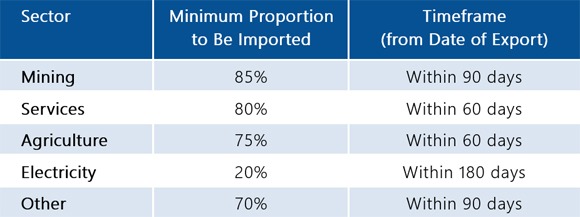
The ratios and timeframes are subject to change depending on the circumstances. If exporters cannot comply with the required ratio and timeline, exporters must provide relevant explanatory documents for the BOL’s consideration.

Selling Foreign-Currency Income

Exporters of goods and services must sell at least the minimum required proportion of their foreign-currency income (see table below) to a commercial bank in Laos. This foreign currency exchange must occur within three working days of receiving the foreign currency into the dedicated bank account in Laos. The selling rate will be determined by the prevailing rate of the commercial bank on the day of the transaction.
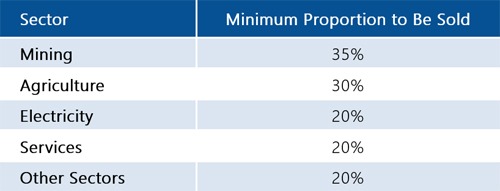
In conducting these transactions, commercial banks are required to carefully consider and manage their reserves and overall liquidity to ensure that they can meet public demand.

If an exporter does not sell at least the minimum required amount of foreign currency within three working days, the relevant commercial bank must proceed with the minimum required exchange and notify the exporter that they are doing so.

These requirements do not apply to re-exporters, such as importers of unprocessed raw materials for re-export to other countries, as determined by the Department of Foreign Currency Management (DFCM).

After selling the minimum required amount to a commercial bank, the remaining foreign-currency income must be used for foreign-currency exchange purposes, such as payments to parties in foreign countries, fulfilling obligations to the state, and so on.

Exporters can sell foreign currency to the BOL by notifying it of the need to sell the foreign currency to the DFCM in the BOL, after which they can sell the currency to the BOL through a commercial bank.

Registration

Decision No. 333 requires service exporters to register as importers and exporters to bring in income generated from exporting services. Although it doesn’t specify the types of service businesses that need to register, a March 2024 notice from the Ministry of Industry and Commerce offers examples of such businesses, including those in international transport, insurance, tourism and hotels, construction, and consulting.

Violations

First-time violations of Decision No. 333 that do not cause damage are subject to training on the importance of complying with Lao law or a warning. If the violation persists after the training or warning, the violator will face suspension of its ability to export goods and services.

For more information on Decision No. 333, or on any aspect of foreign currency management in Laos, please contact Tilleke & Gibbins at [email protected].

RELATED INSIGHTS​ 

March 28, 2025
On October 25, 2024, the State Bank of Vietnam (SBV) issued Circular No. 49/2024/TT-NHNN (“Circular 49”) amending and supplementing certain provisions of Circular No. 11/2022/TT-NHNN dated September 30, 2022, on bank guarantees (“Circular 11”). However, shortly thereafter, the SBV replaced both Circular 11 and Circular 49 with Circular No. 61/2024/TT-NHNN (“Circular 61”) dated December 31, 2024, which incorporates most of the updates from Circular 49 while introducing further amendments to bank guarantee regulations to align with the 2024 Law on Credit Institutions and 2023 Law on Real Estate Business. Circular 61 has an effective date of April 1, 2025. Below, we highlight some new regulations on bank guarantees under Circular 61, including those that were adopted from Circular 49. Updated Definitions Circular 61 broadens the definition of “customer” in bank guarantee relationships, introducing the possibility of a fourth party. Traditionally, a customer would request a credit institution to guarantee its obligations. Under the revised framework, a customer may also request the credit institution to issue a guarantee for another party, such as a parent company requesting a guarantee for its subsidiary. This change establishes a broader scope of parties involved in a bank guarantee relationship, which now includes the customer, the guarantor, the guaranteed party, and the beneficiary. Circular 61 also updates the definitions of “bank guarantee”, “cross-guarantee”, and “guaranteed party” to align with the term “bank guarantee” as defined in the 2024 Law on Credit Institutions. This includes requirements on mandatory debt acknowledgement. Bank Guarantees for Sale of Off-Plan Housing Circular 61, in alignment with Circular 49, the Law on Credit Institutions, and the Law on Real Estate Business, allows foreign bank branches and commercial banks (the “Guarantor”) to guarantee off-plan housing with a detailed procedure. The guarantee agreement between the Guarantor and the real estate project investor
March 21, 2025
Vietnam’s Law on Securities of 2019 was one of several laws amended (“Amended Securities Law”) under the wide-ranging Law No. 56/2024/QH15 passed by the National Assembly on November 29, 2024. The amendments came into force on January 1, 2025, with certain provisions related to professional securities investors and the eligibility criteria for public companies becoming effective on January 1, 2026. Below are some of the key points of the Amended Securities Law. Changes to Professional Securities Investors Professional securities investors (PSIs) are investors who have adequate financial capacity or securities qualifications and can participate in private placements and private funds, among other investment activities. Under the Amended Securities Law, foreign investors, including individuals and organizations, are now automatically classified as PSIs, without having to meet any requirements regarding financial capacity. This loosening of requirements is expected to attract more foreign investment. However, from January 1, 2026, individual PSIs will only be able to purchase, trade, and transfer privately placed corporate bonds that: (i) have been given credit ratings and are secured by collateral, or (ii) have been given credit ratings and covered by payment guarantees from credit institutions. Meanwhile, institutional PSIs will not be bound by these restrictions relating to privately placed corporate bonds. Protecting Shareholders in Private Securities Issuance The Amended Securities Law introduces additional conditions for private issuance of shares, convertible bonds, and warrant-linked bonds by public companies, and revises the required contents in the issuance plans from “criteria and number of investors” to “number of shares, offering price, or principles for determining the offering price.” This change promotes shareholder supervision and protects minority shareholders from overly powerful boards of directors. Expanded Powers of SSC The Amended Securities Law grants the State Securities Commission (SSC) new powers to suspend and cancel private placements of securities and adds
March 19, 2025
On January 1, 2025, the Department of Business Development (DBD) in Thailand’s Ministry of Commerce implemented new stringent corporate registration screening measures in collaboration with several other government agencies to prevent entities from opening corporate mule accounts to commit criminal activities in Thailand. The DBD’s Order of the Office of Central Company and Partnership Registration No. 3/2024 stipulates a new method for registering the establishment of partnerships and limited companies for people who have been involved in underlying crimes or who are owners of bank accounts that are being used for underlying crime, as per the notification of the Anti-Online Scam Operation Center (AOC) to the Anti-Money Laundering Office (AMLO) and the collated AMLO list of such persons. The order establishes the following key requirements: Managing partners and directors of partnerships and limited companies, respectively, whose names have been listed by the AMLO as a person who is involved in an underlying offense, or as the owner of a bank account being used for the underlying offense, must appear before the registrar in person. The concerned persons cited on the AMLO list must provide valid documentation of their identity to the DBD registrar (e.g., national identification card, government official identification card, government or state enterprise employee identification card, alien identification card, passport, document used in lieu of a travel document, or other similar documents with photo identification). This collaboration between the DBD and various relevant government agencies aims to eradicate the problem of fraudsters using mule accounts set up under legally established entities to deceive the public. It also seeks to enhance checks and screening of corporate mule accounts that are used to carry out criminal activities such as money laundering or cybercrime. These actions are part of the Thai government’s broader policy to suppress economic crimes. For more
March 14, 2025
Importers of goods into Thailand can often reduce confusion and preempt customs disputes by proactively seeking an advance ruling on customs classification. This process, which has been possible since Customs Department Announcement No. 17/2561 in 2018, allows importers to request a ruling from Thailand’s Customs Department on the tariff classification of goods prior to importation. Obtaining an advance ruling significantly reduces risks and uncertainties in business operations. Benefits of Requesting an Advance Ruling Some of the benefits of requesting an advance ruling include: Certainty and clarity: Receiving an advance ruling helps importers know the correct tariff classification before importing, aiding in confident business planning and decision-making. Having clear information on tariff classification reduces the risk of fines or penalties due to incorrect classification. Reducing disputes: An advance ruling helps reduce disputes and delays in the customs clearance process, ensuring smooth operations. Importers will have clear evidence to confirm the correct tariff classification, reducing conflicts with customs officials. Cost management: Knowing the tariff classification in advance allows importers to accurately estimate import costs. Financial planning and cost management become more efficient, enabling businesses to better control expenses. Legal compliance: Requesting an advance ruling helps importers comply with customs laws, reducing the risk of fines or penalties. Proper legal compliance builds business credibility and reduces the risk of audits. Operational efficiency: The customs clearance process becomes faster and more efficient as customs officers can proceed based on the predetermined tariff classification. Reducing clearance time helps businesses bring goods to market more quickly. Requesting an Advance Ruling Obtaining advance rulings from the Customs Department is a simple and straightforward process that involves the following steps: Document preparation: Importers must prepare relevant documents such as purchase orders, sales contracts, price lists, or other documents indicating the goods to be imported. Complete and clear