
You are using an outdated browser and your browsing experience will not be optimal. Please update to the latest version of Microsoft Edge, Google Chrome or Mozilla Firefox. Install Microsoft Edge

June 7, 2024

Laos Regulates Management of Foreign Currency from Exports

On March 7, 2024, Laos moved to regulate the management of foreign-currency income from the exportation of goods and services. Effective March 29, 2024, Decision No. 333 (formally the Decision on Management of Income in Foreign Currency from Exportation of Goods and Services No. 333/BOL) from the Bank of Lao PDR (BOL) aims to incentivize the inflow of such foreign currency into Laos and its sale to licensed commercial banks.

Decision No. 333 sets minimum required proportions for importing income in foreign currency derived from the exportation of goods and services, as well as the timeframe for doing so. It also stipulates the requirements for selling such foreign currency to commercial banks in Laos and the minimum proportions that must be sold.

Importing Foreign-Currency Income

Exporters must receive payments from abroad via bank transfer into a dedicated bank account designated for import-export business activities within the timeline specified in the sale-purchase agreement, but not exceeding 180 days from the date of export. Each sector must import income in foreign currency into the Lao PDR according to the minimum proportion of currency to be imported, and it must be done within the required timeframes, as specified in the table below.
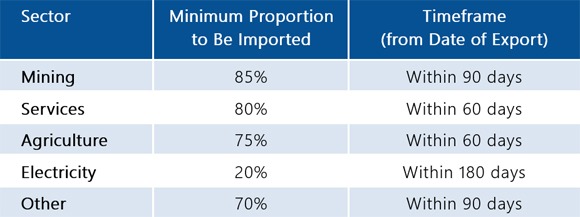
The ratios and timeframes are subject to change depending on the circumstances. If exporters cannot comply with the required ratio and timeline, exporters must provide relevant explanatory documents for the BOL’s consideration.

Selling Foreign-Currency Income

Exporters of goods and services must sell at least the minimum required proportion of their foreign-currency income (see table below) to a commercial bank in Laos. This foreign currency exchange must occur within three working days of receiving the foreign currency into the dedicated bank account in Laos. The selling rate will be determined by the prevailing rate of the commercial bank on the day of the transaction.
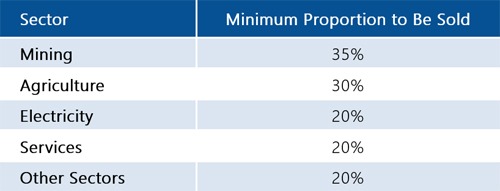
In conducting these transactions, commercial banks are required to carefully consider and manage their reserves and overall liquidity to ensure that they can meet public demand.

If an exporter does not sell at least the minimum required amount of foreign currency within three working days, the relevant commercial bank must proceed with the minimum required exchange and notify the exporter that they are doing so.

These requirements do not apply to re-exporters, such as importers of unprocessed raw materials for re-export to other countries, as determined by the Department of Foreign Currency Management (DFCM).

After selling the minimum required amount to a commercial bank, the remaining foreign-currency income must be used for foreign-currency exchange purposes, such as payments to parties in foreign countries, fulfilling obligations to the state, and so on.

Exporters can sell foreign currency to the BOL by notifying it of the need to sell the foreign currency to the DFCM in the BOL, after which they can sell the currency to the BOL through a commercial bank.

Registration

Decision No. 333 requires service exporters to register as importers and exporters to bring in income generated from exporting services. Although it doesn’t specify the types of service businesses that need to register, a March 2024 notice from the Ministry of Industry and Commerce offers examples of such businesses, including those in international transport, insurance, tourism and hotels, construction, and consulting.

Violations

First-time violations of Decision No. 333 that do not cause damage are subject to training on the importance of complying with Lao law or a warning. If the violation persists after the training or warning, the violator will face suspension of its ability to export goods and services.

For more information on Decision No. 333, or on any aspect of foreign currency management in Laos, please contact Tilleke & Gibbins at [email protected].

RELATED INSIGHTS​ 

August 25, 2025
To implement the recently issued Resolution on International Financial Centers in Vietnam (“IFC Resolution”), which is set to take effect on September 1, 2025 (see our previous article), the government of Vietnam is making every effort to formulate and issue guiding decrees—up to eight in total—before the effective date of the resolution. These decrees will establish key principles, define the rights and obligations of stakeholders, and outline permissible business activities within the IFCs, and serve as a foundation for the legal framework of the IFCs. Below are highlights of two draft decrees that have been released for public consultation. Draft Decree on IFC Establishment Ho Chi Minh City: The IFC in Ho Chi Minh City will focus on capital markets integrated with asset management services, fund management, insurance, financial products and financial derivatives; banking systems and money market products; fintech and financial innovation through sandbox mechanisms; specialized exchanges and new trading platforms; commodity markets, commodity and commodity derivatives exchanges linked to domestic and international physical commodity markets; and regional supply chain services, logistics hubs, maritime transport, and seaport infrastructure. Da Nang: The IFC in Da Nang will mainly develop green finance and commercial finance for SMEs and innovative enterprises, non-resident organizations and individuals (i.e., offshore financial services); cross-border trade activities linked to free trade zones, high-tech zones, new economic zones, and industrial zones; pilot control mechanisms for emerging models, such as digital assets, cryptocurrencies, and digital payments and transfers; new exchanges and trading platforms; investment funds, remittance funds, and small and medium fund management companies; startups in financial solutions for consumer services, tourism, e-commerce, logistics, and services within free trade zones; and related support, advisory, development, and legal services. Incentives: The People’s Committees of Ho Chi Minh City and Da Nang will need to decide on their list of
August 21, 2025
On August 19, 2025, the Trade Competition Commission of Thailand (TCCT) released its draft Guidelines on the Consideration of Unfair Trade Practices and Conduct Constituting Monopoly, Reducing Competition, or Restricting Competition in Multi-Sided Platform Businesses in the Category of Digital Platforms for the Sale of Goods or Services (E-commerce). A public comment period on the guidelines is open until September 18. The draft provides the first detailed framework for how the TCCT will interpret and enforce the substantive provisions under the Trade Competition Act against digital platforms, which have a unique network effect and require complex competition analysis. This development will profoundly impact the operations of e-commerce platforms, sellers, and associated service providers in Thailand. The guidelines primarily target e-commerce digital platform business operators, which are defined as follows: E-commerce digital platform: A medium facilitating the sale, purchase, or exchange of goods or services, including any operations to create transactions or interactions between business operators via an electronic transaction system, regardless of whether service fees are charged. E-commerce digital platform business operator: A service provider of a digital platform for the sale of goods or services who acts as an intermediary facilitating the sale of goods or services, including any operations to create transactions or interactions through an electronic transaction system by receiving orders for goods or services transacted via an electronic system, whether in the form of an e-marketplace, a social marketplace, or any other form that connects purchase orders for goods or services with business operators through an electronic system. Prohibited Conduct The guidelines classify potentially anticompetitive conduct and unfair trade practices into two categories: price-related and non-price-related conduct. 1. Price-related conduct The TCCT is targeting pricing strategies that can harm competition. Key prohibited behaviors include: Price below cost: Setting prices below the average total cost without
August 19, 2025
On August 6, 2025, Myanmar’s National Defence and Security Council (NDSC) issued Order No. 20/2025, announcing a change in the composition of the country’s Foreign Exchange Supervisory Committee (FESC). The prime minister has been appointed committee chair of the FESC, and five other individuals were appointed to the committee. The order took immediate effect. Originally established in April 2022, the FESC is responsible for approving foreign currency conversion, granting exemptions to foreign exchange restrictions, and permitting overseas transfers of foreign currency. The FESC supervises the flow of foreign currencies for domestic and foreign investment, manufacturing, exports and imports, and service businesses (including education- and health-related initiatives). The FESC is specifically responsible for considering and approving the use of foreign currency for the following: Importing machinery, vehicles, equipment, and raw materials essential for foreign investment and manufacturing projects; Importing fuel, medicine, cooking oil, fertilizer, insecticide, and construction materials not readily available on the domestic market; Covering Myanmar citizens’ needs abroad, such as medical treatment, education, or religious activities; Facilitating imports of general goods, loan repayments, interest payments to foreign lenders, service payments, and profit repatriation from investments; and Importing luxury products, including brand-name goods, jewelry, sports cars, and watches. The FESC is empowered to carry out further duties related to foreign exchange management as assigned by the NDSC Importers, exporters, investors, and business owners are encouraged to consult the most current FESC guidelines and approval lists before conducting transactions in Myanmar. For more details on these FESC composition developments, or on any aspect of financial regulations in Myanmar, please contact Tilleke & Gibbins at [email protected].
July 25, 2025
On June 17, 2025, the National Assembly of Vietnam adopted Law No. 76/2025/QH15 (Amended LOE) amending and supplementing the 2020 Law on Enterprises, which aims to reshape the legal framework to enhance transparency and alignment with international standards. The Amended LOE took effect from July 1, 2025. Below are key notes on the Amended LOE. Recognition of Beneficial Owners The beneficial owner (BO) concept was previously addressed under Vietnam’s anti-money laundering framework. However, the formal recognition of a BO in the Amended LOE marks a pivotal advancement in embedding ownership transparency into corporate governance, in line with the G7 Financial Action Task Force’s standards on anti-money laundering and counter-terrorism financing. Under the Amended LOE and Decree No. 168/2025/ND-CP of the government dated June 30, 2025, on enterprise registration (Decree 168), a BO is identified through either equity ownership or control rights. Equity ownership: Individuals holding 25% or more of a company’s charter capital or voting shares, either directly or indirectly, qualify as BOs. Indirect ownership is further defined as ownership of at least 25% of charter capital or voting shares through an intermediary organization. Control rights: Individuals with the authority to make or influence major decisions are considered BOs. The actual control over a company includes the power (i) to appoint or remove most or all members of the board of directors or the members’ council or the general director of a company; (ii) to amend the charter; or (iii) to decide other key matters specified in the company’s charter. Notably, individuals representing state ownership in state-owned enterprises are excluded from the scope of the BO concept. Companies are responsible for collecting, updating, and retaining information about BOs and cooperating with authorities when requested to identify BOs, among other obligations. Additionally, any companies registered before July 1, 2025, must