
You are using an outdated browser and your browsing experience will not be optimal. Please update to the latest version of Microsoft Edge, Google Chrome or Mozilla Firefox. Install Microsoft Edge

June 7, 2024

Laos Regulates Management of Foreign Currency from Exports

On March 7, 2024, Laos moved to regulate the management of foreign-currency income from the exportation of goods and services. Effective March 29, 2024, Decision No. 333 (formally the Decision on Management of Income in Foreign Currency from Exportation of Goods and Services No. 333/BOL) from the Bank of Lao PDR (BOL) aims to incentivize the inflow of such foreign currency into Laos and its sale to licensed commercial banks.

Decision No. 333 sets minimum required proportions for importing income in foreign currency derived from the exportation of goods and services, as well as the timeframe for doing so. It also stipulates the requirements for selling such foreign currency to commercial banks in Laos and the minimum proportions that must be sold.

Importing Foreign-Currency Income

Exporters must receive payments from abroad via bank transfer into a dedicated bank account designated for import-export business activities within the timeline specified in the sale-purchase agreement, but not exceeding 180 days from the date of export. Each sector must import income in foreign currency into the Lao PDR according to the minimum proportion of currency to be imported, and it must be done within the required timeframes, as specified in the table below.
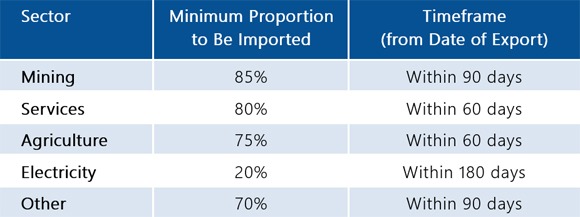
The ratios and timeframes are subject to change depending on the circumstances. If exporters cannot comply with the required ratio and timeline, exporters must provide relevant explanatory documents for the BOL’s consideration.

Selling Foreign-Currency Income

Exporters of goods and services must sell at least the minimum required proportion of their foreign-currency income (see table below) to a commercial bank in Laos. This foreign currency exchange must occur within three working days of receiving the foreign currency into the dedicated bank account in Laos. The selling rate will be determined by the prevailing rate of the commercial bank on the day of the transaction.
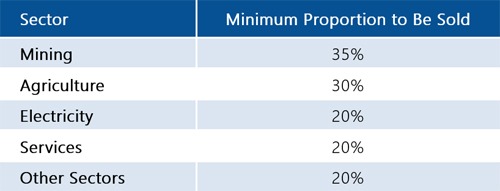
In conducting these transactions, commercial banks are required to carefully consider and manage their reserves and overall liquidity to ensure that they can meet public demand.

If an exporter does not sell at least the minimum required amount of foreign currency within three working days, the relevant commercial bank must proceed with the minimum required exchange and notify the exporter that they are doing so.

These requirements do not apply to re-exporters, such as importers of unprocessed raw materials for re-export to other countries, as determined by the Department of Foreign Currency Management (DFCM).

After selling the minimum required amount to a commercial bank, the remaining foreign-currency income must be used for foreign-currency exchange purposes, such as payments to parties in foreign countries, fulfilling obligations to the state, and so on.

Exporters can sell foreign currency to the BOL by notifying it of the need to sell the foreign currency to the DFCM in the BOL, after which they can sell the currency to the BOL through a commercial bank.

Registration

Decision No. 333 requires service exporters to register as importers and exporters to bring in income generated from exporting services. Although it doesn’t specify the types of service businesses that need to register, a March 2024 notice from the Ministry of Industry and Commerce offers examples of such businesses, including those in international transport, insurance, tourism and hotels, construction, and consulting.

Violations

First-time violations of Decision No. 333 that do not cause damage are subject to training on the importance of complying with Lao law or a warning. If the violation persists after the training or warning, the violator will face suspension of its ability to export goods and services.

For more information on Decision No. 333, or on any aspect of foreign currency management in Laos, please contact Tilleke & Gibbins at [email protected].

RELATED INSIGHTS​ 

July 11, 2025
Vietnam’s recent embrace of “regulatory sandboxes” reflects a deliberate policy choice to balance the need for robust oversight with an equally pressing imperative to catalyze innovation. A sandbox is a controlled, time-bound framework in which businesses may pilot emerging technologies, products, or business models under relaxed or tailor-made regulatory requirements, thereby allowing regulators to observe risks in real time while innovators validate commercial viability without bearing the full weight of the traditional compliance regime. By issuing sandbox regulations, the government of Vietnam is signaling its commitment to accelerating digital transformation, attracting investment, and developing a knowledge-based economy, all while safeguarding financial stability, consumer protection, and national security. This strategy is embodied in a suite of instruments that together establish sector-specific sandboxes: Decree No. 94/2025/ND-CP on the Regulatory Sandbox in the Banking Sector (Fintech Sandbox Decree), effective July 1, 2025. Law on Digital Technology Industry (DTI Law), effective January 1, 2026, and Law on Science, Technology and Innovation (STI Law), effective October 1, 2025. Resolution No. 222/2025/QH15 on International Financial Centers (IFC Resolution), effective September 1, 2025. In addition, a draft resolution on the pilot implementation of the crypto-asset market (Draft Crypto Pilot Resolution) is expected to introduce a dedicated sandbox for crypto-asset service providers later this year, further underscoring Vietnam’s holistic, forward-looking approach to regulating emerging technologies. Below is a brief summary of all the regulatory sandboxes, who they are open for, and what businesses are attracted. Fintech Sandbox Decree Under the Fintech Sandbox Decree, besides credit institutions and foreign bank branches, fintech companies operating in Vietnam can apply for a Certificate of Sandbox Participation issued by the State Bank of Vietnam to operate any of the following services in Vietnam: Credit scoring: A solution applicable to information technology systems of credit institutions, branches of foreign banks, and fintech
July 4, 2025
On July 3, 2025, the Trade Competition Commission of Thailand (TCCT) officially announced an invitation for stakeholders to participate in a public survey to gather feedback on the flexibility and appropriateness of credit terms across different business sectors for goods and services. The TCCT initially introduced guidelines on unfair trade practices related to credit terms applicable to small and medium-sized enterprises (SMEs) in 2021, with amendments following in 2022. The guidelines have had a wide impact, as businesses have had to adapt their payment procedures and practices, particularly those for dealing with SMEs, to comply with the guidelines. The TCCT is now seeking comprehensive feedback from businesses and other stakeholders to evaluate the effectiveness and practicality of these guidelines. The collected responses may potentially lead to future amendments aimed at enhancing fairness and efficiency in business transactions. To summarize the core principles, the guidelines aim to improve the liquidity and cash flow of SMEs, stipulating payment terms of: Within 30 days for agricultural products or primary agricultural processing involving non-complex production. Within 45 days for trade, manufacturing, and service sectors. The guidelines also identify practices deemed unfair, including: Unjustified delays in payment beyond agreed credit terms. Changes to credit terms or contractual conditions without at least 60 days’ advance notice. Other unfair conduct or credit term conditions that impose excessive burdens on an SME. Interested stakeholders are encouraged to submit their feedback through the TCCT’s online survey form available via their official public media channels. The survey is open for responses until July 20, 2025.
July 2, 2025
On June 27, 2025, Vietnam’s National Assembly adopted a Resolution on International Financial Centers in Vietnam (“IFC Resolution”), which is set to take effect September 1, 2025, putting forward major policy breakthroughs on multiple fronts. The IFC Resolution has the goal of turning Ho Chi Minh City and Da Nang into leading international financial centers with autonomy and tools to compete, thereby raising Vietnam’s position in the global financial network, in association with economic growth drivers. Below are some of the key points of the IFC Resolution, which has notable changes from previous drafts (see our articles on Vietnam’s Draft Resolution on Financial Centers: Implications for Fintech and Banking and Vietnam’s Emerging Regulatory Landscape for Blockchain and Cryptocurrency), including: The removal of the Central Supervisory Agency. The addition of a definition of international financial centers, which are specific geographic areas in Ho Chi Minh City and Da Nang with members entitled to special policies. The addition of a list of entities eligible for membership, and entitlement to the special policies. Major Policy Breakthroughs The IFC Resolution introduces specific policies in the following areas: Liberalization of foreign exchange control for members, including policies such as open foreign exchange use between members and exemption from foreign exchange control procedures for 100% foreign-owned members. Specialized licensing for members to establish and operate single-member limited liability banks and foreign bank branches with the ability to apply accounting standards, debt classification, risk provisions, and prudential ratios according to the owner’s policies. Creation of a capital market for innovative startups, including a crowdfunding mechanism or private placement mechanism through a licensed platform, and development of a green finance market with green certification. Creation of a regulatory sandbox for fintech technologies, products, services, and business models not yet prescribed by law, offering exemption from compliance with
June 30, 2025
On April 29, 2025, the State Bank of Vietnam (SBV) issued Circular No. 03/2025/TT-NHNN (Circular 03), which provides detailed guidance on the opening and use of Vietnamese dong (VND) accounts by non-resident foreign investors engaging in indirect investment activities in Vietnam. Circular 03, which took effect on June 16, 2025, amends Circular No. 06/2019/TT-NHNN of the SBV on the management of foreign exchange for foreign direct investment activities in Vietnam (Circular 06) and replaces Circular No. 05/2014/TT-NHNN of the SBV guiding the opening and use of indirect investment capital accounts for implementation of foreign indirect investment activities in Vietnam (Circular 05). Below are some of the key points of Circular 03. Change of Account Name Circular 03 renames “indirect investment capital account” to “indirect investment account” (IIA). This change aligns with the terminology used in other legislation, ensuring consistency across Vietnam’s legal framework governing foreign exchange and investment activities. Additionally, by removing the word “capital,” the new term better encompasses the full range of transactions that may be conducted through these accounts, such as share transfer and other forms of indirect investment-related activities. This helps prevent misinterpretation and facilitates compliance for foreign investors operating in Vietnam. Account Types Circular 03 clearly delineates account types and investor residency status as follows: For non-resident foreign investors: The opening and use of investment accounts in VND is for carrying out transactions related to indirect investment activities. For resident foreign investors: Credit and debit transactions are made through payment accounts in VND in accordance with relevant laws. Additional Permitted Uses of IIAs In addition to the cash inflows and outflows authorized under Circular 05, Circular 03 introduces more cash transactions that can be conducted via IIAs. These include: Receiving interest and other legal income when conducting stock purchase transactions that do not require