
You are using an outdated browser and your browsing experience will not be optimal. Please update to the latest version of Microsoft Edge, Google Chrome or Mozilla Firefox. Install Microsoft Edge

June 7, 2024

Laos Regulates Management of Foreign Currency from Exports

On March 7, 2024, Laos moved to regulate the management of foreign-currency income from the exportation of goods and services. Effective March 29, 2024, Decision No. 333 (formally the Decision on Management of Income in Foreign Currency from Exportation of Goods and Services No. 333/BOL) from the Bank of Lao PDR (BOL) aims to incentivize the inflow of such foreign currency into Laos and its sale to licensed commercial banks.

Decision No. 333 sets minimum required proportions for importing income in foreign currency derived from the exportation of goods and services, as well as the timeframe for doing so. It also stipulates the requirements for selling such foreign currency to commercial banks in Laos and the minimum proportions that must be sold.

Importing Foreign-Currency Income

Exporters must receive payments from abroad via bank transfer into a dedicated bank account designated for import-export business activities within the timeline specified in the sale-purchase agreement, but not exceeding 180 days from the date of export. Each sector must import income in foreign currency into the Lao PDR according to the minimum proportion of currency to be imported, and it must be done within the required timeframes, as specified in the table below.
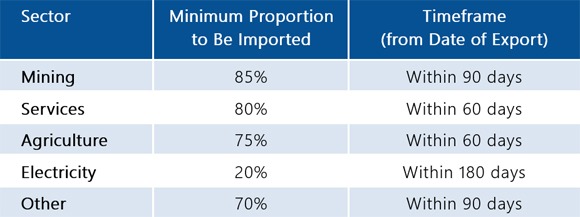
The ratios and timeframes are subject to change depending on the circumstances. If exporters cannot comply with the required ratio and timeline, exporters must provide relevant explanatory documents for the BOL’s consideration.

Selling Foreign-Currency Income

Exporters of goods and services must sell at least the minimum required proportion of their foreign-currency income (see table below) to a commercial bank in Laos. This foreign currency exchange must occur within three working days of receiving the foreign currency into the dedicated bank account in Laos. The selling rate will be determined by the prevailing rate of the commercial bank on the day of the transaction.
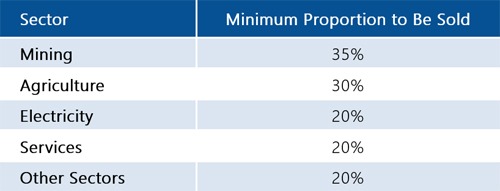
In conducting these transactions, commercial banks are required to carefully consider and manage their reserves and overall liquidity to ensure that they can meet public demand.

If an exporter does not sell at least the minimum required amount of foreign currency within three working days, the relevant commercial bank must proceed with the minimum required exchange and notify the exporter that they are doing so.

These requirements do not apply to re-exporters, such as importers of unprocessed raw materials for re-export to other countries, as determined by the Department of Foreign Currency Management (DFCM).

After selling the minimum required amount to a commercial bank, the remaining foreign-currency income must be used for foreign-currency exchange purposes, such as payments to parties in foreign countries, fulfilling obligations to the state, and so on.

Exporters can sell foreign currency to the BOL by notifying it of the need to sell the foreign currency to the DFCM in the BOL, after which they can sell the currency to the BOL through a commercial bank.

Registration

Decision No. 333 requires service exporters to register as importers and exporters to bring in income generated from exporting services. Although it doesn’t specify the types of service businesses that need to register, a March 2024 notice from the Ministry of Industry and Commerce offers examples of such businesses, including those in international transport, insurance, tourism and hotels, construction, and consulting.

Violations

First-time violations of Decision No. 333 that do not cause damage are subject to training on the importance of complying with Lao law or a warning. If the violation persists after the training or warning, the violator will face suspension of its ability to export goods and services.

For more information on Decision No. 333, or on any aspect of foreign currency management in Laos, please contact Tilleke & Gibbins at [email protected].

RELATED INSIGHTS​ 

November 24, 2021
Attorneys from Tilleke & Gibbins have provided the latest update to the Thailand contribution to Doing Business in…, a Q&A-style guide published by Thomson Reuters Practical Law that presents an overview of the legal framework for doing business in 63 jurisdictions worldwide. The Thailand chapter of the guide outlines Thailand’s legal system and key laws applicable to foreign companies doing business in the country. The chapter specifically covers the following main topics: Legal system: Thailand’s court system and codified legal system. Foreign investment: Lists of reserved business activities, restrictions on doing business with certain jurisdictions, exchange controls and currency regulations, and grants and incentives available to investors. Business vehicles: Ordinary partnerships, registered ordinary partnerships, limited partnerships, private limited companies, and public companies. Environment: Main laws and regulations, factory operation. Employment: Laws, employment contract requirements, work permits, and termination and redundancy. Tax: Taxes on employment, tax and nontax resident employees and businesses, corporate income tax, value added tax, special business tax, municipal tax, stamp duty, dividends, interest, intellectual property royalties. Competition: Important aspects of Thailand’s regulatory regime surrounding competition, centered around the updated Trade Competition Act. Antibribery and corruption: Laws, compliance requirements, regulatory authority. Intellectual property: Patents, trademarks, registered and unregistered designs, and copyright. Marketing agreements and advertising: Regulation of marketing agreements, Thailand’s Consumer Protection Act, direct marketing, role of the Consumer Protection Board and Food and Drug Administration. E-commerce: E-commerce laws and regulations, marketing and sales via online platforms. Data protection: An outline of Thailand’s Personal Data Protection Act. Product liability: Procedures and regulations for product liability and product safety, including the Unsafe Goods Liability Act and the Consumer Case Procedure Act. Product liability: Key regulatory authorities for trade competition, environmental issues, and financial services. To browse, download, or print the Thailand chapter, please visit the Practical Law website.
October 26, 2021
Parallel imports—branded goods imported into a domestic market and sold there without the consent of the intellectual property (IP) owner—pose a unique challenge for IP owners. In contrast to counterfeit goods, parallel imported goods are manufactured by or under the license of the IP owner and formulated or packaged for a particular jurisdiction and then imported into a different jurisdiction without the authorization of the IP owner. Intellectual property laws and perspectives on parallel import vary throughout Southeast Asia. The distinct legal landscape in each nation should be carefully navigated in consultation with legal experts to ensure brand protection to the fullest degree. This guide provides insight into the legal frameworks relating to parallel imports in Cambodia, Indonesia, Laos, Myanmar, Thailand, and Vietnam. Each section examines the relevant laws and regulations that pertain to parallel imports and explores the remedies available to IP owners in each country. Finally, the guide presents some strategies to combat parallel importation and maximize IP protection in Southeast Asia. The full guide can be downloaded through the button below.   This guide was prepared with the assistance of Tilleke & Gibbins interns Christian Pederson and Keoni Williams.
October 26, 2021
Attorneys from Tilleke & Gibbins in Vietnam have written the Vietnam chapter of the newly released Fashion Law 2021, a guide to law surrounding the business of fashion in jurisdictions around the world. The guide covers 18 key jurisdictions for the global fashion industry, offering insights into local legal frameworks surrounding vital issues such as brand enforcement and protection, e-commerce and marketing, and sustainability considerations. The Vietnam chapter of Fashion Law 2021 provides detailed information on the following topics: Trademarks, designs, copyright, and other intellectual property types such as patents and trade secrets. Strategic local contractual arrangements for manufacturing, distributing, and advertising fashion products. Overview and application of online marketing regulations and consumer protection regulations in Vietnam. The most relevant unfair competition rules for fashion businesses, and local courts’ interpretation and enforcement of the rules. ESG (environmental, social, and governance) concerns and sustainability issues for the fashion industry. Customs monitoring and local import and export guards against counterfeit products. The full Vietnam chapter is available for free on the Global Legal Post website, or it can be downloaded as a PDF through the button below. Tilleke & Gibbins also contributed the Thailand chapter to the guide.
October 26, 2021
Attorneys from Tilleke & Gibbins’ Bangkok office have written the Thailand chapter of the newly released Fashion Law 2021, a guide to law surrounding the business of fashion in jurisdictions around the world. The guide covers 18 key jurisdictions for the global fashion industry, offering insights into local legal frameworks surrounding vital issues such as brand enforcement and protection, e-commerce and marketing, and sustainability considerations. The Thailand chapter of Fashion Law 2021 provides detailed information on the following topics: Trademarks, designs, copyright, and other intellectual property types, as well as the main intellectual property legal tools available to protect fashion products in Thailand. Strategic local contractual arrangements for manufacturing, distributing, and advertising fashion products. Overview and application of online marketing regulations and consumer protection regulations in Thailand. The most relevant unfair competition rules for fashion businesses and local courts’ interpretation and enforcement of the rules. ESG (environmental, social, and governance) concerns and sustainability issues for the fashion industry. Customs monitoring and local import and export guards against counterfeit products. Frequently asked questions and common concerns regarding fashion business operations in Thailand. The full Thailand chapter is available for free on the Global Legal Post website, or it can be downloaded as a PDF through the button below. Tilleke & Gibbins also contributed the Vietnam chapter to the guide.