
You are using an outdated browser and your browsing experience will not be optimal. Please update to the latest version of Microsoft Edge, Google Chrome or Mozilla Firefox. Install Microsoft Edge

June 7, 2024

Laos Regulates Management of Foreign Currency from Exports

On March 7, 2024, Laos moved to regulate the management of foreign-currency income from the exportation of goods and services. Effective March 29, 2024, Decision No. 333 (formally the Decision on Management of Income in Foreign Currency from Exportation of Goods and Services No. 333/BOL) from the Bank of Lao PDR (BOL) aims to incentivize the inflow of such foreign currency into Laos and its sale to licensed commercial banks.

Decision No. 333 sets minimum required proportions for importing income in foreign currency derived from the exportation of goods and services, as well as the timeframe for doing so. It also stipulates the requirements for selling such foreign currency to commercial banks in Laos and the minimum proportions that must be sold.

Importing Foreign-Currency Income

Exporters must receive payments from abroad via bank transfer into a dedicated bank account designated for import-export business activities within the timeline specified in the sale-purchase agreement, but not exceeding 180 days from the date of export. Each sector must import income in foreign currency into the Lao PDR according to the minimum proportion of currency to be imported, and it must be done within the required timeframes, as specified in the table below.
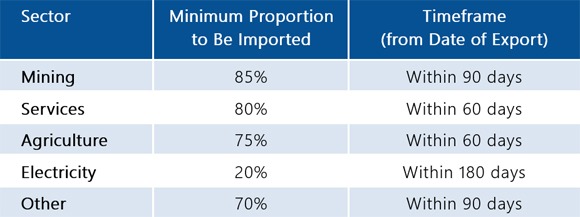
The ratios and timeframes are subject to change depending on the circumstances. If exporters cannot comply with the required ratio and timeline, exporters must provide relevant explanatory documents for the BOL’s consideration.

Selling Foreign-Currency Income

Exporters of goods and services must sell at least the minimum required proportion of their foreign-currency income (see table below) to a commercial bank in Laos. This foreign currency exchange must occur within three working days of receiving the foreign currency into the dedicated bank account in Laos. The selling rate will be determined by the prevailing rate of the commercial bank on the day of the transaction.
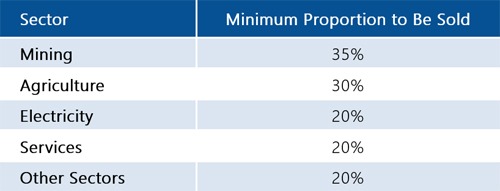
In conducting these transactions, commercial banks are required to carefully consider and manage their reserves and overall liquidity to ensure that they can meet public demand.

If an exporter does not sell at least the minimum required amount of foreign currency within three working days, the relevant commercial bank must proceed with the minimum required exchange and notify the exporter that they are doing so.

These requirements do not apply to re-exporters, such as importers of unprocessed raw materials for re-export to other countries, as determined by the Department of Foreign Currency Management (DFCM).

After selling the minimum required amount to a commercial bank, the remaining foreign-currency income must be used for foreign-currency exchange purposes, such as payments to parties in foreign countries, fulfilling obligations to the state, and so on.

Exporters can sell foreign currency to the BOL by notifying it of the need to sell the foreign currency to the DFCM in the BOL, after which they can sell the currency to the BOL through a commercial bank.

Registration

Decision No. 333 requires service exporters to register as importers and exporters to bring in income generated from exporting services. Although it doesn’t specify the types of service businesses that need to register, a March 2024 notice from the Ministry of Industry and Commerce offers examples of such businesses, including those in international transport, insurance, tourism and hotels, construction, and consulting.

Violations

First-time violations of Decision No. 333 that do not cause damage are subject to training on the importance of complying with Lao law or a warning. If the violation persists after the training or warning, the violator will face suspension of its ability to export goods and services.

For more information on Decision No. 333, or on any aspect of foreign currency management in Laos, please contact Tilleke & Gibbins at [email protected].

RELATED INSIGHTS​ 

February 21, 2022
On February 14, 2022, Thailand’s Securities and Exchange Commission (SEC) announced a public hearing period on proposed advertising regulations for digital asset businesses. The public hearing period is now open for general comments until March 15, 2022. In the announcement, the SEC expressed their intention to provide clear digital asset advertising principles that conform to regulations in other countries, such as Singapore, the UK, and Japan. The SEC, in a meeting on February 3, agreed that the principles to be developed should apply to all digital asset businesses operating in Thailand. During the public hearing period, any interested parties may comment on the SEC’s proposed principles, which include the following key points: Advertisements that educate, inform, or give facts about digital assets, investments or services, or that provide an overall picture of digital assets, must not exaggerate, distort, or conceal information, or otherwise mislead consumers. In addition, advertisements that refer to customer numbers must only indicate the number of customers who have received approval to open an account and who are ready to use the service. Advertisements must be clear and appropriate, provide a warning on investment risks, and include clear and noticeable SEC-mandated statements in the font size stipulated by the SEC. Advertisements that present positive information or suggest an opportunity to receive returns must provide a balanced view that also discloses negative information or states investment risks. Advertisements relating to cryptocurrencies can only be made via a business operator’s official channels (e.g., the operator’s website, app, or other official online channel), and cryptocurrency cannot be advertised in public areas (e.g., billboards, public transportation, websites, newspapers and periodicals, etc.). However, advertisements for the services of a digital assets business can still be made in public areas and other channels. For example, this can be understood as meaning that
December 13, 2021
On November 23, 2021, Thailand’s cabinet approved in principle the amended Ministerial Regulation No. 13 issued under the Exchange Control Act, B.E. 2485 (1942), as amended (ECA). The ECA is an integral instrument of the Bank of Thailand (BOT) for regulating businesses relating to foreign means of payment (i.e., foreign exchange business) and controlling inward and outward remittances as well as exchange and conversion between Thai baht and foreign currencies. Under the current ECA, no party may purchase, sell, lend, exchange, or transfer foreign currencies except for authorized juristic persons (bank and non-bank entities) or authorized individuals who are licensed by the Ministry of Finance. The major amendments to Ministerial Regulation No. 13 of the ECA introduce a number of changes to the current regulations for foreign exchange business operations: Expansion of the scope of foreign exchange business The scope of a foreign exchange business is currently limited to purchasing, selling, lending, and exchanging foreign currency in the form of banknotes, coins, and travelers’ cheques (i.e., banknotes-to-banknotes conversion only). The new amendments will expand the scope of foreign exchange business to include more foreign currency payment types. For instance, foreign travelers will be able to use credit or debit cards issued by a foreign commercial bank to exchange for cash (i.e., card-to-banknotes conversion). Additional modes of authorizing foreign exchange businesses Licensing is currently the only mode of authorization for a foreign exchange business in Thailand. Under the amended regulations, there will be two options for authorization: licensing or registration. While the exact requirements and definition of “registration” will become clearer after the actual amended regulation and any subordinate legislation become available, this indication of an additional mode of authorization may imply varying requirements and burdens in the application process. Allowance of a foreign exchange business license to cover all