
You are using an outdated browser and your browsing experience will not be optimal. Please update to the latest version of Microsoft Edge, Google Chrome or Mozilla Firefox. Install Microsoft Edge

June 7, 2024

Laos Regulates Management of Foreign Currency from Exports

On March 7, 2024, Laos moved to regulate the management of foreign-currency income from the exportation of goods and services. Effective March 29, 2024, Decision No. 333 (formally the Decision on Management of Income in Foreign Currency from Exportation of Goods and Services No. 333/BOL) from the Bank of Lao PDR (BOL) aims to incentivize the inflow of such foreign currency into Laos and its sale to licensed commercial banks.

Decision No. 333 sets minimum required proportions for importing income in foreign currency derived from the exportation of goods and services, as well as the timeframe for doing so. It also stipulates the requirements for selling such foreign currency to commercial banks in Laos and the minimum proportions that must be sold.

Importing Foreign-Currency Income

Exporters must receive payments from abroad via bank transfer into a dedicated bank account designated for import-export business activities within the timeline specified in the sale-purchase agreement, but not exceeding 180 days from the date of export. Each sector must import income in foreign currency into the Lao PDR according to the minimum proportion of currency to be imported, and it must be done within the required timeframes, as specified in the table below.
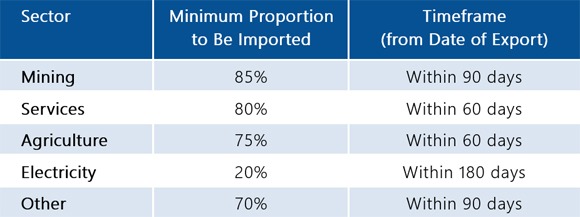
The ratios and timeframes are subject to change depending on the circumstances. If exporters cannot comply with the required ratio and timeline, exporters must provide relevant explanatory documents for the BOL’s consideration.

Selling Foreign-Currency Income

Exporters of goods and services must sell at least the minimum required proportion of their foreign-currency income (see table below) to a commercial bank in Laos. This foreign currency exchange must occur within three working days of receiving the foreign currency into the dedicated bank account in Laos. The selling rate will be determined by the prevailing rate of the commercial bank on the day of the transaction.
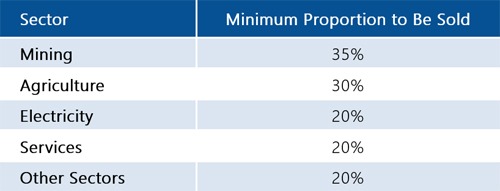
In conducting these transactions, commercial banks are required to carefully consider and manage their reserves and overall liquidity to ensure that they can meet public demand.

If an exporter does not sell at least the minimum required amount of foreign currency within three working days, the relevant commercial bank must proceed with the minimum required exchange and notify the exporter that they are doing so.

These requirements do not apply to re-exporters, such as importers of unprocessed raw materials for re-export to other countries, as determined by the Department of Foreign Currency Management (DFCM).

After selling the minimum required amount to a commercial bank, the remaining foreign-currency income must be used for foreign-currency exchange purposes, such as payments to parties in foreign countries, fulfilling obligations to the state, and so on.

Exporters can sell foreign currency to the BOL by notifying it of the need to sell the foreign currency to the DFCM in the BOL, after which they can sell the currency to the BOL through a commercial bank.

Registration

Decision No. 333 requires service exporters to register as importers and exporters to bring in income generated from exporting services. Although it doesn’t specify the types of service businesses that need to register, a March 2024 notice from the Ministry of Industry and Commerce offers examples of such businesses, including those in international transport, insurance, tourism and hotels, construction, and consulting.

Violations

First-time violations of Decision No. 333 that do not cause damage are subject to training on the importance of complying with Lao law or a warning. If the violation persists after the training or warning, the violator will face suspension of its ability to export goods and services.

For more information on Decision No. 333, or on any aspect of foreign currency management in Laos, please contact Tilleke & Gibbins at [email protected].

RELATED INSIGHTS​ 

July 15, 2022
On July 13, 2022, the Central Bank of Myanmar (CBM) revoked its previous exemption from the foreign currency conversion requirement for companies that are registered with the Directorate of Investment and Company Administration (DICA) and have at least 10% foreign investment. Banks with authorized dealer  status are thus no longer permitted to exempt these companies from the CBM’s requirement to convert foreign currency transfers and balances to Myanmar kyat. This sudden revocation of the prior relaxation was circulated in CBM Letter No. FE-1/739 to AD banks for exchanging foreign currencies in Myanmar. The letter effectively reverses information the CBM circulated in meeting minutes on June 7. Notably, however, this does not affect foreign-owned companies approved by the Myanmar Investment Commission, or investments in special economic zones. These exemptions and others previously announced by the CBM in relation to the currency conversion requirement remain valid, and are not affected by this revocation. For more details on these foreign exchange developments, or on any aspect of financial regulations in Myanmar, please contact Tilleke & Gibbins at [email protected].
July 12, 2022
Before the issuance in late 2019 of the Trade Competition Commission of Thailand’s Guidelines on Unfair Trade Practices in Franchise Businesses, which took effect in February 2020, Thai law made little mention of franchising as a business model—despite the great popularity of franchising in the country. The guidelines, which were issued under the Trade Competition Act B.E. 2560 (2017), partly made up for the absence of a single, codified franchising law in the country and offered valuable direction on how franchisors and franchisees should operate in compliance with Thai law. One of the most significant conditions introduced by the original guidelines in February 2020 was a requirement for franchisors to provide a right of first refusal to their existing franchisees before opening a new franchise outlet within current franchisees’ operating vicinity. An update to the guidelines addressing the right of first refusal was issued in August 2020. Most recently, a second update was announced on July 13, 2021. It was published in the Government Gazette on August 19, 2021, and came into force on the following day. The August 2021 update further revised this provision, and the updated guidelines now adopt a less restrictive approach for franchisors in relation to this first-refusal requirement. Under the updated guidelines, a franchisor who decides to open a new outlet, whether it will be operated by the franchisor or by another franchisee or person, must notify the existing franchisee located in closest proximity to the intended location, and provide the franchisee with a right of first refusal for a period of 30 days. However, the franchisor does not have to provide the closest franchisee with a right of first refusal if the franchisee’s existing performance does not meet the franchisor’s criteria as specified and communicated to the franchisee in advance. In determining what
June 30, 2022
On May 30, 2022, Thailand’s Securities and Exchange Commission (SEC) announced that it would start regulating ready-to-use utility tokens, a type of digital token that had previously been exempted from the SEC’s approval and regulatory control. A public forum was open for comments from various stakeholders until June 29, 2022, and the draft regulation is expected to be issued soon. So far, the SEC has only supervised the issuance of not-ready-to-use utility tokens—digital tokens with the underlying right to acquire specific goods or services, which cannot be utilized upon issuance but at a later date. Due to the growing digital asset industry and lack of regulatory control, ready-to-use utility tokens have become more popular and many are listed for trading in digital asset exchanges. The SEC claimed that it is now necessary to regulate ready-to-use utility tokens as some issuers appeared to be exploiting the regulatory loophole to manipulate the price and supply of these tokens in both the primary and secondary markets, while providing insufficient data disclosure to investors. The SEC’s proposed principles include the following key points: Pre-Approval Requirements The same pre-approval requirement applicable to not-ready-to-use utility tokens will apply to ready-to-use utility tokens which an issuer intends to list on a digital asset exchange. This means that the issuer must proceed with the standard formalities, i.e., obtaining prior approval from the SEC, filing a draft prospectus, and offering the approved tokens via a SEC-approved ICO portal operator only. The SEC offers a fast-track (15 days) approval for qualifying ready-to-use utility tokens, which are those with plain-vanilla characteristics; with an offering price corresponding to the value of the underlying goods/services; for which the supply of goods and services does not vary with the price of the tokens (i.e., fixed coins); and which are not intended to be
May 24, 2022
On April 4, 2022, Myanmar’s State Administration Council (SAC) established the Foreign Exchange Supervisory Committee (FESC) to approve foreign currency conversion, make exemptions to foreign exchange restrictions, and permit overseas foreign currency transfers. The formation of the FESC was made official with the May 13, 2022, publication of the SAC’s Order 28/2022 in the Government Gazette, which appointed six individuals to the new committee. The FESC is the focal body tasked with implementing Myanmar’s recently adopted policy of requiring conversion of foreign currency transfers and balances to local currency. Since the policy was instituted in April 2022, the Central Bank of Myanmar issued further clarifications and instructions for banks authorized to handle foreign currency, responded to concerns from foreign investors by exempting certain foreign investment projects from the conversion requirement, and relaxed the currency conversion requirements for trade at the Chinese and Thai borders. The FESC supervises the flow of foreign currencies for domestic and foreign investment, manufacturing, exports and imports, and service businesses (including education- and health-related initiatives). The FESC is specifically responsible for considering and approving the use of foreign currency for the following: Importation of machinery, vehicles, equipment, and raw materials needed for the foreign investment and manufacturing; Importation of fuels, medicines, cooking oils, fertilizers, insecticides, and construction materials that are not available in the domestic market; Myanmar citizens’ social matters, such as going abroad for purposes of medical treatment, education, or religious activities; Importation of general goods, repayment of loan and interest payments to lenders in foreign countries, service payments, and repatriation of profits from investments; and Imports of various luxury products (e.g., brand-name goods, jewelry, sport cars, watches, etc.). The FESC will also perform other duties relating to foreign exchange management as assigned by the SAC. For more details on these foreign exchange developments,