
You are using an outdated browser and your browsing experience will not be optimal. Please update to the latest version of Microsoft Edge, Google Chrome or Mozilla Firefox. Install Microsoft Edge

June 7, 2024

Laos Regulates Management of Foreign Currency from Exports

On March 7, 2024, Laos moved to regulate the management of foreign-currency income from the exportation of goods and services. Effective March 29, 2024, Decision No. 333 (formally the Decision on Management of Income in Foreign Currency from Exportation of Goods and Services No. 333/BOL) from the Bank of Lao PDR (BOL) aims to incentivize the inflow of such foreign currency into Laos and its sale to licensed commercial banks.

Decision No. 333 sets minimum required proportions for importing income in foreign currency derived from the exportation of goods and services, as well as the timeframe for doing so. It also stipulates the requirements for selling such foreign currency to commercial banks in Laos and the minimum proportions that must be sold.

Importing Foreign-Currency Income

Exporters must receive payments from abroad via bank transfer into a dedicated bank account designated for import-export business activities within the timeline specified in the sale-purchase agreement, but not exceeding 180 days from the date of export. Each sector must import income in foreign currency into the Lao PDR according to the minimum proportion of currency to be imported, and it must be done within the required timeframes, as specified in the table below.
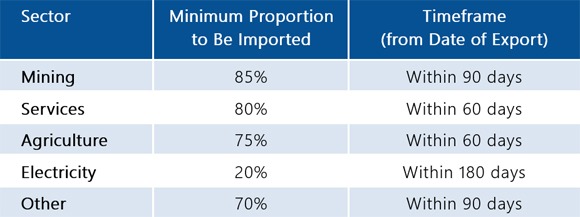
The ratios and timeframes are subject to change depending on the circumstances. If exporters cannot comply with the required ratio and timeline, exporters must provide relevant explanatory documents for the BOL’s consideration.

Selling Foreign-Currency Income

Exporters of goods and services must sell at least the minimum required proportion of their foreign-currency income (see table below) to a commercial bank in Laos. This foreign currency exchange must occur within three working days of receiving the foreign currency into the dedicated bank account in Laos. The selling rate will be determined by the prevailing rate of the commercial bank on the day of the transaction.
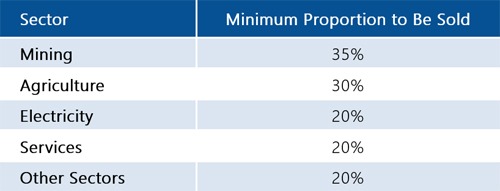
In conducting these transactions, commercial banks are required to carefully consider and manage their reserves and overall liquidity to ensure that they can meet public demand.

If an exporter does not sell at least the minimum required amount of foreign currency within three working days, the relevant commercial bank must proceed with the minimum required exchange and notify the exporter that they are doing so.

These requirements do not apply to re-exporters, such as importers of unprocessed raw materials for re-export to other countries, as determined by the Department of Foreign Currency Management (DFCM).

After selling the minimum required amount to a commercial bank, the remaining foreign-currency income must be used for foreign-currency exchange purposes, such as payments to parties in foreign countries, fulfilling obligations to the state, and so on.

Exporters can sell foreign currency to the BOL by notifying it of the need to sell the foreign currency to the DFCM in the BOL, after which they can sell the currency to the BOL through a commercial bank.

Registration

Decision No. 333 requires service exporters to register as importers and exporters to bring in income generated from exporting services. Although it doesn’t specify the types of service businesses that need to register, a March 2024 notice from the Ministry of Industry and Commerce offers examples of such businesses, including those in international transport, insurance, tourism and hotels, construction, and consulting.

Violations

First-time violations of Decision No. 333 that do not cause damage are subject to training on the importance of complying with Lao law or a warning. If the violation persists after the training or warning, the violator will face suspension of its ability to export goods and services.

For more information on Decision No. 333, or on any aspect of foreign currency management in Laos, please contact Tilleke & Gibbins at [email protected].

RELATED INSIGHTS​ 

May 10, 2022
Following the positive response to the recent Central Bank of Myanmar (CBM) announcement on the exemption of certain foreign direct investment (FDI) projects from the foreign currency conversion requirements, the CBM issued a further exemption on April 26, 2022, for exporters and importers conducting trade at the China-Myanmar or Thailand-Myanmar border. The CBM’s directive (No. 7/2022) extends the currency conversion (THB-MMK or CNY-MMK) deadline to one month, meaning that foreign currency obtained from border trade with Thailand or China no longer has to be converted into Myanmar kyat (MMK) within one day. After export earnings flow into an exporter’s account at an AD bank (i.e., a bank licensed to deal in foreign currency), the exporter can use the foreign currency as desired or sell it to the bank at the official exchange rate within one month. After one month, any unused balance remaining will be sold to the bank. Hence, banks are authorized to directly transact in the foreign currency (i.e., CNY-MMK or THB-MMK) of exporters and importers conducting border trade at the China-Myanmar and Thailand-Myanmar borders. Designated banks may carry out foreign currency settlement for imports without seeking approval from the Foreign Exchange Supervisory Committee. Export earnings, on the other hand, are to be scrutinized by AD banks to ensure that these earnings are deposited into the relevant exporter’s bank account in Myanmar in compliance with stipulations under the Foreign Exchange Management Law and its related regulations. Foreign currency transactions conducted under the China-Myanmar and Thailand-Myanmar border trade programs must be reported to the Foreign Exchange Management Department via the Border Trade Module of the department’s electronic reporting system. The day after issuing the above directive, the CBM issued a separate press release warning relevant parties to strictly comply with the Foreign Exchange Management Law and its related
April 22, 2022
In a significant acknowledgement of the importance of international investment in the country, the Central Bank of Myanmar (CBM) has issued an exemption for certain foreign direct investment (FDI) projects from their recently announced requirement to convert foreign currency balances to Myanmar kyat (MMK). This is welcome news for investors—particularly companies approved by the Myanmar Investment Commission (MIC) and companies established in special economic zones (SEZs). The exemption also covers certain diplomats, locally affiliated airlines, and employees of some international organizations. The changes came on April 20, 2022, with Letter No FE 1/69, which specified that the foreign currency conversion requirements in CBM Notification No 12/2022 do not apply to: FDI businesses holding a permit from the MIC; Direct investment businesses located in SEZs; Diplomats, family members of foreign embassy personnel, those with diplomatic relations with Myanmar, and members of the diplomatic missions of foreign embassies in Myanmar; Employees of the United Nations and Myanmar citizens holding laissez-passer who are employed at missions of the United Nations and its specialized agencies in Myanmar; Foreign employees of development agencies carrying out aid activities in Myanmar; Foreign employees with diplomatic status from international organizations, international NGOs, and development agencies; and Myanmar state-owned airlines or airlines owned by Myanmar citizens. The letter stipulates that banks authorized to exchange and deal in foreign currencies in Myanmar (AD-licensed banks) must carry out know your customer and customer due diligence procedures to verify the status of those included in the exemptions. Exemptions will only apply upon successful verification. Furthermore, AD-licensed banks are responsible for reporting these activities to the CBM. For more details on these foreign exchange developments, or on any aspect of financial regulations in Myanmar, please contact Tilleke & Gibbins at [email protected].
April 9, 2022
Following Myanmar’s recently announced notification requiring conversion of all foreign currency transfers and balances to Myanmar kyat (MMK), the Central Bank of Myanmar (CBM) has issued additional detailed guidance to banks on how to manage transfers, outbound remittances, and various other transactions involving balances in foreign currency. The CBM also announced that the union government and ministries are exempt from the foreign currency conversion requirements. The developments came on April 5, 2022, when the CBM issued Directive No. 5/2022, exempting these government bodies from the requirement, and Directive No. 6/2022, which provides instructions for banks licensed as authorized dealers (ADs) permitted to exchange currencies. The directive makes AD-licensed banks responsible for handling the conversion process by (1) transferring the amount in question to the concerned company’s account, (2) converting the amount to MMK at the CBM exchange rate, and (3) depositing it in an MMK-denominated account. The conversion process must be carried out within one working day of receiving the following types of funds: Export earnings Other earnings (including from services) Foreign currency investments (excluding foreign currency allowed by the CBM’s Foreign Currency Management Committee) The conversion process is also required for the following two types of funds, which require the AD-licensed bank to perform additional checks: Loans for investment. AD-licensed banks may only proceed with the conversion process after determining that CBM approval has been obtained in accordance with section 29(a) of the Foreign Currency Management Law and Rule 48 of the Foreign Currency Management Rules. Unilateral transactions. AD-licensed banks may only proceed with the conversion process after determining that CBM approval has been obtained in accordance with the rules 54 and 55 of the Foreign Exchange Management Rules. As noted in the previous notification instituting the foreign exchange requirements, outbound transfers of foreign currency by resident individuals
April 5, 2022
On April 3, 2022, the Central Bank of Myanmar (CBM) issued far-reaching requirements for nearly all individuals, companies, and other organizations in Myanmar to convert foreign-currency income received from abroad to kyat (MMK) within one working day of its receipt. These requirements are effective immediately for all transfers, and apply retroactively to foreign currency balances already in the country. CBM Notification No. 12/2022 and Directive No. 4/2022, issued in accordance with the Foreign Exchange Management Law, instruct Myanmar banks that hold an authorized dealer (AD) license on converting foreign currency. Together, the notification and the directive stipulate that all foreign-denominated income received by “internal residents” from abroad into a foreign currency account opened at an AD-licensed bank must be exchanged into MMK within one working day, unless subject to regulatory exclusions. “Internal residents” include locally registered companies, organizations, and offices; Myanmar branches of foreign companies; and individuals residing or established in Myanmar for at least 183 days (excluding foreign diplomatic staff and foreign civil servants). As noted above, the notification and the directive have retroactive effect on foreign-currency accounts holding funds that had already entered Myanmar. This means that for the purposes of these regulations, these foreign-currency amounts are treated as if they were transferred into Myanmar after the date of issuance (i.e., April 3, 2022), and are to be converted to MMK in accordance with the new rules. The conversions are to be made at the official exchange rates set by the CBM, which for US dollars is currently USD 1 to MMK 1,850. Additionally, foreign-currency transfers out of Myanmar must be performed through AD-licensed banks with the permission of the CBM’s Foreign Exchange Supervisory Committee. Noncompliance with the notification or directive is punishable under the Foreign Exchange Management Law with imprisonment for up to one year, a