
You are using an outdated browser and your browsing experience will not be optimal. Please update to the latest version of Microsoft Edge, Google Chrome or Mozilla Firefox. Install Microsoft Edge

June 7, 2024

Laos Regulates Management of Foreign Currency from Exports

On March 7, 2024, Laos moved to regulate the management of foreign-currency income from the exportation of goods and services. Effective March 29, 2024, Decision No. 333 (formally the Decision on Management of Income in Foreign Currency from Exportation of Goods and Services No. 333/BOL) from the Bank of Lao PDR (BOL) aims to incentivize the inflow of such foreign currency into Laos and its sale to licensed commercial banks.

Decision No. 333 sets minimum required proportions for importing income in foreign currency derived from the exportation of goods and services, as well as the timeframe for doing so. It also stipulates the requirements for selling such foreign currency to commercial banks in Laos and the minimum proportions that must be sold.

Importing Foreign-Currency Income

Exporters must receive payments from abroad via bank transfer into a dedicated bank account designated for import-export business activities within the timeline specified in the sale-purchase agreement, but not exceeding 180 days from the date of export. Each sector must import income in foreign currency into the Lao PDR according to the minimum proportion of currency to be imported, and it must be done within the required timeframes, as specified in the table below.
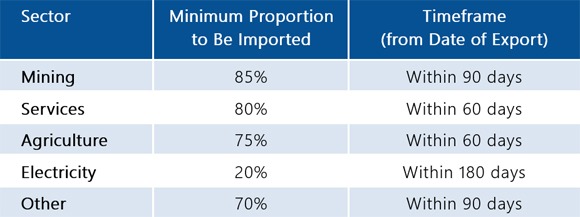
The ratios and timeframes are subject to change depending on the circumstances. If exporters cannot comply with the required ratio and timeline, exporters must provide relevant explanatory documents for the BOL’s consideration.

Selling Foreign-Currency Income

Exporters of goods and services must sell at least the minimum required proportion of their foreign-currency income (see table below) to a commercial bank in Laos. This foreign currency exchange must occur within three working days of receiving the foreign currency into the dedicated bank account in Laos. The selling rate will be determined by the prevailing rate of the commercial bank on the day of the transaction.
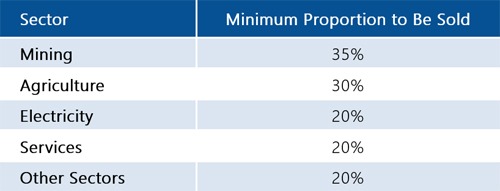
In conducting these transactions, commercial banks are required to carefully consider and manage their reserves and overall liquidity to ensure that they can meet public demand.

If an exporter does not sell at least the minimum required amount of foreign currency within three working days, the relevant commercial bank must proceed with the minimum required exchange and notify the exporter that they are doing so.

These requirements do not apply to re-exporters, such as importers of unprocessed raw materials for re-export to other countries, as determined by the Department of Foreign Currency Management (DFCM).

After selling the minimum required amount to a commercial bank, the remaining foreign-currency income must be used for foreign-currency exchange purposes, such as payments to parties in foreign countries, fulfilling obligations to the state, and so on.

Exporters can sell foreign currency to the BOL by notifying it of the need to sell the foreign currency to the DFCM in the BOL, after which they can sell the currency to the BOL through a commercial bank.

Registration

Decision No. 333 requires service exporters to register as importers and exporters to bring in income generated from exporting services. Although it doesn’t specify the types of service businesses that need to register, a March 2024 notice from the Ministry of Industry and Commerce offers examples of such businesses, including those in international transport, insurance, tourism and hotels, construction, and consulting.

Violations

First-time violations of Decision No. 333 that do not cause damage are subject to training on the importance of complying with Lao law or a warning. If the violation persists after the training or warning, the violator will face suspension of its ability to export goods and services.

For more information on Decision No. 333, or on any aspect of foreign currency management in Laos, please contact Tilleke & Gibbins at [email protected].

RELATED INSIGHTS​ 

September 8, 2022
Thailand’s Trade Competition Commission has amended the guidelines prohibiting large purchasers from setting unfair credit terms for small and medium-sized enterprises (SMEs). The new guidelines, which were published in the Government Gazette on August 17, 2022, revise the definition of SMEs and clarify the duties of concerned parties. The original guidelines, which took effect in December 2021, set a favorable maximum period for credit terms for SMEs selling products or services to a third-party purchaser. Prescribing longer credit terms than the mandatory period would constitute an unfair trade practice in violation of the Trade Competition Act B.E. 2560 (2017). In defining what businesses are considered SMEs, the guidelines set thresholds for the number of employees and amount of annual turnover. The amended guidelines maintain these thresholds, but the new guidelines require that both employee-number and turnover thresholds be met in order for a business to be considered an SME. In contrast, the original guidelines only required either the employee-number threshold or the turnover threshold to be met. This amendment will likely mean that fewer business operators qualify as SMEs. Accordingly, two types of businesses are defined as SMEs under the guidelines: Manufacturers of goods with up to 200 employees and an annual turnover of no more than THB 500 million (approximately USD 13.5 million); or Service providers or wholesale or retail businesses with up to 100 employees and an annual turnover of no more than THB 300 million (approximately USD 8.1 million). To benefit from protection under the new guidelines against unfair credit terms, SMEs must provide documents proving the number of employees and the amount of annual turnover to trade partners that purchase goods or services from them. The new guidelines come into force on September 16, 2022. For more information on the unfair credit term guidelines, or
August 26, 2022
Thailand’s Board of Investment (BOI) has extended its previously announced period for reduction of import duty on imported raw and essential materials for battery manufacturing for electric vehicles and other applications. The BOI’s announcement No. 5/2565 dated August 8, 2022, extended the reduction period to a maximum of five years. The BOI’s promoted activities list includes two battery-manufacturing business activities: Activity 4.8.3.1 – Battery manufacturing Activity 5.2.6.1 – High energy density battery manufacturing Qualifying battery manufacturers who have cell or module manufacturing processes are eligible for 90% import duty reductions on raw and essential materials that cannot be produced in Thailand. These reductions will be available on an annual basis, and are renewable for five years in total—up from the original two years. Existing projects (i.e., those which have the original two-year duration in their BOI certificate) can also benefit from the extension by preparing a project amendment form, along with a clarification letter and supporting documents, for submission to the BOI office. For more details on these customs duty reductions, or on any aspect of investment promotion in Thailand, please contact Charuwan Charoonchitsathian at [email protected] or +66 2056 5657, or Napassorn Lertussavavivat at [email protected] or +66 2056 5662.
August 25, 2022
On July 27, 2022, Myanmar’s Ministry of Commerce (MOC) issued Newsletter No. 8/2022 to effectively ban foreign companies and foreign joint ventures from exporting value-added beans, corn, and sesame. This newsletter repealed Newsletter No. 2/2020, which had prescribed the criteria for beans, corn, and sesame to be considered “value-added” crops. These criteria had to be fulfilled in order for these commodities to be exported in accordance with Notification No. 24/2019, which had permitted foreign companies and foreign joint ventures to purchase seven categories of commodities from local manufacturers for export, subject to certain terms and conditions. These include: Meat and fish; Value-added crops; Pulp and paper; Seeds; Refined metals; Semi-finished or finished valued-added fruit products; and Timber-based furniture. With the repeal of the conditions in Newsletter No. 2/2020, foreign exporters are left with no reference criteria for how to achieve “value-added” status for beans, corn, and sesame, and thus will not be able to submit a complete application for the necessary export license. However, exportation of the other items in the list above remains unaffected and open to foreign exporters who meet the applicable requirements. The MOC explained their decision to revoke the permitted criteria by noting that some foreign companies were not actually producing beans, corn, and sesame that fulfilled the criteria for value-added status as laid out in Newsletter No. 2/2020, but were falsely exporting their goods as “value-added crops.” The revocation of the export criteria for beans, corn, and sesame took immediate effect. For more details on these export restrictions, or on any aspect of importation and exportation regulations in Myanmar, please contact Tilleke & Gibbins at [email protected].
August 11, 2022
On August 5, 2022, the Central Bank of Myanmar (CBM) adjusted the country’s official reference exchange rates. The new rate for US dollars is USD 1 to MMK 2,100—up from the previous rate of USD 1 to MMK 1,850. Authorized dealer (AD) banks (i.e., those licensed to exchange foreign currency) were to begin using the updated rates that same day, in accordance with Myanmar’s requirement to convert foreign currency transfers and balances to local currency using the official CBM rates. In addition, the CBM issued Notification No. 36/2022 to clarify its foreign currency conversion requirement for exporters. The notification specifies that only 65 percent of income received from exportation needs to be converted into MMK within one day. An analysis of the regulations laying out the currency conversion requirements mentioned above suggests that the remaining 35 percent of export earnings balance will be converted into MMK if exporters do not use it within 30 days. Noncompliance with the requirements of Notification No. 36/2022 is punishable under the Foreign Exchange Management Law with imprisonment for up to one year, a fine, or both. For more details on these foreign exchange developments, or on any aspect of financial regulations in Myanmar, please contact Tilleke & Gibbins at [email protected].