
You are using an outdated browser and your browsing experience will not be optimal. Please update to the latest version of Microsoft Edge, Google Chrome or Mozilla Firefox. Install Microsoft Edge

June 7, 2024

Laos Regulates Management of Foreign Currency from Exports

On March 7, 2024, Laos moved to regulate the management of foreign-currency income from the exportation of goods and services. Effective March 29, 2024, Decision No. 333 (formally the Decision on Management of Income in Foreign Currency from Exportation of Goods and Services No. 333/BOL) from the Bank of Lao PDR (BOL) aims to incentivize the inflow of such foreign currency into Laos and its sale to licensed commercial banks.

Decision No. 333 sets minimum required proportions for importing income in foreign currency derived from the exportation of goods and services, as well as the timeframe for doing so. It also stipulates the requirements for selling such foreign currency to commercial banks in Laos and the minimum proportions that must be sold.

Importing Foreign-Currency Income

Exporters must receive payments from abroad via bank transfer into a dedicated bank account designated for import-export business activities within the timeline specified in the sale-purchase agreement, but not exceeding 180 days from the date of export. Each sector must import income in foreign currency into the Lao PDR according to the minimum proportion of currency to be imported, and it must be done within the required timeframes, as specified in the table below.
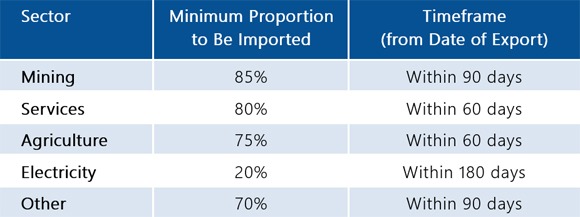
The ratios and timeframes are subject to change depending on the circumstances. If exporters cannot comply with the required ratio and timeline, exporters must provide relevant explanatory documents for the BOL’s consideration.

Selling Foreign-Currency Income

Exporters of goods and services must sell at least the minimum required proportion of their foreign-currency income (see table below) to a commercial bank in Laos. This foreign currency exchange must occur within three working days of receiving the foreign currency into the dedicated bank account in Laos. The selling rate will be determined by the prevailing rate of the commercial bank on the day of the transaction.
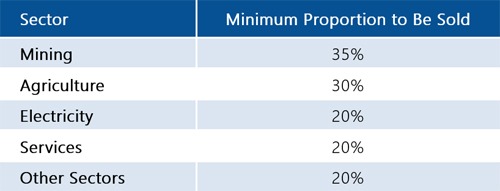
In conducting these transactions, commercial banks are required to carefully consider and manage their reserves and overall liquidity to ensure that they can meet public demand.

If an exporter does not sell at least the minimum required amount of foreign currency within three working days, the relevant commercial bank must proceed with the minimum required exchange and notify the exporter that they are doing so.

These requirements do not apply to re-exporters, such as importers of unprocessed raw materials for re-export to other countries, as determined by the Department of Foreign Currency Management (DFCM).

After selling the minimum required amount to a commercial bank, the remaining foreign-currency income must be used for foreign-currency exchange purposes, such as payments to parties in foreign countries, fulfilling obligations to the state, and so on.

Exporters can sell foreign currency to the BOL by notifying it of the need to sell the foreign currency to the DFCM in the BOL, after which they can sell the currency to the BOL through a commercial bank.

Registration

Decision No. 333 requires service exporters to register as importers and exporters to bring in income generated from exporting services. Although it doesn’t specify the types of service businesses that need to register, a March 2024 notice from the Ministry of Industry and Commerce offers examples of such businesses, including those in international transport, insurance, tourism and hotels, construction, and consulting.

Violations

First-time violations of Decision No. 333 that do not cause damage are subject to training on the importance of complying with Lao law or a warning. If the violation persists after the training or warning, the violator will face suspension of its ability to export goods and services.

For more information on Decision No. 333, or on any aspect of foreign currency management in Laos, please contact Tilleke & Gibbins at [email protected].

RELATED INSIGHTS​ 

August 4, 2022
Cosmetics have become an essential feature of the modern lifestyle led by many consumers in Cambodia. Every day, a wide range of new cosmetic brands, variants, and formats enter the Cambodian market, catering to a growing consumer base. The market generally relies on the import of foreign cosmetic brands, making Cambodia an attractive market for overseas cosmetics companies, but local brands are on the rise as well. Alongside the significant growth of the cosmetics market in Cambodia, and the Royal Government’s continuing push to increase consumer protection in Cambodia, in 2022, the Ministry of Commerce (MOC) issued Prakas No. 0064 on the Requirements for Cosmetic Distribution (the Prakas). The Prakas applies to both locally manufactured and imported cosmetics, and both individual and businesses that trade in cosmetics. The Prakas aims to regulate cosmetics and cosmetic business activities, to ensure that cosmetics distributed in Cambodia are of good quality and safe for use.  The key points contained in the Prakas are summarized below. Legal Obligations for Trading Cosmetics Any person trading in cosmetics, including wholesale or retail, and those that offer cosmetics as gifts or for testing, must ensure that the products are safe and meet the legal labelling requirements. Anyone trading cosmetics must respect the Law on Consumer Protection, with the Prakas highlighting key aspects of that law and referring to the applicable penalties under that law. Online sellers of cosmetics must obtain an additional approval letter (for individuals) or a license (for legal entities) to operate an online business, issued by the MOC. In addition, they require a certificate for providing online services from the Ministry of Post and Telecommunications. Interestingly, the Prakas does not refer to the cosmetic business licensing required under regulations issued by the Ministry of Health. As the Prakas does not outright contradict these
July 25, 2022
Vietnam’s current Law on E-Transactions was passed in 2005 and has been effective since March 1, 2006. This law is considered a framework law, developed based on the Model Law on E-Commerce of the United Nations Commission on International Trade Law (UNCITRAL). According to the Ministry of Information and Communications (MIC), over the past 17 years, the implementation and application of e-transactions has shown significant evolution in certain areas demanding high levels of international integration, such as banking and e-commerce, but has faced difficulties in other areas due to a lack of detailed guidance. In addition, with the strong growth and breakthrough development of digital technologies such as artificial intelligence, big data, biometrics, and blockchain, and in the context of the ongoing Industrial Revolution 4.0 and the development of digital government, digital economy, and digital society, the 2005 Law on E-Transactions has revealed its shortcomings. Therefore, the government of Vietnam has entrusted the MIC to take the lead in drafting a new Law on E-Transactions, which will replace the old 2005 law in order to meet the country’s development needs. Accordingly, the MIC published a Draft Law on E-Transactions (“Draft Law”) for public consultation from May 4 to July 4, 2022. The latest accessible version of the Draft Law at the time of writing is Version 4. The effective date of the Draft Law is still not yet determined, though this law is expected to be submitted to the National Assembly for its review and comments in October 2022 and approval in May 2023. The following are some key contents of the Draft Law: 1. Scope of Application Unlike the current law, which explicitly excludes certain areas such as the issuance of certificates of land use rights and marriage certificates from the scope of application, the Draft Law attempts
July 19, 2022
On June 23, 2022, Thailand’s Securities and Exchange Commission (SEC) opened a public hearing period on regulatory controls for initial coin offering (ICO) portals that serve as financial advisors to digital token issuers. The proposed measures aim to prevent conflicts of interest; allow ICO portals to outsource certain functions; and establish additional notification obligations for ICO portals. The public hearing is open for general comments until July 23, 2022, and the new legislation is expected to be issued soon after that. During the public hearing period, any interested parties can comment on the SEC’s proposed principles. The key proposed points are outlined below. Conflicts of Interest Similar to SEC-approved financial advisors for securities offerings, ICO portals must be clear of conflicts of interest when representing issuers in a coin offering. According to the draft regulation, the following conflicts of interest are prohibited: The ICO portal (and certain individuals as specified by the SEC) directly or indirectly holds a prohibited amount of shares in the issuer, its affiliates, or its subsidiaries. If the issuer is not a listed company, any shareholding or portion thereof is prohibited. If the issuer is a listed company on the Stock Exchange of Thailand (SET), the shares held by the ICO platform may not total more than five percent of the total voting rights. The issuer (and certain individuals as specified by the SEC) directly or indirectly holds shares in the ICO portal in any amount if the ICO portal is not a listed company, or totaling more than five percent of the voting rights if the ICO portal is listed on the SET. Any of the ICO portal’s directors or executives, or the head of the department responsible for screening the ICO project, is also a director in the issuer. The ICO portal has
July 18, 2022
On July 15, 2022, the Central Bank of Myanmar (CBM) issued Letter No. FE-1/754 instructing banks with authorized dealer (AD) status to inform the CBM of the balances in foreign-currency accounts belonging to Myanmar companies with up to 35% foreign ownership. This was to be done by 6 p.m. on the same day. In addition, AD banks were ordered to purchase the balances of the relevant foreign-currency accounts and exchange the amounts with Myanmar kyat (MMK). These amounts are to be entered into the bank-customer (bid) and non-trade inward (real time-R) lists by 6 p.m. on July 18, 2022. The letter also warned that the failure to follow this instruction would be subject to various sanctions, including warnings, restriction of foreign exchange management functions, fines, temporary or permanent suspension of banking authorizations, and cancellation of business licenses. Letter No. FE-1/754 followed a decision made by the Foreign Exchange Supervisory Committee in meeting No. 32/2002 requiring foreign-currency balances held in accounts of Myanmar companies with up to 35% foreign ownership to be converted into MMK. A list of these companies, provided by the Foreign Exchange Supervisory Committee, was included with the letter. For more details on these foreign exchange developments, or on any aspect of financial regulations in Myanmar, please contact Tilleke & Gibbins at [email protected].