
You are using an outdated browser and your browsing experience will not be optimal. Please update to the latest version of Microsoft Edge, Google Chrome or Mozilla Firefox. Install Microsoft Edge

June 7, 2024

Laos Regulates Management of Foreign Currency from Exports

On March 7, 2024, Laos moved to regulate the management of foreign-currency income from the exportation of goods and services. Effective March 29, 2024, Decision No. 333 (formally the Decision on Management of Income in Foreign Currency from Exportation of Goods and Services No. 333/BOL) from the Bank of Lao PDR (BOL) aims to incentivize the inflow of such foreign currency into Laos and its sale to licensed commercial banks.

Decision No. 333 sets minimum required proportions for importing income in foreign currency derived from the exportation of goods and services, as well as the timeframe for doing so. It also stipulates the requirements for selling such foreign currency to commercial banks in Laos and the minimum proportions that must be sold.

Importing Foreign-Currency Income

Exporters must receive payments from abroad via bank transfer into a dedicated bank account designated for import-export business activities within the timeline specified in the sale-purchase agreement, but not exceeding 180 days from the date of export. Each sector must import income in foreign currency into the Lao PDR according to the minimum proportion of currency to be imported, and it must be done within the required timeframes, as specified in the table below.
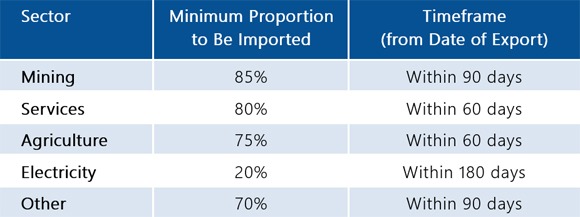
The ratios and timeframes are subject to change depending on the circumstances. If exporters cannot comply with the required ratio and timeline, exporters must provide relevant explanatory documents for the BOL’s consideration.

Selling Foreign-Currency Income

Exporters of goods and services must sell at least the minimum required proportion of their foreign-currency income (see table below) to a commercial bank in Laos. This foreign currency exchange must occur within three working days of receiving the foreign currency into the dedicated bank account in Laos. The selling rate will be determined by the prevailing rate of the commercial bank on the day of the transaction.
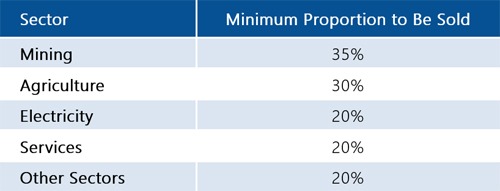
In conducting these transactions, commercial banks are required to carefully consider and manage their reserves and overall liquidity to ensure that they can meet public demand.

If an exporter does not sell at least the minimum required amount of foreign currency within three working days, the relevant commercial bank must proceed with the minimum required exchange and notify the exporter that they are doing so.

These requirements do not apply to re-exporters, such as importers of unprocessed raw materials for re-export to other countries, as determined by the Department of Foreign Currency Management (DFCM).

After selling the minimum required amount to a commercial bank, the remaining foreign-currency income must be used for foreign-currency exchange purposes, such as payments to parties in foreign countries, fulfilling obligations to the state, and so on.

Exporters can sell foreign currency to the BOL by notifying it of the need to sell the foreign currency to the DFCM in the BOL, after which they can sell the currency to the BOL through a commercial bank.

Registration

Decision No. 333 requires service exporters to register as importers and exporters to bring in income generated from exporting services. Although it doesn’t specify the types of service businesses that need to register, a March 2024 notice from the Ministry of Industry and Commerce offers examples of such businesses, including those in international transport, insurance, tourism and hotels, construction, and consulting.

Violations

First-time violations of Decision No. 333 that do not cause damage are subject to training on the importance of complying with Lao law or a warning. If the violation persists after the training or warning, the violator will face suspension of its ability to export goods and services.

For more information on Decision No. 333, or on any aspect of foreign currency management in Laos, please contact Tilleke & Gibbins at [email protected].

RELATED INSIGHTS​ 

June 2, 2023
In April 2022, Myanmar’s State Administration Council established the Foreign Exchange Supervisory Committee (FESC) to approve foreign currency conversion, make exemptions to foreign exchange restrictions, and permit overseas foreign currency transfers. Because of the FESC’s establishment and related regulatory changes, companies that would like to transfer funds out of Myanmar for capital reduction, share capital for liquidated companies, share transfers, or share dividends must abide by the FESC’s requirements, which vary depending on the type of company. The Myanmar Investment Commission (MIC) has announced that companies permitted by or endorsed under the Myanmar Investment Law must submit various supporting documents when applying to transfer foreign currency internationally. These documents, which must be addressed to the MIC chairman, include the following: Prescribed form for transfer of foreign currency; Application letter giving a specific reason for the transfer; Original board of directors’ resolution; Audited financial statements for the relevant financial year; Up-to-date bank statement of the company; Tax assessment confirmation letter for the relevant financial year; Tax clearance certificate for the relevant financial year, in the case of liquidated companies; and Copy of the updated quarterly performance report using the form prescribed by the MIC. If the transferor cannot submit the documents in person, the required documents need to be accompanied by a power-of-attorney or appointment-of-representative letter. Though the FESC has not announced its own documentation requirements, experience shows that MIC companies must submit an application to the MIC Investment Monitoring Division before submitting their offshore remittance application to the FESC. Once the MIC has received a complete application, it will request a recommendation from the Central Bank of Myanmar (CBM). With this recommendation in hand, the Investment Monitoring Department will then seek FESC approval internally. Aside from MIC companies, DICA companies (i.e., companies that do not require approval from the
May 23, 2023
Life sciences specialists at Tilleke & Gibbins’ office in Bangkok have contributed a new “Life Sciences Commercialization in Thailand” chapter to the Life Sciences Global Guide from Practical Law. The Q&A-style guide provides strategic information for companies active in the life sciences sector in Thailand. The chapter covers a number of key areas: Overview of the life sciences sector Pricing, government funding, and reimbursement: National health care system, price regulation and reimbursement Distribution and sale Cross-border trade and parallel imports Advertising and engagement with patient organizations Patents: Conditions for patentability, registration, length of protection, infringement, international treaties Trademarks: Requirements, registration Competition law issues: Authorities and legislation, commercial contracts and competition law, licensing approvals and formalities Product liability: Regulators, medicinal product liability law, liable partners, defenses, product liability claims, remedies Practical Law, produced by Thomson Reuters, is the world’s leading legal know-how resource for business lawyers, publishing a huge range of guides covering hundreds of jurisdictions and practice areas. The full “Life Sciences Commercialization in Thailand” section can be found on the Practical Law website.
May 16, 2023
On April 25, 2023, Myanmar’s Ministry of Planning and Finance issued a standard operating procedure (SOP) requiring entities and individuals remitting foreign currency equivalent to more than USD 10,000 out of Myanmar to clear their tax payments prior to the remittance. The SOP took effect on May 1, 2023. This is the latest development since Myanmar began imposing restrictions in April 2022 on the remittance of foreign currency out of the country, implemented by the Central Bank of Myanmar and the Foreign Currency Supervisory Committee. The SOP requires the remitters described above to obtain certain documents evidencing payment of all requisite taxes and duties, and to submit them to their licensed authorized dealer (AD) bank as part of the remittance process. The documents required as evidence differ depending on the purpose of the remittance. The SOP details three main categories, as summarized below. Payments for Interest, Royalties, Trademarks, Copyrights, or Services A remitter of foreign currency for payment of interest, royalties, trademarks, copyrights, or services, must first apply to the Internal Revenue Department (IRD) for evidence that all applicable withholding tax has been paid. In addition, if the country to which the payments are being remitted is party to an avoidance of double taxation agreement with Myanmar, evidence of the recipient’s tax residency must also be submitted to the AD bank. Payments for Goods A remitter of foreign currency to pay for goods must submit the necessary IRD forms along with evidence that corporate income tax and other applicable taxes have been paid. Evidence may include a tax clearance certificate for the fiscal year, the company name, the taxpayer name, and the taxpayer identification number (TIN). Salary Payments A person remitting, in foreign currency, salary earned in Myanmar must submit the required form showing that they paid income tax
April 21, 2023
In the context of low investor confidence in the bond market due to recent negative news and the difficulties in cash flow of bond issuers, especially those in the real estate and banking sectors, the government of Vietnam has taken action to address legal bottlenecks in order for the bond market to recover and develop sustainably. In contrast to the gentle hand offered to bond issuers shouldering the debts of corporate bonds, a more stringent approach is being applied to bond purchases by banks. This is being done to mitigate the negative impact of the bond market on Vietnam’s banking health. New Decree Loosens Requirements for Bond Issuers On March 5, 2023, the government promulgated Decree No. 08/2023/ND-CP (“Decree 08”), which took effect immediately, loosening requirements for bond issuers. The key changes under Decree 08 include the following: 1. Ability to negotiate repayment of bonds with in-kind payment: For corporate bonds in the domestic market, Decree 08 allows the bond issuer to negotiate with bondholders to make payment in assets other than cash if the bond issuer is unable to make full and timely payments of bond principal and coupon in VND according to the announced bond issuance plan. There are certain conditions which must be satisfied, such as bondholders’ consent, disclosure of the changes, and legal status of the assets used for payment (e.g., title, encumbrances, and material agreements involving the assets). 2. Ability to change terms and conditions of bonds: Previously, while, bond issuers were able to change the terms (such as extension of the term or use purpose of the bond proceeds) for corporate bonds issued after September 16, 2022, they were not allowed to do so for older corporate bonds. Now, Decree 08 allows the bond issuers to change the terms and conditions of the