
You are using an outdated browser and your browsing experience will not be optimal. Please update to the latest version of Microsoft Edge, Google Chrome or Mozilla Firefox. Install Microsoft Edge

June 7, 2024

Laos Regulates Management of Foreign Currency from Exports

On March 7, 2024, Laos moved to regulate the management of foreign-currency income from the exportation of goods and services. Effective March 29, 2024, Decision No. 333 (formally the Decision on Management of Income in Foreign Currency from Exportation of Goods and Services No. 333/BOL) from the Bank of Lao PDR (BOL) aims to incentivize the inflow of such foreign currency into Laos and its sale to licensed commercial banks.

Decision No. 333 sets minimum required proportions for importing income in foreign currency derived from the exportation of goods and services, as well as the timeframe for doing so. It also stipulates the requirements for selling such foreign currency to commercial banks in Laos and the minimum proportions that must be sold.

Importing Foreign-Currency Income

Exporters must receive payments from abroad via bank transfer into a dedicated bank account designated for import-export business activities within the timeline specified in the sale-purchase agreement, but not exceeding 180 days from the date of export. Each sector must import income in foreign currency into the Lao PDR according to the minimum proportion of currency to be imported, and it must be done within the required timeframes, as specified in the table below.
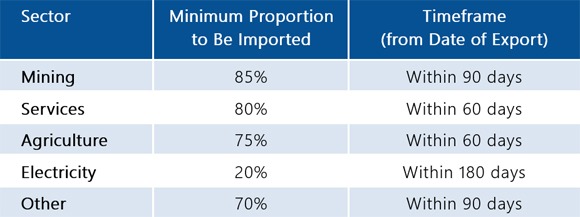
The ratios and timeframes are subject to change depending on the circumstances. If exporters cannot comply with the required ratio and timeline, exporters must provide relevant explanatory documents for the BOL’s consideration.

Selling Foreign-Currency Income

Exporters of goods and services must sell at least the minimum required proportion of their foreign-currency income (see table below) to a commercial bank in Laos. This foreign currency exchange must occur within three working days of receiving the foreign currency into the dedicated bank account in Laos. The selling rate will be determined by the prevailing rate of the commercial bank on the day of the transaction.
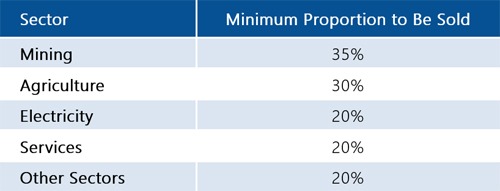
In conducting these transactions, commercial banks are required to carefully consider and manage their reserves and overall liquidity to ensure that they can meet public demand.

If an exporter does not sell at least the minimum required amount of foreign currency within three working days, the relevant commercial bank must proceed with the minimum required exchange and notify the exporter that they are doing so.

These requirements do not apply to re-exporters, such as importers of unprocessed raw materials for re-export to other countries, as determined by the Department of Foreign Currency Management (DFCM).

After selling the minimum required amount to a commercial bank, the remaining foreign-currency income must be used for foreign-currency exchange purposes, such as payments to parties in foreign countries, fulfilling obligations to the state, and so on.

Exporters can sell foreign currency to the BOL by notifying it of the need to sell the foreign currency to the DFCM in the BOL, after which they can sell the currency to the BOL through a commercial bank.

Registration

Decision No. 333 requires service exporters to register as importers and exporters to bring in income generated from exporting services. Although it doesn’t specify the types of service businesses that need to register, a March 2024 notice from the Ministry of Industry and Commerce offers examples of such businesses, including those in international transport, insurance, tourism and hotels, construction, and consulting.

Violations

First-time violations of Decision No. 333 that do not cause damage are subject to training on the importance of complying with Lao law or a warning. If the violation persists after the training or warning, the violator will face suspension of its ability to export goods and services.

For more information on Decision No. 333, or on any aspect of foreign currency management in Laos, please contact Tilleke & Gibbins at [email protected].

RELATED INSIGHTS​ 

March 20, 2023
Thailand has enacted new legislation to counter cybercrime and scams. The Royal Decree on Measures for Protection and Suppression of Technology Crimes B.E. 2566 (2023) (“Cybercrime Decree”) was published in the Government Gazette on March 16, 2023, and took effect the following day. The Cybercrime Decree provides a new legal tool to interrupt the money-laundering process and aims to crack down on cybercrime perpetrators and scammers by providing stronger legal measures applying to certain types of offenders that had not been sufficiently covered by existing laws. This new legislation grants victims the right to have commercial banks and online payment platforms freeze suspicious transactions and obligates these banks and platforms to comply with such requests. It further requires these banks and platforms—as well as other service providers—to share data for the prompt prevention and suppression of cybercrime. The key rights, duties, and offenses established by the Cybercrime Decree are detailed below. Freezing Transactions The Cybercrime Decree requires commercial banks and online payment platforms to temporarily freeze (for 72 hours) any related transactions of their account holders upon receipt of an alert from the account holder that he or she is the victim of cybercrime. Victims can report these illicit transactions by phone or electronic means. If by phone, the relevant bank or platform must document the call. The victim must file a police complaint about the illicit transaction within 72 hours of the freeze being made. A police inquiry officer will then notify the bank or platform about the complaint, and the transaction freeze must be maintained for seven days from the filing of the complaint with the police. The police will then determine whether it is necessary to keep the transaction frozen for longer than seven days. If the seven days lapse without a further order to freeze the
February 10, 2023
On January 16, 2023, Thailand’s Securities and Exchange Commission (SEC) prescribed a set of security measures that digital asset business operators must implement if they provide custody of digital assets for their customers. The new security measures are prescribed in two notifications from the SEC and its office on digital asset wallet management systems and cryptographic key management systems, with the aim of safeguarding digital assets in custody against loss, fraud, and cybertheft. The notifications took immediate effect. The new security measures and the management systems are summarized below. Policy and guidelines for managing systems related to digital asset custody Digital asset business operators must have a written risk management policy for all systems relating to digital asset custody, approved by their board of directors and made accessible to all employees. The policy must be reviewed or revised at least once annually, or promptly if any potential risks are identified. Specific procedures must be implemented, such as establishment of a compliance team and internal controls. Management of systems for digital asset wallets and cryptographic keys Digital asset business operators must have policies and procedures for managing all systems relating to digital asset custody. This includes properly designing, developing, and managing digital asset wallets in a safe and secure manner. The same requirement on policies and procedures applies to cryptographic key management as well. Management of incidents that may affect systems related to digital asset custody Digital asset business operators must have measures in place to manage incidents that may impact systems related to digital asset custody. The measures include designating a person responsible for incident management, testing and reviewing the incident management policy annually, reporting any incidents affecting digital asset custody to the designated responsible person and the SEC immediately, and conducting a digital forensic investigation with an independent
January 26, 2023
On December 30, 2022, the Central Bank of Myanmar (CBM) updated its guidelines on the Thai baht to Myanmar kyat (THB-MMK) direct payment mechanism for Myanmar-Thailand border trade and other flows of capital. The CBM’s guidelines outline an expanded mechanism allowing more trade gates and more designated banks, stipulating banking arrangements for worker remittances, setting out a payment mechanism for exports, clarifying procedures for importing goods via the Myanmar-Thailand border trade, and instituting new reporting procedures. The THB-MMK mechanism came into being on March 3, 2022, as a pilot project for border trade in Myawaddy, Tachileik, and other areas approved by Myanmar’s Central Committee on Ensuring Smooth Flow of Trade and Goods. In this update, Myawaddy, Tachileik, Myeik, Kawthoung, Mawtaung, and other approved border trading zones are identified as open to the THB-MMK mechanism. During 2022, the following banks were approved to provide services for the THB-MMK direct payment mechanism: Approved March 4: Ayeyarwaddy Farmers Development Bank and Kasikornbank Public Company Limited Approved July 29: Myanmar Economic Bank and Bangkok Bank Public Company Limited (Yangon branch) Approved August 12: Kanbawza Bank (KBZ) and Bangkok Bank Public Company Limited (Yangon branch) Approved December 30: Ayeyarwady Bank and Bangkok Bank Public Company Limited (Yangon branch), CB Bank PCL and Bangkok Bank Public Company Limited (Yangon branch), UAB Bank and Krung Thai Public Company Limited, Myanmar Apex Bank and Siam Commercial Bank Myanmar Limited, Yoma Bank and Siam Commercial Bank Myanmar Limited Banking arrangements for workers’ remittances were also stipulated in the new update. In this regard, designated banks can process these remittances by partnering with CBM-permitted international currency transfer businesses, mobile banking service providers, and mobile money service providers after obtaining approval from the CBM. An addition to the direct payment mechanism is a requirement that exporters manage their received export
January 24, 2023
The Contract Committee of Thailand’s Consumer Protection Board has issued new requirements and prohibitions for consumer loan agreements. The Notification of the Contract Committee Re: Stipulation of Loan Business for Consumers as a Contract-Controlled Business B.E. 2565 (2022) was published in the Government Gazette on December 13, 2022, and will take effect after 90 days (i.e., on March 13, 2023). The notification repeals and replaces the Contract Committee’s previous notifications regarding the same subject matter, which were issued in 2001 (Nos. 1–2), 2002 (No. 3), and 2015 (No. 4). The notification enhances protection for consumers by extending the scope of application and stringently regulating the content of agreements for loans to individual consumers. Key Definitions The scope of the notification is largely indicated by its definitions of a few key terms: “Loan business for consumers” refers to a business in which the operator enters into an agreement to grant a loan to a consumer (i.e., not a juristic person) or to allow the consumer to borrow money from the business operator, whereby the consumer will spend money for a purpose other than their occupation or business to earn income. This includes granting loans to consumers through an electronic channel. The notification can also apply to personal loan businesses, digital loan businesses, and peer-to-peer lending businesses regulated by the Bank of Thailand. “Business operators” include financial institutions under the law relating to financial institutions; banks established under specific laws; individuals who carry out a loan business in their ordinary course of business; and juristic persons that engage in loan business, securitization business, or asset management of rights to monetary claim. Certain types of businesses and organizations—such as cooperatives—are excluded from the scope of this notification. “Interest” means legal interest in accordance with the Civil and Commercial Code, and it includes