
You are using an outdated browser and your browsing experience will not be optimal. Please update to the latest version of Microsoft Edge, Google Chrome or Mozilla Firefox. Install Microsoft Edge

June 7, 2024

Laos Regulates Management of Foreign Currency from Exports

On March 7, 2024, Laos moved to regulate the management of foreign-currency income from the exportation of goods and services. Effective March 29, 2024, Decision No. 333 (formally the Decision on Management of Income in Foreign Currency from Exportation of Goods and Services No. 333/BOL) from the Bank of Lao PDR (BOL) aims to incentivize the inflow of such foreign currency into Laos and its sale to licensed commercial banks.

Decision No. 333 sets minimum required proportions for importing income in foreign currency derived from the exportation of goods and services, as well as the timeframe for doing so. It also stipulates the requirements for selling such foreign currency to commercial banks in Laos and the minimum proportions that must be sold.

Importing Foreign-Currency Income

Exporters must receive payments from abroad via bank transfer into a dedicated bank account designated for import-export business activities within the timeline specified in the sale-purchase agreement, but not exceeding 180 days from the date of export. Each sector must import income in foreign currency into the Lao PDR according to the minimum proportion of currency to be imported, and it must be done within the required timeframes, as specified in the table below.
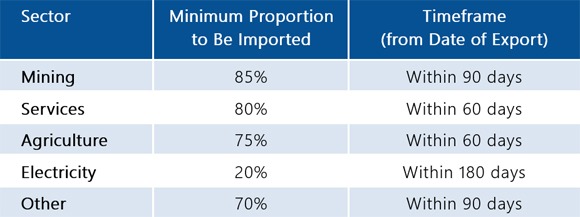
The ratios and timeframes are subject to change depending on the circumstances. If exporters cannot comply with the required ratio and timeline, exporters must provide relevant explanatory documents for the BOL’s consideration.

Selling Foreign-Currency Income

Exporters of goods and services must sell at least the minimum required proportion of their foreign-currency income (see table below) to a commercial bank in Laos. This foreign currency exchange must occur within three working days of receiving the foreign currency into the dedicated bank account in Laos. The selling rate will be determined by the prevailing rate of the commercial bank on the day of the transaction.
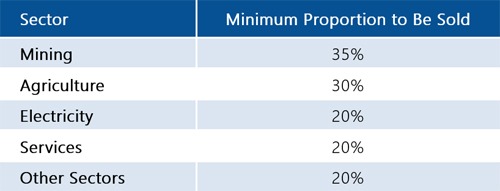
In conducting these transactions, commercial banks are required to carefully consider and manage their reserves and overall liquidity to ensure that they can meet public demand.

If an exporter does not sell at least the minimum required amount of foreign currency within three working days, the relevant commercial bank must proceed with the minimum required exchange and notify the exporter that they are doing so.

These requirements do not apply to re-exporters, such as importers of unprocessed raw materials for re-export to other countries, as determined by the Department of Foreign Currency Management (DFCM).

After selling the minimum required amount to a commercial bank, the remaining foreign-currency income must be used for foreign-currency exchange purposes, such as payments to parties in foreign countries, fulfilling obligations to the state, and so on.

Exporters can sell foreign currency to the BOL by notifying it of the need to sell the foreign currency to the DFCM in the BOL, after which they can sell the currency to the BOL through a commercial bank.

Registration

Decision No. 333 requires service exporters to register as importers and exporters to bring in income generated from exporting services. Although it doesn’t specify the types of service businesses that need to register, a March 2024 notice from the Ministry of Industry and Commerce offers examples of such businesses, including those in international transport, insurance, tourism and hotels, construction, and consulting.

Violations

First-time violations of Decision No. 333 that do not cause damage are subject to training on the importance of complying with Lao law or a warning. If the violation persists after the training or warning, the violator will face suspension of its ability to export goods and services.

For more information on Decision No. 333, or on any aspect of foreign currency management in Laos, please contact Tilleke & Gibbins at [email protected].

RELATED INSIGHTS​ 

August 17, 2023
On August 14, 2023, the Central Bank of Myanmar (CBM) approved the Thai baht (THB) as a permissible currency for international payments and settlement transactions. This announcement, which took immediate effect with the issuance of CBM Instruction No. 11/2023, reduces currency conversion complications for Thai businesses and investors in Myanmar. Under Myanmar’s current rules requiring conversion of foreign currency transfers and balances to local currency—in place since April 3, 2022—the US dollar (USD) is used for international payment and settlement transactions and must be converted at the official exchange rate (currently USD 1 to MMK 2,100). Subsequently, the CBM instituted a direct payment mechanism allowing THB to MMK conversion for Myanmar-Thailand border trade and other flows of capital. The CBM’s latest announcement now permits international payments and settlement transactions in THB through authorized dealer banks. Business owners and investors using THB for international payments are still required to obtain prior approval from the Foreign Exchange Supervisory Committee (FESC), the body overseeing foreign exchange and conversion matters in Myanmar. Capital-related transactions using THB also still require approval from the CBM before applying for approval from the FESC. For more details on these THB-MMK payment systems, or on any aspect of foreign exchange regulations in Myanmar, please contact Tilleke & Gibbins at [email protected].
August 17, 2023
Attorneys from Tilleke & Gibbins’ offices in Vietnam have provided the Vietnam chapter for the Aviation Finance & Leasing 2023 guide from Chambers and Partners. The guide covers the most important legal developments affecting aircraft lessors, lessees, and financiers in 32 jurisdictions worldwide. In addition to the Vietnam chapter, Tilleke & Gibbins also contributed the Thailand chapter for Aviation Finance & Leasing 2023. Each chapter provides in-depth details on the legal regimes affecting all aspects of aircraft sale and purchase, aircraft and engine leasing, and aircraft debt finance, including sale and lease agreement terms; taxation; lease registration and enforcement; lease assignment/novation; insurance and reinsurance; debt structuring; securities; liens; and many others that affect the day-to-day operations of leading players in the aviation industry. Chambers and Partners’ Global Practice Guides provide in-house counsel with expert legal commentary focusing on practical legal issues affecting business, enabling readers to compare legislation and relevant procedures across a range of key jurisdictions. The Vietnam chapter of Aviation Finance & Leasing 2023 is available as a PDF through the button below, courtesy of Chambers and Partners. The full guide is accessible for free on the Chambers and Partners website.
August 17, 2023
Aviation specialists from Tilleke & Gibbins’ Bangkok office have contributed the Thailand chapter for Aviation Finance & Leasing 2023 from Chambers and Partners. The guide covers the most important legal developments affecting aircraft lessors, lessees, and financiers in 32 jurisdictions worldwide. In addition to the Thailand chapter, Tilleke & Gibbins also provided the Vietnam chapter for Aviation Finance & Leasing 2023. Each chapter provides in-depth details on the legal regimes affecting all aspects of aircraft sale and purchase, aircraft and engine leasing, and aircraft debt finance, including sale and lease agreement terms; taxation; lease registration and enforcement; lease assignment/novation; insurance and reinsurance; debt structuring; securities; liens; and many others that affect the day-to-day operations of leading players in the aviation industry. Chambers and Partners’ Global Practice Guides provide in-house counsel with expert legal commentary focusing on practical legal issues affecting business, enabling readers to compare legislation and relevant procedures across a range of key jurisdictions. The Thailand chapter of Aviation Finance & Leasing 2023 is available as a PDF through the button below, courtesy of Chambers and Partners. The full guide is accessible for free on the Chambers and Partners website.
July 18, 2023
On July 14, 2023, Myanmar’s Ministry of Planning and Finance issued Notification No. 50/2023, which sets out the rules, requirements, and procedures for registered trademark owners to protect their intellectual property rights through customs recordation in accordance with the relevant section of the Trademark Law 2019. The notification is accompanied by eight forms to be used in trademark-related customs matters (three for use by applicants and five for use by the Customs Department). Customs Recordation Owners of trademarks registered under the Trademark Law 2019 can apply (directly or via a legal representative) for customs recordation to protect against cross-border trade in counterfeit goods bearing their registered marks. Applications using the specified form should attach the required documentary evidence, including any separately specified by the Customs Department. If the application for recordation is accepted, the Customs Department will provide the applicant with a registration number within 15 days of receiving the application. Recordations are valid for two years from the acceptance date of the application and can be renewed every two years, 30 days before the expiration date. According to the notification, owners of marks recorded by the Customs Department must notify the department within three working days upon amendment or withdrawal of any information related to the mark at the Intellectual Property Department (IPD), and submit any necessary documentation. Suspension Order Regardless of whether a customs recordation has been filed, owners of trademarks registered under the Trademark Law 2019 can request a suspension order to prevent the release of goods into free circulation by laying out sufficient grounds for believing that counterfeit goods are being or will be imported into the country. Applications can be in English or Myanmar language, and a translation may be required upon the Customs Department’s request. Applications can be submitted in person, by post,