
You are using an outdated browser and your browsing experience will not be optimal. Please update to the latest version of Microsoft Edge, Google Chrome or Mozilla Firefox. Install Microsoft Edge

June 7, 2024

Laos Regulates Management of Foreign Currency from Exports

On March 7, 2024, Laos moved to regulate the management of foreign-currency income from the exportation of goods and services. Effective March 29, 2024, Decision No. 333 (formally the Decision on Management of Income in Foreign Currency from Exportation of Goods and Services No. 333/BOL) from the Bank of Lao PDR (BOL) aims to incentivize the inflow of such foreign currency into Laos and its sale to licensed commercial banks.

Decision No. 333 sets minimum required proportions for importing income in foreign currency derived from the exportation of goods and services, as well as the timeframe for doing so. It also stipulates the requirements for selling such foreign currency to commercial banks in Laos and the minimum proportions that must be sold.

Importing Foreign-Currency Income

Exporters must receive payments from abroad via bank transfer into a dedicated bank account designated for import-export business activities within the timeline specified in the sale-purchase agreement, but not exceeding 180 days from the date of export. Each sector must import income in foreign currency into the Lao PDR according to the minimum proportion of currency to be imported, and it must be done within the required timeframes, as specified in the table below.
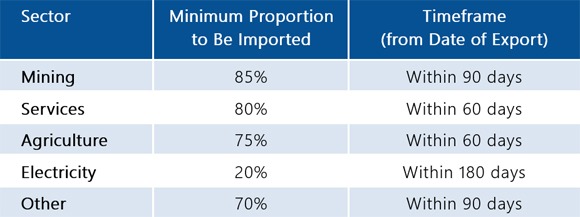
The ratios and timeframes are subject to change depending on the circumstances. If exporters cannot comply with the required ratio and timeline, exporters must provide relevant explanatory documents for the BOL’s consideration.

Selling Foreign-Currency Income

Exporters of goods and services must sell at least the minimum required proportion of their foreign-currency income (see table below) to a commercial bank in Laos. This foreign currency exchange must occur within three working days of receiving the foreign currency into the dedicated bank account in Laos. The selling rate will be determined by the prevailing rate of the commercial bank on the day of the transaction.
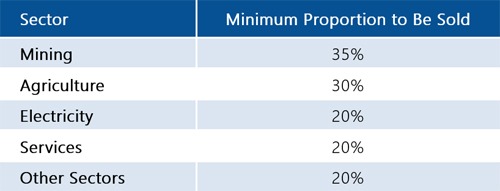
In conducting these transactions, commercial banks are required to carefully consider and manage their reserves and overall liquidity to ensure that they can meet public demand.

If an exporter does not sell at least the minimum required amount of foreign currency within three working days, the relevant commercial bank must proceed with the minimum required exchange and notify the exporter that they are doing so.

These requirements do not apply to re-exporters, such as importers of unprocessed raw materials for re-export to other countries, as determined by the Department of Foreign Currency Management (DFCM).

After selling the minimum required amount to a commercial bank, the remaining foreign-currency income must be used for foreign-currency exchange purposes, such as payments to parties in foreign countries, fulfilling obligations to the state, and so on.

Exporters can sell foreign currency to the BOL by notifying it of the need to sell the foreign currency to the DFCM in the BOL, after which they can sell the currency to the BOL through a commercial bank.

Registration

Decision No. 333 requires service exporters to register as importers and exporters to bring in income generated from exporting services. Although it doesn’t specify the types of service businesses that need to register, a March 2024 notice from the Ministry of Industry and Commerce offers examples of such businesses, including those in international transport, insurance, tourism and hotels, construction, and consulting.

Violations

First-time violations of Decision No. 333 that do not cause damage are subject to training on the importance of complying with Lao law or a warning. If the violation persists after the training or warning, the violator will face suspension of its ability to export goods and services.

For more information on Decision No. 333, or on any aspect of foreign currency management in Laos, please contact Tilleke & Gibbins at [email protected].

RELATED INSIGHTS​ 

December 6, 2023
Over the past two years, Laos has experienced a sharp depreciation in the value of the kip (LAK) against foreign currencies. To thwart this depreciation and get its currency back on track, the government took a series of measures and issued the Law on Foreign Exchange Management No. 15/NA of July 7, 2022 (the “FX Law”) to improve management of the foreign currency and reiterate restrictions on foreign currency in the country. The amended law also aimed to strengthen foreign exchange liquidity and increase the reserve of foreign currency held in Laos. This year, the prime minister of Laos issued the Order on the Implementation of Foreign Exchange Management, which came into force on July 14, 2023. The order addresses foreign currency use, movement, and possession and clarifies administrative roles regarding the FX Law. This article outlines some of the key points related to the FX Law and the prime minister’s recent order. Use of Foreign Currency Other than a major relaxation regarding remuneration for foreign employees, the amended FX Law retains Laos’ strict regulatory approach to the use of foreign currencies. The general rule is that foreign currency payments for goods, services, debt, dividends, or taxes are prohibited; these payments must be in LAK. The amended law also seems to prevent suggestions that a price in LAK may be adjusted based on another currency. One of the few exceptions to these requirements is for the export of goods and services abroad, in which case it is acceptable to receive payment in foreign currencies. Similarly, the import of goods may allow payment in foreign currency. Announcements or advertisements of the price of goods or services in a foreign currency are likewise prohibited, as is offering a salary in foreign currency when advertising a job in Laos. Similarly, employees’ remuneration,
November 21, 2023
In this article originally published by World Trademark Review, Tilleke & Gibbins senior associate David Mol shares advice on how to collaborate effectively with customs officials at Cambodian border points and ports, offering a guide on how to successfully monitor for—and enforce against—counterfeit and grey market goods.   Can rights holders record trademark and brand-related IP information with Customs and, if so, how?   At present, there is no formal customs IP recordal system in place in Cambodia. However, rights holders may consider: a request letter to Customs; or recordal of an exclusive distributorship. Request letter to Customs A request letter to Customs would be an effective measure in cases where a rights holder is aware of a specific customs checkpoint that is being used to smuggle infringing goods. The rights holder may request to set up a meeting with Customs at the checkpoint to provide officials with: guidance on the issue; the IP rights involved; and information on product identification. The rights holder may further request the official’s assistance in monitoring shipments for certain goods. Customs has been open and cooperative in the past, setting up direct communication lines between rights holders and border officials. Officials then: monitor shipments; exchange sighting reports; and set up inspections where applicable. However, this option is not directly regulated under any laws or regulations, and can only be considered as an ad hoc approach in cases where the rights holder is aware of issues at a specific checkpoint. We usually do not recommend using this approach to alert all checkpoints in Cambodia, as it is rather time-intensive, requiring close cooperation and active liaison with officials. Instead, targeting specific checkpoints has proven to work in our experience. A request letter to Customs may apply to all types of intellectual property. However, a recently issued regulation that addresses suspensions
October 30, 2023
On October 9, 2023, Laos issued Presidential Decree No. 003, which raised excise tax rates for certain goods, effective immediately. The move to increase excise tax rates comes amid the marked depreciation of the Lao kip (LAK). The Lao government is trying to monitor and discourage imports of non-essential products in order to reduce the outflow of foreign currency from the country. Increasing the tax rate for some of these products is part of these efforts. The specific products and excise tax rates are listed in the table below.   This new rate policy is also in line with recent government efforts to encourage avoiding payment in foreign currency to prevent the depletion of foreign currency reserves in Laos. In this regard, commercial banks have already taken action to ration the supply of foreign currency by prioritizing imports of essential goods, such as fuel. The products listed above formalize this impetus to prioritize certain imports and discourage others deemed not essential. In addition, the increased excise tax rates on fuel-powered vehicles show the commitment of the Lao government to move toward electric vehicles, which would also lessen the country’s dependence on fuel imports. For more information on these excise tax changes, or on any aspect of Laos’ international trade regulations, please contact Tilleke & Gibbins at [email protected].
October 12, 2023
Thailand has announced tax exemptions for issuers and holders of depositary receipts (DRs) of listed foreign securities to encourage DR transactions, create more investment products in the Thai capital markets, and promote and offer opportunities for retail investors to invest in foreign securities. The exemptions are laid out in the Royal Decree under the Revenue Code B.E. 2481 (No. 775) B.E. 2566 (Royal Decree No. 775), which came into force on August 16, 2023. DRs are certificates representing underlying foreign securities listed on a foreign exchange, but DRs are listed and traded on the Stock Exchange of Thailand (SET). Holders of a DR can receive the same benefits payable from the underlying listed foreign securities as direct holders of the listed foreign securities. According to the relevant notifications from Thailand’s Securities and Exchange Commission (SEC), DRs include the following: Certificates that confer the right to receive financial benefits equivalent or in reference to the received financial benefit from certain underlying listed foreign securities held by the certificate’s issuer; Unitized instruments having the same terms and conditions for each unit and issued by a custodian for the purpose of representing the holder’s right to claim for the deposited underlying listed foreign securities subject to the deposit agreement, or other rights as described by the custodian in the instrument. Issuance of a DR is subject to similar approval and disclosure requirements as those the SEC sets for general securities issued in Thailand. The recently announced tax exemptions for DR issuers and holders—which also apply to fractional DRs (also called DRx)—are detailed below. Corporate Income Tax Exemption Under Royal Decree No. 775, companies or registered partnerships that issue a DR in accordance with the Securities and Exchange Act B.E. 2535 (1992) (SEA) are exempt from paying corporate income tax (CIT) for income