
You are using an outdated browser and your browsing experience will not be optimal. Please update to the latest version of Microsoft Edge, Google Chrome or Mozilla Firefox. Install Microsoft Edge

June 7, 2024

Laos Regulates Management of Foreign Currency from Exports

On March 7, 2024, Laos moved to regulate the management of foreign-currency income from the exportation of goods and services. Effective March 29, 2024, Decision No. 333 (formally the Decision on Management of Income in Foreign Currency from Exportation of Goods and Services No. 333/BOL) from the Bank of Lao PDR (BOL) aims to incentivize the inflow of such foreign currency into Laos and its sale to licensed commercial banks.

Decision No. 333 sets minimum required proportions for importing income in foreign currency derived from the exportation of goods and services, as well as the timeframe for doing so. It also stipulates the requirements for selling such foreign currency to commercial banks in Laos and the minimum proportions that must be sold.

Importing Foreign-Currency Income

Exporters must receive payments from abroad via bank transfer into a dedicated bank account designated for import-export business activities within the timeline specified in the sale-purchase agreement, but not exceeding 180 days from the date of export. Each sector must import income in foreign currency into the Lao PDR according to the minimum proportion of currency to be imported, and it must be done within the required timeframes, as specified in the table below.
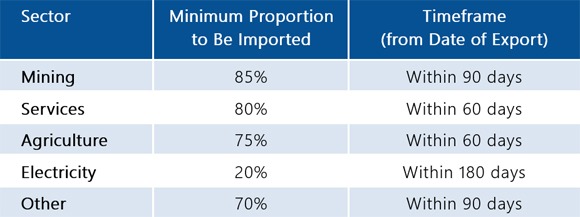
The ratios and timeframes are subject to change depending on the circumstances. If exporters cannot comply with the required ratio and timeline, exporters must provide relevant explanatory documents for the BOL’s consideration.

Selling Foreign-Currency Income

Exporters of goods and services must sell at least the minimum required proportion of their foreign-currency income (see table below) to a commercial bank in Laos. This foreign currency exchange must occur within three working days of receiving the foreign currency into the dedicated bank account in Laos. The selling rate will be determined by the prevailing rate of the commercial bank on the day of the transaction.
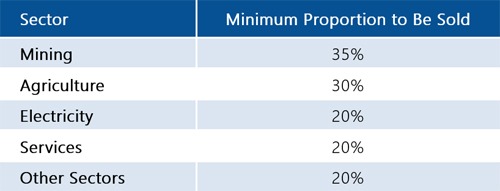
In conducting these transactions, commercial banks are required to carefully consider and manage their reserves and overall liquidity to ensure that they can meet public demand.

If an exporter does not sell at least the minimum required amount of foreign currency within three working days, the relevant commercial bank must proceed with the minimum required exchange and notify the exporter that they are doing so.

These requirements do not apply to re-exporters, such as importers of unprocessed raw materials for re-export to other countries, as determined by the Department of Foreign Currency Management (DFCM).

After selling the minimum required amount to a commercial bank, the remaining foreign-currency income must be used for foreign-currency exchange purposes, such as payments to parties in foreign countries, fulfilling obligations to the state, and so on.

Exporters can sell foreign currency to the BOL by notifying it of the need to sell the foreign currency to the DFCM in the BOL, after which they can sell the currency to the BOL through a commercial bank.

Registration

Decision No. 333 requires service exporters to register as importers and exporters to bring in income generated from exporting services. Although it doesn’t specify the types of service businesses that need to register, a March 2024 notice from the Ministry of Industry and Commerce offers examples of such businesses, including those in international transport, insurance, tourism and hotels, construction, and consulting.

Violations

First-time violations of Decision No. 333 that do not cause damage are subject to training on the importance of complying with Lao law or a warning. If the violation persists after the training or warning, the violator will face suspension of its ability to export goods and services.

For more information on Decision No. 333, or on any aspect of foreign currency management in Laos, please contact Tilleke & Gibbins at [email protected].

RELATED INSIGHTS​ 

February 23, 2024
Two of Tilleke & Gibbins’ licensing specialists in Bangkok have contributed the Thailand chapter to the newly issued Licensing 2024, a comprehensive guide from Lexology Panoramic to licensing in various jurisdictions around the world. The Thailand chapter covers the following topics: Laws and licensing arrangements: Unfair Contract Terms Act, Trade Competition Act, pre-contractual disclosure, registration of international licensing, implied obligations, Civil and Commercial Code, Trademark Act, Patent Act, Trade Secrets Act Intellectual property issues: Paris Convention for the Protection of Industrial Property, contesting the validity of licensor’s IP rights, invalidity and expiry of IP rights, security interests, proceedings against third parties, sublicensing, jointly owned IP, first to file, scope of patent protection, trade secrets, copyright Software licensing: Perpetual licensing, legal requirements, user restrictions Royalties and payments, currency conversion, and taxes: Relevant legislation, restrictions, taxation of foreign licensors Competition law issues: Restrictions on trade, legal restrictions, and IP-related court rulings Indemnification, disclaimers, and damages: Prevalence and enforceability of indemnity provisions and contractual waivers of damages Termination: Right to terminate, impact of termination Bankruptcy: Impact of licensee or licensor bankruptcy Dispute resolution: Governing law, arbitration, enforceability, injunctive relief, contractual waivers The Thailand chapter was authored by Alan Adcock, partner, and Kasama Sriwatanakul, counsel, both in the Thailand regulatory affairs team. The full Thailand chapter is available below as a PDF. Tilleke & Gibbins also contributed the Vietnam chapter to Licensing 2024. Readers can gain 30 days of complementary access to the full Licensing 2024 guide and the rest of Lexology Panoramic’s varied offerings through this link.
January 23, 2024
The Bank of Thailand (BOT) has issued a new notification to sustainably address Thailand’s household debt problems by establishing responsible and fair lending requirements for lending service providers throughout their lending journey. Notification No. SorKorChor. 7/2566 Re: Provision of Responsible and Fair Lending was announced on December 21, 2023, and took effect on January 1, 2024. The lending service providers this notification applies to include both commercial banks and nonbank business operators (e.g., personal loan business operators, nano-financing business operators, and credit card business operators). The key principle of this notification is to provide criteria for responsible and fair lending that supplement market conduct principles, covering eight areas in the debt cycle: Lending product development. Service providers must offer lending products that are suitable to customers’ needs and repayment capabilities, avoiding encouragement of excessive debt. Loan interest rates should align with the borrower’s risk profile and credit characteristics (risk-based pricing) to ensure fair contract conditions. Advertising. Service providers must prepare and control advertisements with “correct and clear” content, presenting complete and comparable conditions, interest rates, and various fees to customers. The advertisements should not encourage excessive debt, enabling customers to make informed decisions and promoting financial discipline. Sales. In the selling process, service providers must ensure that customers receive complete, accurate, and unexaggerated information that facilitates appropriate consideration of decisions based on a correct understanding of the product or service. Products should also align with customers’ purposes or needs for fund utilization, avoiding encouragement of excessive debt. Consideration of debt repayment ability (affordability). Service providers must be conscientious in considering customers’ debt repayment ability, taking into account all obligations and residual income. Promotion of discipline and financial management. Service providers must provide important information and warnings to debtors, including regular reminders to promote responsible borrowing. Helping debtors with persistent debt.
January 11, 2024
Tilleke & Gibbins’ project finance specialists in Vietnam have contributed the Vietnam chapter to Project Finance 2024 from The Legal 500. The guide, which is part of The Legal 500’s Country Comparative Guides series, furnishes investors and businesses with key information related to project finance in jurisdictions around the world. Each Q&A-style chapter provides in-depth details on the legal regimes affecting a wide range of project financing topics, including: Ownership structures and corporate governance; Security interests, regimes, and enforcement; Regulatory requirements and consents; Foreign exchange considerations; Environmental, social, and governance (ESG) issues; Public-private partnerships; Foreign judgments; Tax considerations; Common funding structures; and Insurance law principles. Tilleke & Gibbins also authored the Thailand chapter of Project Finance 2024. The Vietnam chapter of the guide is available as a PDF through the button below, courtesy of The Legal 500. The full guide is accessible for free on The Legal 500 website.
January 11, 2024
Project finance specialists from Tilleke & Gibbins’ Bangkok office have contributed the Thailand chapter to Project Finance 2024 from The Legal 500. The guide, which is part of The Legal 500’s Country Comparative Guides series, furnishes investors and businesses with key information related to project finance in jurisdictions around the world. Each Q&A-style chapter provides in-depth details on the legal regimes affecting a wide range of project financing topics, including: Ownership structures and corporate governance; Security interests, regimes, and enforcement; Regulatory requirements and consents; Foreign exchange considerations; Environmental, social, and governance (ESG) issues; Public-private partnerships; Foreign judgments; Tax considerations; Common funding structures; and Insurance law principles. Tilleke & Gibbins also authored the Vietnam chapter of Project Finance 2024. The Thailand chapter of the guide is available as a PDF through the button below, courtesy of The Legal 500. The full guide is accessible for free on The Legal 500 website.