
You are using an outdated browser and your browsing experience will not be optimal. Please update to the latest version of Microsoft Edge, Google Chrome or Mozilla Firefox. Install Microsoft Edge

June 7, 2024

Laos Regulates Management of Foreign Currency from Exports

On March 7, 2024, Laos moved to regulate the management of foreign-currency income from the exportation of goods and services. Effective March 29, 2024, Decision No. 333 (formally the Decision on Management of Income in Foreign Currency from Exportation of Goods and Services No. 333/BOL) from the Bank of Lao PDR (BOL) aims to incentivize the inflow of such foreign currency into Laos and its sale to licensed commercial banks.

Decision No. 333 sets minimum required proportions for importing income in foreign currency derived from the exportation of goods and services, as well as the timeframe for doing so. It also stipulates the requirements for selling such foreign currency to commercial banks in Laos and the minimum proportions that must be sold.

Importing Foreign-Currency Income

Exporters must receive payments from abroad via bank transfer into a dedicated bank account designated for import-export business activities within the timeline specified in the sale-purchase agreement, but not exceeding 180 days from the date of export. Each sector must import income in foreign currency into the Lao PDR according to the minimum proportion of currency to be imported, and it must be done within the required timeframes, as specified in the table below.
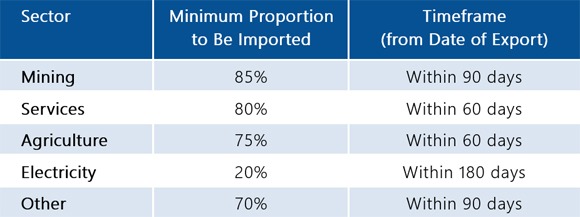
The ratios and timeframes are subject to change depending on the circumstances. If exporters cannot comply with the required ratio and timeline, exporters must provide relevant explanatory documents for the BOL’s consideration.

Selling Foreign-Currency Income

Exporters of goods and services must sell at least the minimum required proportion of their foreign-currency income (see table below) to a commercial bank in Laos. This foreign currency exchange must occur within three working days of receiving the foreign currency into the dedicated bank account in Laos. The selling rate will be determined by the prevailing rate of the commercial bank on the day of the transaction.
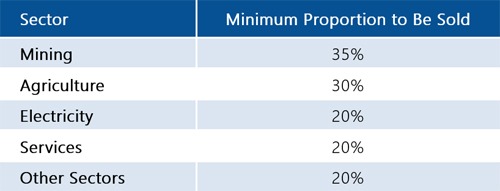
In conducting these transactions, commercial banks are required to carefully consider and manage their reserves and overall liquidity to ensure that they can meet public demand.

If an exporter does not sell at least the minimum required amount of foreign currency within three working days, the relevant commercial bank must proceed with the minimum required exchange and notify the exporter that they are doing so.

These requirements do not apply to re-exporters, such as importers of unprocessed raw materials for re-export to other countries, as determined by the Department of Foreign Currency Management (DFCM).

After selling the minimum required amount to a commercial bank, the remaining foreign-currency income must be used for foreign-currency exchange purposes, such as payments to parties in foreign countries, fulfilling obligations to the state, and so on.

Exporters can sell foreign currency to the BOL by notifying it of the need to sell the foreign currency to the DFCM in the BOL, after which they can sell the currency to the BOL through a commercial bank.

Registration

Decision No. 333 requires service exporters to register as importers and exporters to bring in income generated from exporting services. Although it doesn’t specify the types of service businesses that need to register, a March 2024 notice from the Ministry of Industry and Commerce offers examples of such businesses, including those in international transport, insurance, tourism and hotels, construction, and consulting.

Violations

First-time violations of Decision No. 333 that do not cause damage are subject to training on the importance of complying with Lao law or a warning. If the violation persists after the training or warning, the violator will face suspension of its ability to export goods and services.

For more information on Decision No. 333, or on any aspect of foreign currency management in Laos, please contact Tilleke & Gibbins at [email protected].

RELATED INSIGHTS​ 

December 28, 2023
On October 13, 2023, Laos’ official gazette published the amended Law on Commercial Banks No. 39/NA dated July 17, 2023. The amended law came into effect on September 15, 2023, following its promulgation by the president of Laos. Below are some of the significant changes. Registered Capital Under the amended law, the minimum registered capital for establishing a commercial bank has been increased from LAK 500 billion (approx. USD 24.2 million) to LAK 1 trillion (approx. USD 48.4 million), while the minimum registered capital for Lao branches of foreign commercial banks has been raised from LAK 300 billion (approx. USD 14.5 million) to LAK 600 billion (approx. USD 29 million). Currently, the Bank of Lao PDR (BOL) is preparing a new regulation that will define the timeframe within which banks established in Laos before the enactment of the amended law must increase their registered capital. This change is not as significant as it may seem. Since the last Law on Commercial Banks (which also stipulated an increase in registered capital), Laos has seen a sharp depreciation of the Lao kip against foreign currencies. The increase of capital mandated by the amended law is meant to compensate for this depreciation. Change of Status of a Commercial Bank of a Brand of a Foreign Commercial Bank Another article in the amended law outlines two scenarios in which banks may alter their status. First, a foreign commercial bank in Laos holding 100% shares may change its status to a Lao branch of a foreign commercial bank. Conversely, a Lao branch of a foreign commercial bank may elevate its status to that of a foreign commercial bank holding 100% shares. In both cases, the bank must request a business operating license from the BOL corresponding to its new status, requiring it to meet
December 15, 2023
As part of its membership in Lex Mundi, Tilleke & Gibbins has published an updated edition of its Guide to Doing Business in Thailand for 2023. This guide outlines the key factors for starting and operating a business in the Thai market. Issues covered include: Investment incentives Financial facilities Exchange controls Import and export regulations Structures for doing business Requirements for the Establishment of a Business Operation of the Business Cessation or Termination of the Business Labor legislation, relations, and supply Tax Immigration requirements This publication is part of Lex Mundi’s Country Guides series prepared by member firms in more than 100 jurisdictions worldwide. The guides serve as a useful resource for planning international business strategy and researching new markets. The full Guide to Doing Business in Thailand is available through the button below.
December 8, 2023
In a significant development on December 5, 2023, the Central Bank of Myanmar (CBM) issued Letter No. FE-1/2937 granting authorized dealer licensed banks (ADLBs) the authority to freely transact in foreign currency trades, buying and selling at the market exchange rate for Myanmar kyat (MMK) as proposed by buyers and sellers through online trading platforms. Offshore remittances, however, must comply with the remittance criteria set by the Foreign Exchange Supervisory Committee. The online trading platform Refinitiv, initiated in June 2022 under the CBM’s guidance, facilitates the buying and selling of foreign currency between ADLBs and between banks and customers. The initiative was implemented in accordance with CBM Letter No. FE-1/789, dated June 21, 2023. The platform’s inception saw the exchange rate set at over MMK 2,900 per USD 1. Then, in August 2023, the CBM ordered banks and traders to limit foreign exchange transactions to an approved online trading platform, again with the exchange rate fixed at MMK 2,900 per USD 1. Transactions outside of online trading platforms continue to be governed by the exchange rate set by the CBM of 2,100 MMK per USD 1. Conversion Rules for Exporters On December 6, 2023, the CBM issued Notification No. 26/2023 lowering the percentage of Myanmar companies’ export earnings in foreign currency subject to mandatory conversion into MMK from 50% to 35% at the current official exchange rate set by the CBM at USD 1 to MMK 2,100. This mandatory conversion must follow the requirements for mandatory conversion of foreign currency, which remain in effect. For more details on foreign exchange developments, or on any aspect of financial regulations in Myanmar, please contact Tilleke & Gibbins at [email protected].
December 7, 2023
Thailand’s Securities and Exchange Commission (SEC) has updated its regulations regarding public initial coin offerings (ICOs) that exhibit debt-like or infrastructure-backed characteristics. These new regulations are set to transform the landscape for digital fundraising, ensuring enhanced investor protection and risk mitigation. The introduction of these regulations is a major move toward cultivating a more transparent and secure digital token market in Thailand. It highlights the importance of comprehensive information disclosure and aligning digital-asset fundraising practices with established financial standards. The adjustments require more collaboration between token issuers and ICO portals to comply with the developing regulatory environment. The key features of the new regulations, which took effect on November 16, 2023, are summarized below. Debt-Like ICOs Debt-like digital tokens are digital tokens for which a fixed rate of return is predetermined. The rate does not vary based on the performance of the project or enterprise, but it may be supplemented by extra returns. To ensure that investors have access to adequate and essential information prior to making informed investment decisions, and to evaluate the risk of default by the issuer, the regulation requires disclosure of the project’s creditworthiness and risk assessment factors, as detailed below. Project creditworthiness. Disclosures about project creditworthiness should include information about the credibility assessment of the project, which should be conducted reasonably by an ICO portal or an independent expert. Risk assessment factors. Disclosures should include information about the factors considered in the assessment of risks—particularly the financial capability to repay the investment project’s debt. Infrastructure-Backed ICOs Infrastructure-backed digital tokens are issued for investment in infrastructure assets or to earn a share of the revenue stream from infrastructure projects. The regulations for the ICOs of these infrastructure-backed tokens have been revised to align with those for infrastructure trusts. These regulatory updates cover various aspects: Definition