
You are using an outdated browser and your browsing experience will not be optimal. Please update to the latest version of Microsoft Edge, Google Chrome or Mozilla Firefox. Install Microsoft Edge

June 7, 2024

Laos Regulates Management of Foreign Currency from Exports

On March 7, 2024, Laos moved to regulate the management of foreign-currency income from the exportation of goods and services. Effective March 29, 2024, Decision No. 333 (formally the Decision on Management of Income in Foreign Currency from Exportation of Goods and Services No. 333/BOL) from the Bank of Lao PDR (BOL) aims to incentivize the inflow of such foreign currency into Laos and its sale to licensed commercial banks.

Decision No. 333 sets minimum required proportions for importing income in foreign currency derived from the exportation of goods and services, as well as the timeframe for doing so. It also stipulates the requirements for selling such foreign currency to commercial banks in Laos and the minimum proportions that must be sold.

Importing Foreign-Currency Income

Exporters must receive payments from abroad via bank transfer into a dedicated bank account designated for import-export business activities within the timeline specified in the sale-purchase agreement, but not exceeding 180 days from the date of export. Each sector must import income in foreign currency into the Lao PDR according to the minimum proportion of currency to be imported, and it must be done within the required timeframes, as specified in the table below.
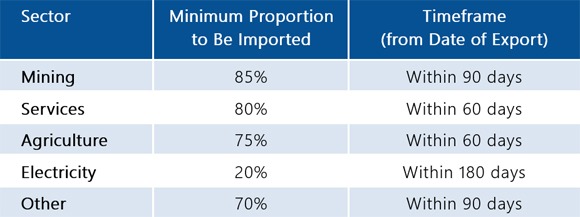
The ratios and timeframes are subject to change depending on the circumstances. If exporters cannot comply with the required ratio and timeline, exporters must provide relevant explanatory documents for the BOL’s consideration.

Selling Foreign-Currency Income

Exporters of goods and services must sell at least the minimum required proportion of their foreign-currency income (see table below) to a commercial bank in Laos. This foreign currency exchange must occur within three working days of receiving the foreign currency into the dedicated bank account in Laos. The selling rate will be determined by the prevailing rate of the commercial bank on the day of the transaction.
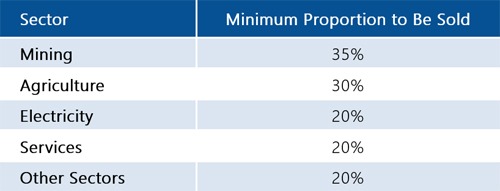
In conducting these transactions, commercial banks are required to carefully consider and manage their reserves and overall liquidity to ensure that they can meet public demand.

If an exporter does not sell at least the minimum required amount of foreign currency within three working days, the relevant commercial bank must proceed with the minimum required exchange and notify the exporter that they are doing so.

These requirements do not apply to re-exporters, such as importers of unprocessed raw materials for re-export to other countries, as determined by the Department of Foreign Currency Management (DFCM).

After selling the minimum required amount to a commercial bank, the remaining foreign-currency income must be used for foreign-currency exchange purposes, such as payments to parties in foreign countries, fulfilling obligations to the state, and so on.

Exporters can sell foreign currency to the BOL by notifying it of the need to sell the foreign currency to the DFCM in the BOL, after which they can sell the currency to the BOL through a commercial bank.

Registration

Decision No. 333 requires service exporters to register as importers and exporters to bring in income generated from exporting services. Although it doesn’t specify the types of service businesses that need to register, a March 2024 notice from the Ministry of Industry and Commerce offers examples of such businesses, including those in international transport, insurance, tourism and hotels, construction, and consulting.

Violations

First-time violations of Decision No. 333 that do not cause damage are subject to training on the importance of complying with Lao law or a warning. If the violation persists after the training or warning, the violator will face suspension of its ability to export goods and services.

For more information on Decision No. 333, or on any aspect of foreign currency management in Laos, please contact Tilleke & Gibbins at [email protected].

RELATED INSIGHTS​ 

September 24, 2024
In recent years, Thailand has witnessed significant developments in its personal finance sector, particularly in alternative lending options. This article explores two key concepts in the Thai financial landscape: nano finance and personal loans. These alternative lending models, regulated by the Bank of Thailand (BOT), aim to provide more accessible financial services to individuals and small entrepreneurs who might have limited access to traditional funding sources. Nano Finance: Empowering Small Entrepreneurs The nano finance scheme under the BOT’s supervision is designed to provide funding to small entrepreneurs who might have limited access to traditional financial resources. One of the key features of this scheme is the ability of licensed nano finance providers to use alternative data in assessing loan applicants’ ability to repay (information-based lending). To implement this approach, nano finance providers must have an internal policy on credit approval that supports: Identifying scope and processes for utilizing alternative factors or technologies in determining debt repayment capacity, credit line limits for each loan applicant and total credit limits, and acceptable debt repayment targets; Having resources and personnel with sufficient knowledge, capability, experience, and expertise to operate efficiently and effectively, as well as clear checks and balances; Establishing guidelines for selecting and analyzing factors or financial models to evaluate or predict loan applicants’ ability and willingness to repay; Having an internal sandbox to test key success factors of the selected factors or models; and Having a process for monitoring and reviewing the application of the selected factors or models in assessing debt repayment capability. This approach allows nano finance providers to make more informed lending decisions based on a broader range of data, potentially increasing access to finance for small entrepreneurs who may not have traditional credit histories or collateral. Personal Loans The personal loan scheme under BOT supervision aims
September 23, 2024
The General Department of Customs and Excise (GDCE) in Cambodia’s Ministry of Economy and Finance launched a trial phase of its Intellectual Property Rights Recordation System (IPRRS) on September 1, 2024. The system compiles necessary information and documents related to intellectual property rights in the country, enabling customs authorities to swiftly access these documents and enhance their ability to identify and intercept potential parallel imports and infringing goods at the border. This will also better facilitate ex-officio actions by customs authorities. The system is currently referred to as being in a “trial phase” to support further amendments or updates to address any potential technical errors that may arise from public use. However, the IPRRS is already fully operational. Types of Recordation Currently, the IPRRS allows two types of recordation: Intellectual property recordation is available for trademarks, geographical indications, copyrights, and related rights that are protected in Cambodia. It allows IP owners, authorized representatives, and legal representatives to record information and documents relating to such rights, including information on possible or potential counterfeit goods, with the GDCE. Recordation will give customs authorities quicker access to the information and enable them to promptly take action against potential counterfeit or infringing goods. Exclusive distributorship recordation is meant to streamline the process that takes place after the Ministry of Commerce issues a notice of the recordation of exclusive rights. Under the current practice, after receiving a copy of a notice of the recordal of an exclusive distributorship issued by the Ministry of Commerce (MOC), the GDCE needs to enter the information into their system manually to enable them to promptly identify or stop potential parallel importation at the border. This reportedly causes delays in border officers’ access to the necessary information. Recordation through the IPRRS, on the other hand, allows local exclusive distributors
September 20, 2024
On September 12, 2024, the Bank of Thailand (BOT) Notification Re: Virtual Bank Supervision Criteria took effect. According to this notification, virtual banks must adhere to standards for traditional commercial banks, along with additional requirements tailored to address virtual banks’ digital nature and corporate structure. Specific Requirements The concepts of supervision remain unchanged from the consultation paper titled “Criteria for Supervising Virtual Banks”. Some of the key additional provisions and details on supervision criteria relate to the following: Financial business groups: The notification identifies virtual banks as financial businesses, subject to the BOT’s regulations on financial business group supervision. If a virtual bank is a part of another financial institution’s financial business group, the virtual bank must be under a solo consolidated group. After the “initial phase” (see below), other financial institutions and companies within the financial business group are prohibited from extending credit to or engaging in transactions similar to lending activities with the virtual bank. Capital fund requirements: If other financial institutions’ investment in a virtual bank increases the capital fund in the financial system beyond a safe level and this poses a risk to other financial institutions, the BOT may order the relevant financial institution to maintain capital funds as the BOT deems appropriate. Service channels and outsourcing: Virtual banks must provide services solely through digital channels, except when necessary. For example, with the BOT’s approval, a virtual bank may use other commercial bank electronic branches via an ATM pool system, use a banking agent to serve customer needs for cash, or occasionally provide on-site services. Initial Phase The “initial phase” runs from the date that the virtual bank commences its operations until it receives the BOT’s approval to become fully operational. During this period, certain BOT supervisory requirements are relaxed as follows: Governance: Virtual banks in the initial phase may request
September 16, 2024
On July 23, 2024, the State Bank of Vietnam (SBV) published a draft circular regulating the implementation of open (publicly available) application programming interfaces, or Open APIs, in the banking industry (Draft Circular) to collect public comments. Open APIs in the banking sector are APIs of banks that allow third parties to process data for their own use or to provide products and services to customers. Urgent need Currently, the development of Open APIs in Vietnam is fragmented, with each bank using different API standards and security standards. There is no common standard for information technology systems, information storage, security, connectivity, or legal frameworks. Therefore, the promulgation of a regulation on Open APIs is urgently needed to create a clear legal basis and guidance for electronic banking transactions, especially in connecting to bank information systems and processing customer data safely, and creating new, innovative products and services to meet the increasing needs of customers. Cooperation of banks required The Draft Circular requires banks to provide Open API services to third parties for connection to the bank system and data processing. Banks have the right to refuse or suspend Open API services if third parties do not meet specified conditions. However, banks will be responsible for ensuring the quality and security of data, providing tools for customer data queries and revocation of third-party data processing rights, and coordinating with third parties and authorities to resolve issues. The Draft Circular standardizes Open API functions for all banks according to the Open API function list and the technical standards list specified in the Draft Circular. Open API service contract The template Open API service contract between banks and third parties using Open API services must have certain required contents such as provisions regarding confidentiality, data use purpose, and that the security level