
You are using an outdated browser and your browsing experience will not be optimal. Please update to the latest version of Microsoft Edge, Google Chrome or Mozilla Firefox. Install Microsoft Edge

June 7, 2024

Laos Regulates Management of Foreign Currency from Exports

On March 7, 2024, Laos moved to regulate the management of foreign-currency income from the exportation of goods and services. Effective March 29, 2024, Decision No. 333 (formally the Decision on Management of Income in Foreign Currency from Exportation of Goods and Services No. 333/BOL) from the Bank of Lao PDR (BOL) aims to incentivize the inflow of such foreign currency into Laos and its sale to licensed commercial banks.

Decision No. 333 sets minimum required proportions for importing income in foreign currency derived from the exportation of goods and services, as well as the timeframe for doing so. It also stipulates the requirements for selling such foreign currency to commercial banks in Laos and the minimum proportions that must be sold.

Importing Foreign-Currency Income

Exporters must receive payments from abroad via bank transfer into a dedicated bank account designated for import-export business activities within the timeline specified in the sale-purchase agreement, but not exceeding 180 days from the date of export. Each sector must import income in foreign currency into the Lao PDR according to the minimum proportion of currency to be imported, and it must be done within the required timeframes, as specified in the table below.
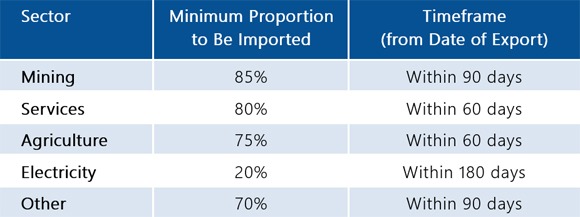
The ratios and timeframes are subject to change depending on the circumstances. If exporters cannot comply with the required ratio and timeline, exporters must provide relevant explanatory documents for the BOL’s consideration.

Selling Foreign-Currency Income

Exporters of goods and services must sell at least the minimum required proportion of their foreign-currency income (see table below) to a commercial bank in Laos. This foreign currency exchange must occur within three working days of receiving the foreign currency into the dedicated bank account in Laos. The selling rate will be determined by the prevailing rate of the commercial bank on the day of the transaction.
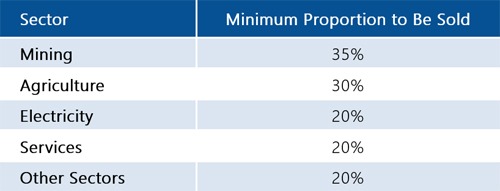
In conducting these transactions, commercial banks are required to carefully consider and manage their reserves and overall liquidity to ensure that they can meet public demand.

If an exporter does not sell at least the minimum required amount of foreign currency within three working days, the relevant commercial bank must proceed with the minimum required exchange and notify the exporter that they are doing so.

These requirements do not apply to re-exporters, such as importers of unprocessed raw materials for re-export to other countries, as determined by the Department of Foreign Currency Management (DFCM).

After selling the minimum required amount to a commercial bank, the remaining foreign-currency income must be used for foreign-currency exchange purposes, such as payments to parties in foreign countries, fulfilling obligations to the state, and so on.

Exporters can sell foreign currency to the BOL by notifying it of the need to sell the foreign currency to the DFCM in the BOL, after which they can sell the currency to the BOL through a commercial bank.

Registration

Decision No. 333 requires service exporters to register as importers and exporters to bring in income generated from exporting services. Although it doesn’t specify the types of service businesses that need to register, a March 2024 notice from the Ministry of Industry and Commerce offers examples of such businesses, including those in international transport, insurance, tourism and hotels, construction, and consulting.

Violations

First-time violations of Decision No. 333 that do not cause damage are subject to training on the importance of complying with Lao law or a warning. If the violation persists after the training or warning, the violator will face suspension of its ability to export goods and services.

For more information on Decision No. 333, or on any aspect of foreign currency management in Laos, please contact Tilleke & Gibbins at [email protected].

RELATED INSIGHTS​ 

May 6, 2025
On May 2, 2025, the Trade Competition Commission of Thailand (TCCT), in cooperation with the OECD, held a conference to discuss the results of the OECD Peer Review of Thailand’s competition law and policy. This review, conducted under the second phase of the OECD-Thailand Country Program, marks a significant milestone in Thailand’s ongoing institutional reform. Tilleke & Gibbins’ trade competition experts were invited to participate in both the program and the conference. The OECD Peer Review aimed to assess the current state of Thailand’s legal and regulatory environment surrounding competition law and policies, pinpoint strengths and weaknesses, and offer recommendations on potential future development. This article highlights the review’s key findings and recommendations, and their implications for businesses operating in Thailand. Institutional Framework: Room for Improvement Competition law in Thailand has undergone significant transformation, particularly since the enactment of the Trade Competition Act B.E. 2560 (2017) (TCA). This landmark legislation aimed to revolutionize the competition regime, notably by amending important legal provisions to enhance public enforcement capabilities and establishing the TCCT as an independent authority separate from government ministries, endowed with its own budget and powers to enforce competition law across key areas: anticompetitive agreements, abuse of dominant market positions, merger control, and unfair trade practices. The goal was to create a more efficient, flexible, and independent agency and to prevent political intervention. However, the OECD Peer Review points out a major impediment. The TCCT faces considerable budget and human resource constraints, which may impact its enforcement capacity. Its budget is comparatively low by international and regional standards, and only a fraction of its staff is dedicated to core competition enforcement (merger control and anticompetitive behavior). Furthermore, there is room for the TCCT to continue its improvements in expertise and efficiency—areas the TCCT has been attempting to shore up
May 5, 2025
On April 29, 2025, the government of Vietnam promulgated Decree No. 94/2025/ND-CP with regulations on a controlled “sandbox” for innovative fintech solutions in the banking sector (Decree 94). The decree aims to promote innovation, modernize banking, and enhance financial inclusion while assessing risks and benefits of fintech solutions in a controlled testing environment. Fintech Sandbox Currently, the fintech sandbox focuses on three specific areas: Credit scoring Open API data sharing Peer-to-peer (P2P) lending Eligible participants for the fintech sandbox include: Credit institutions and foreign bank branches (except for P2P lending) Fintech companies operating in Vietnam Cross-border supply by foreign providers is not included in the sandbox framework. Eligible participants are permitted to provide fintech solutions only within the scope specified in the Certificate of Sandbox Participation issued by the State Bank of Vietnam in consultation with other ministries. P2P lending companies face specific restrictions within the fintech sandbox, including prohibitions against: Providing security for customer loans Operating as a customer (i.e., P2P lender or borrower) Providing P2P lending solutions to pawn shops The maximum sandbox period is two years, with the possibility of extension as permitted by law. The outcomes of the fintech sandbox will serve as a practical basis for authorities to develop and refine future fintech regulations. It is worth noting that participation in the sandbox does not guarantee that participants will meet relevant business and investment conditions that may be stipulated in future regulations. Decree 94 will take effect on July 1, 2025, signaling that the Vietnamese government intends to take a proactive approach to fostering fintech development. Implications Parties interested in participating in the fintech sandbox should begin preparing now to be ready to apply for a Certificate of Sandbox Participation when the decree takes effect.
May 2, 2025
Attorneys from Tilleke & Gibbins have updated the latest edition of Doing Business in Thailand, a Q&A-style guide from Thomson Reuters Practical Law that offers an overview of key legal considerations for companies operating in jurisdictions worldwide. The contribution outlines the country’s legal and regulatory framework for foreign investment and business operations and reflects the latest legislative developments. The chapter addresses the following core topics: Legal system: Structure of the courts and the codified nature of Thai law. Foreign investment: Business restrictions under the Foreign Business Act, sector-specific regulations, exchange control rules, and investment incentives. Business vehicles: Overview of partnerships, private and public limited companies, and other legal entities. Employment: Labor protections, employment contracts, foreign worker requirements, and termination procedures. Tax: Corporate and personal income tax, indirect taxes, and tax obligations for residents and non-residents. Intellectual property: Registration and enforcement of patents, trademarks, designs, and copyrights. Data protection: Key provisions of the Personal Data Protection Act and related compliance obligations. Competition law: Regulatory framework under the Trade Competition Act. Anti-bribery and corruption: Relevant legislation and enforcement mechanisms. E-commerce and digital business: Legal regime for online transactions and digital platforms. Marketing and advertising: Consumer protection laws and regulations affecting advertising and marketing practices. Product regulation and liability: Safety standards, liability regimes, and roles of enforcement authorities. Practical Law, a legal reference resource from Thomson Reuters, publishes a range of guides for hundreds of jurisdictions and practice areas. The insurance and reinsurance guide is a valuable resource for legal practitioners, covering numerous jurisdictions worldwide. To view the latest version of the guide, please visit the Practical Law website and enroll in the free Practical Law trial to gain full access.
April 28, 2025
In recent years, Vietnam has positioned itself among the leading countries in the world in terms of digital asset ownership and trading volume. This rapid adoption reflects the country’s growing digital economy and the increasing engagement of individuals and businesses in blockchain-based financial activities. Central to this growth are Resolution No. 57-NQ/TW of the Politburo dated December 22, 2024, on breakthroughs in science, technology, innovation, and national digital transformation with a vision to 2045 (“Resolution 57”) and Resolution No. 03/NQ-CP of the Government dated January 9, 2025, promulgating the Action Plan to Implement Resolution 57 (“Resolution 03”), which outline a flexible and innovative policy framework that embraces pilot programs for emerging technologies to lay the groundwork for Vietnam’s legislative framework concerning cryptocurrency and blockchain technologies. Regulatory clarity in terms of digital assets and blockchain technologies is now more critical than ever for businesses and investors. In light of this, Vietnam is currently in the process of introducing three key legal instruments, with drafts of the Law on Digital Technology Industry (“Draft DTI Law”), Resolution of the National Assembly on the Establishment of Regional and International Financial Centers in Vietnam (“Draft Financial Center Resolution”), and Resolution of the Government on the Pilot Implementation of Crypto Asset Markets in Vietnam (“Draft Crypto Pilot Resolution”) nearing promulgation. Current Regulatory Direction and Schedule Vietnam’s regulatory framework for crypto assets and blockchain has been in a developmental stage since 2017, focusing on directions, plans, and schedules rather than established regulations. In February 2024, under Decision No. 194/QD-TTg of the Prime Minister, the Ministry of Finance (MOF) was assigned to draft a legal framework to either prohibit or regulate virtual assets and service providers by May 2025, signaling a clearer regulatory direction. In March 2025, Directive No. 05/CT-TTg of the Prime Minister directed the MOF