
You are using an outdated browser and your browsing experience will not be optimal. Please update to the latest version of Microsoft Edge, Google Chrome or Mozilla Firefox. Install Microsoft Edge

June 7, 2024

Laos Regulates Management of Foreign Currency from Exports

On March 7, 2024, Laos moved to regulate the management of foreign-currency income from the exportation of goods and services. Effective March 29, 2024, Decision No. 333 (formally the Decision on Management of Income in Foreign Currency from Exportation of Goods and Services No. 333/BOL) from the Bank of Lao PDR (BOL) aims to incentivize the inflow of such foreign currency into Laos and its sale to licensed commercial banks.

Decision No. 333 sets minimum required proportions for importing income in foreign currency derived from the exportation of goods and services, as well as the timeframe for doing so. It also stipulates the requirements for selling such foreign currency to commercial banks in Laos and the minimum proportions that must be sold.

Importing Foreign-Currency Income

Exporters must receive payments from abroad via bank transfer into a dedicated bank account designated for import-export business activities within the timeline specified in the sale-purchase agreement, but not exceeding 180 days from the date of export. Each sector must import income in foreign currency into the Lao PDR according to the minimum proportion of currency to be imported, and it must be done within the required timeframes, as specified in the table below.
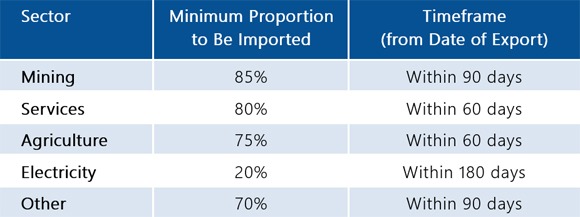
The ratios and timeframes are subject to change depending on the circumstances. If exporters cannot comply with the required ratio and timeline, exporters must provide relevant explanatory documents for the BOL’s consideration.

Selling Foreign-Currency Income

Exporters of goods and services must sell at least the minimum required proportion of their foreign-currency income (see table below) to a commercial bank in Laos. This foreign currency exchange must occur within three working days of receiving the foreign currency into the dedicated bank account in Laos. The selling rate will be determined by the prevailing rate of the commercial bank on the day of the transaction.
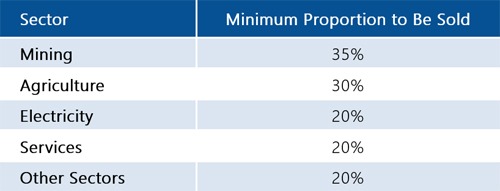
In conducting these transactions, commercial banks are required to carefully consider and manage their reserves and overall liquidity to ensure that they can meet public demand.

If an exporter does not sell at least the minimum required amount of foreign currency within three working days, the relevant commercial bank must proceed with the minimum required exchange and notify the exporter that they are doing so.

These requirements do not apply to re-exporters, such as importers of unprocessed raw materials for re-export to other countries, as determined by the Department of Foreign Currency Management (DFCM).

After selling the minimum required amount to a commercial bank, the remaining foreign-currency income must be used for foreign-currency exchange purposes, such as payments to parties in foreign countries, fulfilling obligations to the state, and so on.

Exporters can sell foreign currency to the BOL by notifying it of the need to sell the foreign currency to the DFCM in the BOL, after which they can sell the currency to the BOL through a commercial bank.

Registration

Decision No. 333 requires service exporters to register as importers and exporters to bring in income generated from exporting services. Although it doesn’t specify the types of service businesses that need to register, a March 2024 notice from the Ministry of Industry and Commerce offers examples of such businesses, including those in international transport, insurance, tourism and hotels, construction, and consulting.

Violations

First-time violations of Decision No. 333 that do not cause damage are subject to training on the importance of complying with Lao law or a warning. If the violation persists after the training or warning, the violator will face suspension of its ability to export goods and services.

For more information on Decision No. 333, or on any aspect of foreign currency management in Laos, please contact Tilleke & Gibbins at [email protected].

RELATED INSIGHTS​ 

June 27, 2025
Tilleke & Gibbins has contributed the Cambodia, Thailand, and Vietnam chapters to Taking and Enforcing Collateral Security and Guarantees in Southeast Asia, a comparative guide developed by Drew Network Asia (DNA). The publication examines the legal frameworks governing collateral security and guarantees across seven Southeast Asian jurisdictions and is intended to assist financial institutions, corporate borrowers, and cross-border investors in evaluating secured lending options in the region. The guide provides a practical overview of key issues relevant to taking and enforcing security interests—covering, among other topics, the types of assets that may be secured, the formalities and registration requirements for creating security, and the rights and procedures available in enforcement scenarios. Each chapter follows a consistent question-and-answer format to allow readers to compare approaches across jurisdictions easily. While the guide offers a high-level survey of the region’s collateral and guarantee regimes, it also notes that country-specific developments and transaction-specific considerations may affect the applicable requirements. Readers seeking detailed advice are encouraged to consult the lawyers listed at the end of each jurisdictional chapter. The full guide is available for download using the button below or directly from the DNA website.
June 19, 2025
The Bank of Thailand (BOT) has released draft guidelines establishing principles for managing artificial intelligence (AI) risks in the financial sector. The draft guidelines provide a structured framework for the responsible adoption of AI technologies. Financial service providers will be able to use the guidelines as a reference to appropriately manage their risks in a manner that aligns with internationally recognized best practices. The BOT is accepting public comments on the draft guidelines until June 30, 2025. Scope and Application The draft guidelines apply to all financial service providers, including financial institutions and special financial institutions under the Financial Institution Business Act, as well as payment providers under the Payment Systems Act. These guidelines supplement existing BOT risk management guidelines covering IT risk management, third-party risk management, data governance, and market conduct. The guidelines define AI systems as systems that mimic human intelligence, including machine learning, deep learning, generative AI (such as large language models), and agentic AI. This definition specifically excludes rule-based automation systems like robotic process automation and condition matching. Key Risk Management Principles The guidelines lay out two main principles in managing AI risk. Governance: Financial service providers should define and establish clear roles and responsibilities for their personnel and AI system supervision structures to uphold FEAT (fairness, ethics, accountability, and transparency) principles as follows: Stakeholder roles and responsibilities. Financial service providers should define roles and responsibilities for boards and executives on AI risk oversight. Responsibilities include establishing an AI system usage policy, designating personnel responsible for AI risk management, and building awareness of AI-related risk within the organization. AI system usage policy. The AI system usage policy should be aligned with organizational objectives, regulatory requirements, and FEAT principles. These policies should be reviewed regularly to respond to technological advancements and evolving risk profiles. Risk management
June 17, 2025
On January 9, 2025, the Lao official gazette published the newly amended Decision on Trade Inspection Implementation No. 0019/MOIC, dated January 6, 2025. This decision aims to establish principles and rules for trade officers to inspect, fine, and take measures against violators of trade laws and their related regulations on business competition, business operations, and intellectual property rights to protect consumers and business operators in Laos. Changes in Trade Inspection Procedures Previously, trade inspection officers, operating independently under the central Ministry of Industry and Commerce (MOIC) or the provincial-level Department of Industry and Commerce (DOIC), were responsible for administrative raid actions focusing exclusively on intellectual property issues. However, following the enactment of Decision No. 0019/MOIC, trade inspection officers will now be grouped into the Trade Officers Unit, which will also include business competition officers and consumer protection officers. This unit will conduct and participate in raids, considering not only intellectual property laws but also competition and consumer protection laws when imposing penalties on infringers. Trade Inspection Authority Levels Trade inspection implementation is overseen by authorities at three levels: Central level: Department of Business Competition and Trade Inspection, MOIC. The MOIC handles trade inspection work covering all provinces in Laos. Provincial level: DOIC offices in provinces and Vientiane handle trade inspections covering two or more districts. District level: Office of the Industry and Commerce offices in districts. Violations Individuals, legal entities, and organizations violating the newly amended trade inspection decision, the Decree on Trade Inspection, or other related regulations will be educated about the issue, warned, disciplined (for government servants), fined, subject to compensation for damage incurred, or punished by the relevant laws, depending on the gravity of the violation. Trade Violations Violations of trade laws and regulations concerning business operations will result in fines and additional measures. Examples include:
June 12, 2025
Thailand’s Ministry of Finance has issued a royal decree placing the business of hire purchase and leasing of cars and motorcycles under the scope of the Financial Institution Business Act B.E. 2551 (2008), effective December 2, 2025. This is to ensure appropriate regulatory oversight of these business activities, as they function similarly to credit granting and serve as a source of funding for the public with a broad impact on the overall economic system and consumers at large. The business operators that this royal decree applies to include corporate entities engaging regularly in the business of hire purchase or leasing of cars or motorcycles, currently excluding: Financial institutions and specialized financial institutions. Individuals operating such businesses (noncorporate entities). Cooperatives. Key regulatory obligations of this royal decree include the following: Business operators must disclose interest rates, service fees, and other relevant business information to the public and report to the Bank of Thailand (BOT). Business operators must display how the annual percentage rate (APR), including all annual charges covering interest and service fees, is calculated. Business operators must maintain accurate accounting records in accordance with recognized accounting standards. The BOT may issue warnings or suspend operations if business operators fail to comply with this royal decree or act unfairly in a way that may result in serious harm to customers. Directors, managers, and responsible persons of any business operator that violates this royal decree may also be subject to the prescribed penalties. Before the royal decree takes effect, business operators should conduct internal assessments and engage with counsel to prepare for regulatory implementation. The BOT is expected to issue further subordinate regulations and guidance regarding: Interest, service fees, deposits, collateral, benefits, and penalties that may be charged by business operators. Contract content, methods of benefit calculation, and format in conducting