
You are using an outdated browser and your browsing experience will not be optimal. Please update to the latest version of Microsoft Edge, Google Chrome or Mozilla Firefox. Install Microsoft Edge

June 7, 2024

Laos Regulates Management of Foreign Currency from Exports

On March 7, 2024, Laos moved to regulate the management of foreign-currency income from the exportation of goods and services. Effective March 29, 2024, Decision No. 333 (formally the Decision on Management of Income in Foreign Currency from Exportation of Goods and Services No. 333/BOL) from the Bank of Lao PDR (BOL) aims to incentivize the inflow of such foreign currency into Laos and its sale to licensed commercial banks.

Decision No. 333 sets minimum required proportions for importing income in foreign currency derived from the exportation of goods and services, as well as the timeframe for doing so. It also stipulates the requirements for selling such foreign currency to commercial banks in Laos and the minimum proportions that must be sold.

Importing Foreign-Currency Income

Exporters must receive payments from abroad via bank transfer into a dedicated bank account designated for import-export business activities within the timeline specified in the sale-purchase agreement, but not exceeding 180 days from the date of export. Each sector must import income in foreign currency into the Lao PDR according to the minimum proportion of currency to be imported, and it must be done within the required timeframes, as specified in the table below.
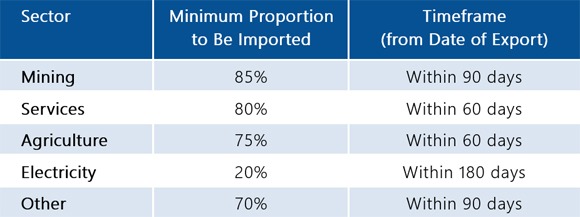
The ratios and timeframes are subject to change depending on the circumstances. If exporters cannot comply with the required ratio and timeline, exporters must provide relevant explanatory documents for the BOL’s consideration.

Selling Foreign-Currency Income

Exporters of goods and services must sell at least the minimum required proportion of their foreign-currency income (see table below) to a commercial bank in Laos. This foreign currency exchange must occur within three working days of receiving the foreign currency into the dedicated bank account in Laos. The selling rate will be determined by the prevailing rate of the commercial bank on the day of the transaction.
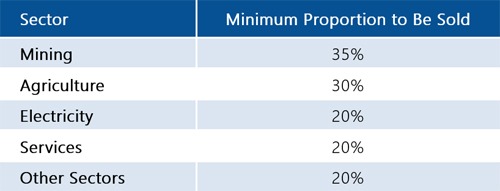
In conducting these transactions, commercial banks are required to carefully consider and manage their reserves and overall liquidity to ensure that they can meet public demand.

If an exporter does not sell at least the minimum required amount of foreign currency within three working days, the relevant commercial bank must proceed with the minimum required exchange and notify the exporter that they are doing so.

These requirements do not apply to re-exporters, such as importers of unprocessed raw materials for re-export to other countries, as determined by the Department of Foreign Currency Management (DFCM).

After selling the minimum required amount to a commercial bank, the remaining foreign-currency income must be used for foreign-currency exchange purposes, such as payments to parties in foreign countries, fulfilling obligations to the state, and so on.

Exporters can sell foreign currency to the BOL by notifying it of the need to sell the foreign currency to the DFCM in the BOL, after which they can sell the currency to the BOL through a commercial bank.

Registration

Decision No. 333 requires service exporters to register as importers and exporters to bring in income generated from exporting services. Although it doesn’t specify the types of service businesses that need to register, a March 2024 notice from the Ministry of Industry and Commerce offers examples of such businesses, including those in international transport, insurance, tourism and hotels, construction, and consulting.

Violations

First-time violations of Decision No. 333 that do not cause damage are subject to training on the importance of complying with Lao law or a warning. If the violation persists after the training or warning, the violator will face suspension of its ability to export goods and services.

For more information on Decision No. 333, or on any aspect of foreign currency management in Laos, please contact Tilleke & Gibbins at [email protected].

RELATED INSIGHTS​ 

June 11, 2025
Myanmar’s Ministry of Commerce has established new regulatory measures for importing electric vehicles (EVs) as part of a pilot project running from January 2025 to March 31, 2026, while the Ministry of Planning and Finance has reduced customs duty rates for fuel-powered vehicles manufactured domestically under semi-knocked down (SKD) and completely knocked down (CKD) systems, effective June 1, 2025, to May 31, 2026. Importation of EVs On May 29, 2025, Myanmar’s Ministry of Commerce (MOC) issued an announcement regarding the importation of EVs from abroad as part of its pilot project, detailed in MOC Notification No. 40/2025. The MOC notification establishes the following regulatory measures to support the development of EVs and related businesses: Approval must be obtained from the National-Level Steering Committee for the Development of Electric Vehicles and Related Enterprises. A registration certificate for an EV sales showroom must be secured. Vehicles must be imported in accordance with the permitted number and standards defined by the National-Level Steering Committee for the Development of Electric Vehicles and Related Enterprises. The importing company must provide necessary arrangements for warranties on imported EVs, spare parts, and after-sales services. For companies wishing to open a sales showroom, the following requirements apply: The company must be a registered national or joint venture entity with the Directorate of Investment and Company Administration. The company must be officially appointed as a distributorship or dealership by the original company or regional office for each brand. A permit from the respective state or regional government and a business license from the respective Municipal Committee must be obtained. The company must provide evidence of tax clearance issued by the Internal Revenue Department. Standards for the showroom, building, and warehouse, as issued periodically by the MOC, must be adhered to, including: Compound area: 10,000 square feet (the total
May 28, 2025
Tilleke & Gibbins attorneys in Vietnam have contributed the 2025 edition of Doing Business in Vietnam, a comprehensive Q&A-style resource from Thomson Reuters Practical Law that provides essential insights for companies navigating business operations in Vietnam. The guide presents a detailed overview of the country’s legal framework and regulatory environment, reflecting recent updates in Vietnamese legislation and practice. This annually updated guide offers key information on the following areas: Legal system: Structure of the Vietnamese judiciary and the role of codified law. Foreign investment: Conditions for market access, licensing requirements, foreign ownership restrictions, and investment incentives. Business vehicles: Formation and operation of legal entities, including limited liability companies, joint-stock companies, and representative offices. Employment: Employment contracts, social insurance, labor rights, and procedures for hiring foreign nationals. Tax: Overview of corporate income tax, personal income tax, value-added tax, and other tax obligations. Intellectual property: Procedures for protecting and enforcing patents, trademarks, copyrights, and other IP rights. Data protection: Compliance requirements under Vietnam’s data privacy laws, including the Personal Data Protection Decree. Competition law: Antitrust rules and regulatory oversight under the Law on Competition. Anti-bribery and corruption: Legal framework and enforcement practices aimed at curbing corrupt activities. E-commerce and digital business: Regulations governing online platforms, digital content, and cross-border services. Marketing and advertising: Laws and guidelines on advertising standards and consumer protection. Product regulation and liability: Safety requirements, product liability issues, and roles of relevant authorities. Doing Business in Vietnam is part of Practical Law’s global series of legal guides designed to support international practitioners and businesses. To access the most recent edition of the Vietnam guide, visit the Practical Law website and sign up for a free trial.
May 27, 2025
With the fifth round of negotiations between Thailand and the EU for a free trade agreement (FTA) now complete and the sixth round scheduled for June, both sides appear to be well on the way to meeting the desired Christmas 2025 deadline. The latest discussions were held in Brussels, and Pichai Naripthaphan, Thailand’s commerce minister, announced that the two sides have reached agreement on two chapters: Customs and Trade Facilitation, and Sustainable Food Systems. No details have been released regarding what concessions were made to reach the agreement, but reports suggest that good progress is being made in all remaining chapters. Market access for goods has reportedly become the current focus of negotiations. The first draft of goods and services that will be exempted is expected in early June, which will be welcome news for importers. While the first draft cannot be expected to represent the finalized list, it will at least provide an indication of the goods and services likely to benefit from tariff exemption. Similarly, both sides have begun to share the geographical indications that they wish to be protected, which will be of great interest to producers and manufacturers in Thailand and the EU. This is especially true considering the upcoming amendments to the Geographical Indications Protection Act B.E. 2546 (2003) expected in Thailand, as one of the key changes under the prospective amendment is to enable easier registration for geographical indications protected under international agreements. Other updates from the intellectual property (IP) chapter show good progress in relation to copyright and civil and border enforcement of IP rights. Both sides are also continuing to examine possible bridging proposals for unresolved issues. Given the substantial differences in IP laws between Thailand and the EU, how negotiators will bridge this gap remains at the forefront of most
May 26, 2025
On May 21, 2025, the Trade Competition Commission of Thailand (TCCT) published a press release signaling heightened regulation of digital platforms in response to the influx of products from foreign countries being sold in Thailand via e-commerce platforms. In recent years, the rapid expansion of cross-border multi-sided e-commerce platforms has unlocked unprecedented growth, but it has also flooded Thailand’s digital marketplaces with low-cost imports sold by unregulated foreign vendors via these platforms, unfairly undercutting local merchants’ market share and exposing consumers to uneven product quality. According to the press release, the TCCT announced progress on drafting new guidelines on unfair trade practices, monopolistic conduct, and competition restraint by multi-sided e-commerce platforms at a recent meeting of the Management Committee for Addressing Issues of Foreign Goods and Businesses Violating Laws. This regulatory push is part of a broader governmental effort to tackle issues stemming from the foregoing that create uneven playing fields and undermine consumer welfare. The draft guidelines are designed to regulate platform operators and their complex and multidimensional trade relations that cause network effects and distort competition. The forthcoming guidelines, to be issued under the Trade Competition Act B.E. 2560 (2017), will undergo public consultation to ensure platform operators, the public, and other stakeholders will have an opportunity to provide input before they are finalized and enforced. The guidelines are seen as an important priority, with the minister of commerce urging swift implementation of the measures to achieve the government’s objectives. In addition to the legislative advancement, one of the TCCT commissioners has been appointed to advise a subcommittee on preventing nominee arrangements by foreign investors and a subcommittee dedicated to promoting Thai SMEs and eliminating poor-quality imports. The appointee will also support the nationwide task force against illegal foreign products in overseeing proactive field operations and comprehensive