
You are using an outdated browser and your browsing experience will not be optimal. Please update to the latest version of Microsoft Edge, Google Chrome or Mozilla Firefox. Install Microsoft Edge

October 1, 2024

Indonesia Prepares to Require Nutritional Labeling for Sugar, Salt, and Fat Content

The Indonesian food and drug authority, also known as “BPOM,” issued a draft regulation on September 9, 2024, proposing standard labeling disclosing the sugar, salt, and fat content of packaged food products sold in the country.

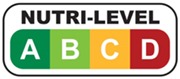
The draft Regulation on Nutritional Value Information on Food Labels to implement Government Regulation No. 28 of 2024 on the Implementation of the Health Law seeks to mandate “Nutri-Level” front-of-pack nutrition labeling to indicate the amount of sugar, salt, and fat at four possible levels, with a modified stoplight-color system:

  • Level “A” (lowest amount) has a dark green background
  • Level “B” has a light green background
  • Level “C” has a yellow background
  • Level “D” (highest amount) has a red background

These levels are shown in the following sample image:
The requirements for sugar, salt, and fat content for each level are based on amounts per 100 milliliters of ready-to-eat processed food as follows:

Further requirements relating to nutrients reflected in the Nutri-Level labeling include:

  • Foods labeled as level A are not allowed to contain natural or artificial sweetening food additives, either through direct addition or carried over from other ingredients.
  • Foods labeled as level B may only contain natural sweetening food additives.
  • Foods labeled as level C or D may use natural and artificial sweetening food additives.
  • “Sugar” includes all monosaccharides and disaccharides, excluding lactose.
  • Processed plain liquid milk and plain milk powder are exempt from the requirement to declare total fat content on the Nutri-Level label.

Labeling Implementation

The implementation of Nutri-Level labeling must comply with the following requirements:

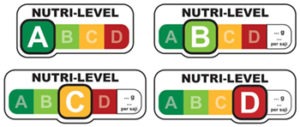
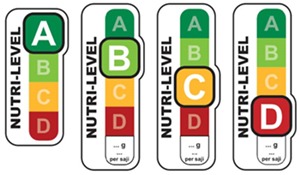
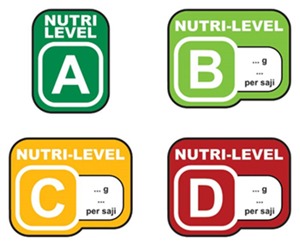
  • The Nutri-Level label must list all four letters (as shown in the examples below) unless the package meets the criteria for display of a simplified format label.
  • The Nutri-Level of the processed food must be indicated by enlarging the relevant letter, as shown in the examples below.
  • Processed foods at levels C and D must include a Nutri-Level label, while processed foods at levels A and B may do so on a voluntary basis.
  • The inclusion of a Nutri-Level label on processed foods at levels C and D must be accompanied by the sugar, salt, and fat content per serving (per saji in Indonesian, as shown in the examples below) or per package.

Nutri-Level Label Format

The draft regulation provides Nutri-Level label examples in both full and simplified formats. The simplified format applies to small packages of 30 square centimeters or less, while the full format must be used on other packages.

Full (horizontal)
Full (vertical)
Simplified
Timeline for Compliance

The draft regulation provides a grace period for existing product registrations:

  • Processed food that has obtained a product registration or for which a product registration application is pending before the regulation comes into effect must be amended within 30 months of the effective date of the regulation.
  • Ready-to-drink beverages, liquid concentrates, and powdered beverages must be amended within 18 months of the effective date of the regulation.

It is anticipated that the draft regulation will be finalized by the end of 2024.

For more details on this draft regulation, or on any aspect of food labeling requirements in Indonesia, please contact Tilleke & Gibbins at [email protected].

RELATED INSIGHTS​ 

April 22, 2026
A new decree in Vietnam brings significant implementation clarity to the country’s existing extended producer responsibility (EPR) legal framework. An EPR mechanism was first codified in Vietnam in the 2020 Law on Environmental Protection amid ongoing challenges surrounding the collection and treatment of product and packaging waste. The mechanism was progressively detailed through Decree No. 08/2022/ND‑CP and its successive amendments, but the regulatory framework remained insufficiently developed, notably in terms of support mechanisms for waste collection, recycling, and treatment. The newly launched regulations in Decree No. 110/2026/ND-CP (Decree 110), issued on April 1, 2026, and taking effect on May 25, 2026, stipulate fully and clearly the responsibility of manufacturers and importers to recycle products and packaging and to treat waste. Some key provisions of Decree 110 for manufacturers, importers, and related stakeholders are presented below. Subjects of EPR The Law on Environmental Protection assigns responsibility to manufacturers and importers for product and packaging recycling (under Article 54) or waste collection and treatment (under Article 55), depending on the type of products and packaging they produce or import. Decree 110 elaborates on these EPR provisions by specifying the responsible entities and listing out the types of products and packaging subject to recycling and waste treatment responsibilities. Decree 110 clarifies the responsible entities in special cases, such as when products under the same brand are made by multiple manufacturers, when there is a contract manufacturing or entrusted import relationship, and when the manufacturer or importer is part of a corporate group. Notably, exemptions may be applied in some scenarios, such as for manufacturers and importers of products and packaging exclusively for export, temporary import and re-export, or research and testing purposes, as well as for entities with annual revenue from related products not exceeding VND 30 billion. Recycling Responsibilities Decree 110
March 30, 2026
In response to an emerging crisis on food safety, the government of Vietnam promulgated Decree No. 46/2026/ND-CP (Decree 46) on January 26, 2026, and Resolution No. 66.13/2026/NQ-CP (Resolution 66.13) on January 27, 2026, setting out a number of substantive changes to the procedure and strict requirements for the declaration, registration, and importation of food products. Both instruments took effect upon issuance. However, shortly after they entered into force, food businesses encountered significant implementation challenges, particularly with respect to state inspection procedures at the customs clearance stage for imported products. In response, the government issued Resolution No. 09/2026/NQ-CP (Resolution 09) on February 4, 2026, temporarily suspending Decree 46 and Resolution 66.13 until a new effective date of April 16, 2026. Continued Suspension of Implementation of Decree 46 and Resolution 66.13 After considering feedback gathered by the Ministry of Health from food businesses and other stakeholders during the suspension period, the Vietnam Government Office issued a notice on March 20, 2026, agreeing to extend the suspension until the issuance of an amended Law on Food Safety and its guiding decree. Following this notice, on March 22, 2026, the Ministry of Health prepared a draft resolution to implement the notice and replace Resolution 09. Under the draft resolution, the effectiveness of Decree 46 and Resolution No. 66.13 would continue to be suspended until the amended Law on Food Safety takes effect, except for the provisions under Resolution 66.13 allowing flexibility in documents evidencing product efficacy, which would take effect on April 16, 2026, and remain effective until the Law on Food Safety is replaced (but not later than February 28, 2027). Accordingly, for products subject to the registration declaration procedure, such as health supplements, efficacy may be substantiated by either (i) scientific evidence supporting the declared function and effects of the product
February 26, 2026
Laos’ Food and Drug Department (FDD) has been using a new online registration system for drugs since the beginning of the year. The system, which was implemented following the November 2025 issuance of Notice No. 5960/FDD, became the official pathway for submissions on January 1, 2026. Since that date, paper-based registrations have no longer been accepted. This marks a significant advancement in the digitalization of regulatory processes in Laos. As the online system is now the exclusive platform for registration, renewal, and amendments, companies that have not yet aligned their processes to the new system should act promptly to ensure a smooth transition. To assist with this, the FDD will conduct periodic training sessions on the use of the online registration system, which will be delivered either in person or remotely, depending on operator demand. To start using the system, drug and medical device manufacturers, as well as import-export companies, that have not yet registered must submit a formal request identifying the authorized personnel who will access the platform, after which they will be issued user accounts and access codes. Each request must be accompanied by the company’s enterprise registration certificate (incorporation certificate), a copy of the identity card or passport of each designated user, and a scanned copy of their signature. There is no restriction on the number of users per company, allowing flexibility to meet operational needs. Companies that already hold accounts and access codes from the trial phase may continue using them and may apply for additional accounts if needed. Additional Requirements The new system also introduces a standardized format for drug registration numbers. For example, an import drug registration number such as 06 I 4040/15 will be changed to 06-IM-04040-15, and a domestic drug registration number such as 06 L 4040/15 will be changed to
January 21, 2026
Spurred by global geopolitics and Canada’s Indo-Pacific Strategy, which aims to forge deeper ties with ASEAN, Canadian companies have been showing growing interest in Thailand and Southeast Asia in recent years. To understand the opportunities offered by the region, we sat down with Andrew Stoutley, a Toronto native and the chief operating officer of Tilleke & Gibbins, a leading Southeast Asian regional law firm with over 130 years of history in Thailand. Q: Why are Canadian companies looking at Thailand and Southeast Asia right now? A: Two reasons stand out. First, diversification has moved up the agenda. Many Canadian companies want options outside North America due to tariff volatility and policy uncertainty in the United States, as well as questions around the next Canada–United States–Mexico Agreement mandatory joint review. At the same time, the shift of global production from China to Southeast Asia is accelerating, driven by rising costs, geopolitics, and the need to avoid overreliance on a single market. As a result, Canadian companies are looking for a second production base or a regional hub, and Thailand and its neighbors are natural choices given their manufacturing depth, location, and established supply chains. Second, Canada’s own efforts in the region are gaining traction. The Indo-Pacific Strategy has led to more on-the-ground support, including larger trade missions, upgraded diplomatic posts, and new financing options. Export Development Canada (EDC) now has a presence in Bangkok, giving Canadian companies a direct line to financing and insurance in Thailand. There’s also steady progress on trade frameworks like the recently signed Canada–Indonesia Comprehensive Economic Partnership Agreement (which will come into effect pending domestic procedures), ongoing negotiations of a Canada–ASEAN FTA, and the exciting announcement about the launch of negotiations of a Canada–Thailand FTA. Together, these developments have the potential to make it much easier