
You are using an outdated browser and your browsing experience will not be optimal. Please update to the latest version of Microsoft Edge, Google Chrome or Mozilla Firefox. Install Microsoft Edge

October 1, 2024

Indonesia Prepares to Require Nutritional Labeling for Sugar, Salt, and Fat Content

The Indonesian food and drug authority, also known as “BPOM,” issued a draft regulation on September 9, 2024, proposing standard labeling disclosing the sugar, salt, and fat content of packaged food products sold in the country.

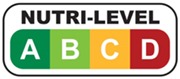
The draft Regulation on Nutritional Value Information on Food Labels to implement Government Regulation No. 28 of 2024 on the Implementation of the Health Law seeks to mandate “Nutri-Level” front-of-pack nutrition labeling to indicate the amount of sugar, salt, and fat at four possible levels, with a modified stoplight-color system:

  • Level “A” (lowest amount) has a dark green background
  • Level “B” has a light green background
  • Level “C” has a yellow background
  • Level “D” (highest amount) has a red background

These levels are shown in the following sample image:
The requirements for sugar, salt, and fat content for each level are based on amounts per 100 milliliters of ready-to-eat processed food as follows:

Further requirements relating to nutrients reflected in the Nutri-Level labeling include:

  • Foods labeled as level A are not allowed to contain natural or artificial sweetening food additives, either through direct addition or carried over from other ingredients.
  • Foods labeled as level B may only contain natural sweetening food additives.
  • Foods labeled as level C or D may use natural and artificial sweetening food additives.
  • “Sugar” includes all monosaccharides and disaccharides, excluding lactose.
  • Processed plain liquid milk and plain milk powder are exempt from the requirement to declare total fat content on the Nutri-Level label.

Labeling Implementation

The implementation of Nutri-Level labeling must comply with the following requirements:

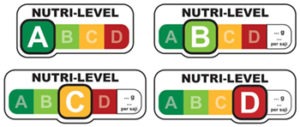
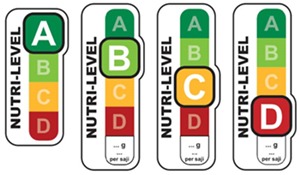
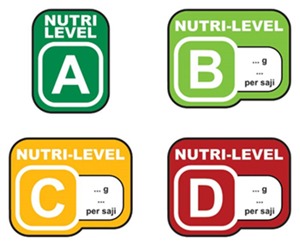
  • The Nutri-Level label must list all four letters (as shown in the examples below) unless the package meets the criteria for display of a simplified format label.
  • The Nutri-Level of the processed food must be indicated by enlarging the relevant letter, as shown in the examples below.
  • Processed foods at levels C and D must include a Nutri-Level label, while processed foods at levels A and B may do so on a voluntary basis.
  • The inclusion of a Nutri-Level label on processed foods at levels C and D must be accompanied by the sugar, salt, and fat content per serving (per saji in Indonesian, as shown in the examples below) or per package.

Nutri-Level Label Format

The draft regulation provides Nutri-Level label examples in both full and simplified formats. The simplified format applies to small packages of 30 square centimeters or less, while the full format must be used on other packages.

Full (horizontal)
Full (vertical)
Simplified
Timeline for Compliance

The draft regulation provides a grace period for existing product registrations:

  • Processed food that has obtained a product registration or for which a product registration application is pending before the regulation comes into effect must be amended within 30 months of the effective date of the regulation.
  • Ready-to-drink beverages, liquid concentrates, and powdered beverages must be amended within 18 months of the effective date of the regulation.

It is anticipated that the draft regulation will be finalized by the end of 2024.

For more details on this draft regulation, or on any aspect of food labeling requirements in Indonesia, please contact Tilleke & Gibbins at [email protected].

RELATED INSIGHTS​ 

January 8, 2026
Thailand’s approach to cannabis regulation has moved quickly from broad access to a medical, prescription‑only system. The latest government regulation classifies the cannabis flower as a controlled herb under the Thai Traditional Medicine Wisdom Act. The latest rules ban advertising and recreational sales, allow sales only to patients with prescriptions (up to 30 days), and require flowers to come from GACP‑certified (Good Agricultural and Collection Practices) farms. More importantly, cannabis dispensaries can only sell to patients presenting valid prescriptions issued by one of seven professions—medical doctors, Thai traditional practitioners, applied Thai traditional practitioners, traditional Chinese medicine practitioners, pharmacists, dentists, and folk healers—consistent with approved clinical indications. Noncompliance risks license suspension or revocation, and criminal penalties of up to one year’s imprisonment or a THB 20,000 fine. The dispensary‑only model that proliferated in Thailand in recent years is expected to end soon, as the rules will push all cannabis dispensaries into medical settings or retail pharmacies. Dispensaries must convert into medical establishments—clinics, pharmacies, or traditional pharmacies—complete with on‑site licensed practitioners as well as budtenders; strong controls for storage, hygiene, odor, and smoke; and facilities for record-keeping. All flowers dispensed or exported must come from GACP‑certified farms. If the government ends dispensaries outright and forces a conversion to clinics or pharmacies, compensation will not be automatic at the outset. As a result, business operators should plan for compliance and repurposing under the Medical Facilities Act, Modern Drug Act, and Herbal Product Act, which regulate medical clinics, modern pharmacies, and traditional medicine pharmacies, respectively. The table below summarizes the required licenses for clinics, pharmacies, and traditional medicine pharmacies selling cannabis flowers in Thailand. Aside from the specific listed licenses, all three types of establishments must also obtain a license to sell a controlled herb (cannabis flowers) from the Department of Thai Traditional
January 6, 2026
On December 30, 2025, Thailand’s Electronic Transactions Development Agency (ETDA) notified digital marketplace operators of a consolidated list of “high‑risk products” that are subject to strict monitoring on digital platforms. The list was jointly prepared by the Thai Industrial Standards Institute (TISI) and the Food and Drug Administration (FDA) to guide platform compliance in the initial phase of implementation of the Electronic Transaction Committee’s Notification on Other Measures for Marketplace for Goods with Specific Characteristics under Section 18(2) of the 2022 Royal Decree on Digital Platform Businesses Requiring Notification B.E.2568 (2025). The notice is addressed to operators of digital platform services that function as product marketplaces with specific characteristics laid out in the notification. The ETDA states that the TISI and the FDA are closely monitoring the high‑risk product categories on digital platforms, and the published list serves as the baseline reference for platform screening during the initial phase of the notification’s implementation. High‑Risk Product List The list aggregates categories of products that are illegal to sell online or are otherwise tightly regulated under Thai law, with an emphasis on health-related products, controlled substances, medical devices, and a wide range of industrial products that require certification or compliance with specified Thai Industrial Standards, as detailed below. Prohibited and tightly controlled health products. This includes all categories of modern medicines subject to control other than general household remedies; all categories of controlled herbal products except for over-the-counter herbal products; narcotics; psychotropic substances; and medical devices requiring use in medical facilities or a physician’s prescription. Selected industrial products requiring heightened controls. The list highlights dozens of TISI-regulated items commonly sold online. Examples include pacifiers, rice cookers, electrical wire, food wrap film, crayons, washing machines and dryers, air conditioners, electric cookers and air fryers, water heaters, microwave ovens, LED luminaires, hair dryers
January 5, 2026
On December 31, 2025, Vietnam’s Ministry of Health (MOH) issued Circular No. 57/2025/TT-BYT providing guidance on the classification of medical devices according to technical standards and quality requirements (Circular 57), applicable to procurement activities for medical devices in Vietnam. According to the MOH, the purpose of the classification is to establish a principle-based legal framework and regulations that enable purchasers to easily identify groups of medical devices aligned with their professional requirements and financial capacity. Some of the key stipulations of Circular 57 are outlined below. Basis for Determining Technical Standards and Quality Under Circular 57, the technical standards of medical devices are determined in accordance with Vietnamese laws on standards and technical regulations, through the following means: Certification of conformity with standards in accordance with Vietnamese laws on standards and technical regulations; Results of conformity assessment conducted by an internationally recognized conformity assessment organization or a legally established domestic or foreign conformity assessment organization operating in Vietnam; and Documentation evidencing compliance provided by the medical device owner. The quality of medical devices is determined based on whether the device has been approved for circulation by the relevant marketing authority of one or more jurisdictions. Classification of Medical Devices Circular 57 classifies medical devices into six groups (from Group 1 to Group 6) based on technical standards and quality. Medical devices subject to classification must simultaneously meet technical standards and quality requirements in accordance with professional specifications and user needs, and must be lawfully marketed in Vietnam. Medical devices manufactured in Vietnam may participate in all corresponding groups, provided they meet the technical standards required by the user and are lawfully marketed in Vietnam. Outlook Circular No. 57 will take effect on February 15, 2026, while the classification requirements will become effective on January 1, 2027. Holders of medical
December 30, 2025
The Intellectual Property Office of Vietnam (IP Office), with support from the Japan International Cooperation Agency (JICA), is drafting additional annexes to its Guidelines for Patent Examination, focusing on the examination of patent applications in the pharmaceutical and biotechnology sectors. The new annexes are expected to be officially issued in early 2026 as Annexes III and IV, following the successful issuance in 2023 of Annexes I and II addressing computer program-related inventions. The IP Office recently organized a seminar to gather feedback on the draft annexes from intellectual property representatives, academic institutions, research institutes, and other interested parties, emphasizing its intention to receive further constructive opinions to refine the guidelines for pharmaceuticals and biotechnology. Why These Guidelines Matter Patent examination in Vietnam has traditionally relied on the Guidelines for Patent Examination issued under Decision No. 487/QD-SHTT (2010), recently supplemented by Annexes I and II. While these documents provide a solid foundation, they do not fully address practical challenges in examining pharmaceutical and biotech inventions, particularly issues related to clarity, sufficiency of disclosure, enablement, features of function and utility, combination therapies, and inventions involving artificial intelligence (AI) applications in these fields. Annexes III and IV aim to close these gaps by introducing structured principles and illustrative examples. Guidance on Patent Specification Requirements Annex III provides detailed guidance on the requirements for patent specifications in pharmaceuticals and biotechnology, covering two main parts: Part A addresses sufficiency of disclosure, clarity of specifications, and consistency between claims and descriptions. Part B covers inventions related to Markush-type compounds, claims containing exclusion statements (disclaimers), and additional experimental data submitted during examination. The Guidelines outline specific disclosure requirements for subject matters such as compounds, formulations, pharmaceutical compositions, genes, polypeptides, proteins, vectors, transgenic organisms, modified organisms, and hybrid cells. Annex III emphasizes that disclaimers are not accepted