
You are using an outdated browser and your browsing experience will not be optimal. Please update to the latest version of Microsoft Edge, Google Chrome or Mozilla Firefox. Install Microsoft Edge

October 1, 2024

Indonesia Prepares to Require Nutritional Labeling for Sugar, Salt, and Fat Content

The Indonesian food and drug authority, also known as “BPOM,” issued a draft regulation on September 9, 2024, proposing standard labeling disclosing the sugar, salt, and fat content of packaged food products sold in the country.

The draft Regulation on Nutritional Value Information on Food Labels to implement Government Regulation No. 28 of 2024 on the Implementation of the Health Law seeks to mandate “Nutri-Level” front-of-pack nutrition labeling to indicate the amount of sugar, salt, and fat at four possible levels, with a modified stoplight-color system:

  • Level “A” (lowest amount) has a dark green background
  • Level “B” has a light green background
  • Level “C” has a yellow background
  • Level “D” (highest amount) has a red background

These levels are shown in the following sample image:
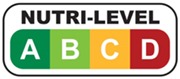
The requirements for sugar, salt, and fat content for each level are based on amounts per 100 milliliters of ready-to-eat processed food as follows:

Further requirements relating to nutrients reflected in the Nutri-Level labeling include:

  • Foods labeled as level A are not allowed to contain natural or artificial sweetening food additives, either through direct addition or carried over from other ingredients.
  • Foods labeled as level B may only contain natural sweetening food additives.
  • Foods labeled as level C or D may use natural and artificial sweetening food additives.
  • “Sugar” includes all monosaccharides and disaccharides, excluding lactose.
  • Processed plain liquid milk and plain milk powder are exempt from the requirement to declare total fat content on the Nutri-Level label.

Labeling Implementation

The implementation of Nutri-Level labeling must comply with the following requirements:

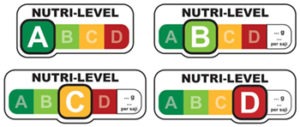
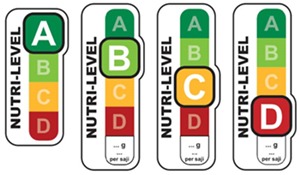
  • The Nutri-Level label must list all four letters (as shown in the examples below) unless the package meets the criteria for display of a simplified format label.
  • The Nutri-Level of the processed food must be indicated by enlarging the relevant letter, as shown in the examples below.
  • Processed foods at levels C and D must include a Nutri-Level label, while processed foods at levels A and B may do so on a voluntary basis.
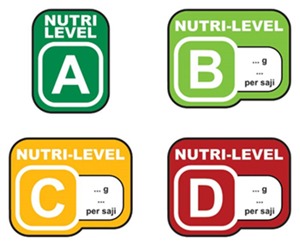
  • The inclusion of a Nutri-Level label on processed foods at levels C and D must be accompanied by the sugar, salt, and fat content per serving (per saji in Indonesian, as shown in the examples below) or per package.

Nutri-Level Label Format

The draft regulation provides Nutri-Level label examples in both full and simplified formats. The simplified format applies to small packages of 30 square centimeters or less, while the full format must be used on other packages.

Full (horizontal)
Full (vertical)
Simplified
Timeline for Compliance

The draft regulation provides a grace period for existing product registrations:

  • Processed food that has obtained a product registration or for which a product registration application is pending before the regulation comes into effect must be amended within 30 months of the effective date of the regulation.
  • Ready-to-drink beverages, liquid concentrates, and powdered beverages must be amended within 18 months of the effective date of the regulation.

It is anticipated that the draft regulation will be finalized by the end of 2024.

For more details on this draft regulation, or on any aspect of food labeling requirements in Indonesia, please contact Tilleke & Gibbins at [email protected].

RELATED INSIGHTS​ 

August 4, 2022
Cosmetics have become an essential feature of the modern lifestyle led by many consumers in Cambodia. Every day, a wide range of new cosmetic brands, variants, and formats enter the Cambodian market, catering to a growing consumer base. The market generally relies on the import of foreign cosmetic brands, making Cambodia an attractive market for overseas cosmetics companies, but local brands are on the rise as well. Alongside the significant growth of the cosmetics market in Cambodia, and the Royal Government’s continuing push to increase consumer protection in Cambodia, in 2022, the Ministry of Commerce (MOC) issued Prakas No. 0064 on the Requirements for Cosmetic Distribution (the Prakas). The Prakas applies to both locally manufactured and imported cosmetics, and both individual and businesses that trade in cosmetics. The Prakas aims to regulate cosmetics and cosmetic business activities, to ensure that cosmetics distributed in Cambodia are of good quality and safe for use.  The key points contained in the Prakas are summarized below. Legal Obligations for Trading Cosmetics Any person trading in cosmetics, including wholesale or retail, and those that offer cosmetics as gifts or for testing, must ensure that the products are safe and meet the legal labelling requirements. Anyone trading cosmetics must respect the Law on Consumer Protection, with the Prakas highlighting key aspects of that law and referring to the applicable penalties under that law. Online sellers of cosmetics must obtain an additional approval letter (for individuals) or a license (for legal entities) to operate an online business, issued by the MOC. In addition, they require a certificate for providing online services from the Ministry of Post and Telecommunications. Interestingly, the Prakas does not refer to the cosmetic business licensing required under regulations issued by the Ministry of Health. As the Prakas does not outright contradict these
July 20, 2022
What does “digital health” include within each jurisdiction? Thailand: For the most part, the idea of “digital health” or “telemedicine” has generally fallen within the area of medical device regulation in Thailand. The normal sort of digital health components you would think of—like software and device accessories for diagnosis, monitoring, prevention, or treatment of illnesses—would fall into medical device classification, so long as they do not achieve their intended function by immunological, metabolic, or pharmacological means. The “digital health” devices you commonly think of, like mobile medical apps, wearable technologies and software, fall mainly within this definition. After the last update to the Medical Device Act in 2008, Thailand next looked at digital health in 2019, with the Personal Data Protection Act (PDPA)—which is largely aligned with GDPR principles—and the Cybersecurity Act. These deal with important issues arising from “digital health” and “telemedicine” like personal data protection, consent to use and consent to transfer data, and privacy. Vietnam: Similarly, in Vietnam, while there’s not a clear definition of “digital health” in the law, it is understood to include various types of medical devices, software, and online services used for healthcare purposes—including diagnosis and treatment as well as medical records and telemedicine. There’s no law on digital health, per se, but many of these areas are covered by separate circulars issued by the Ministry of Health. There’s a circular (referred to as “Circular 49”) from late 2017 on telemedicine, for example, that actually uses the term “telemedicine” to identify the industry and sets out licensing and technical requirements. Indicators such as this show that Vietnam is definitely embracing the concept. Indonesia: In Indonesia, there is also no precise definition of “digital health.” Digital health is regulated under several laws and regulations, such as provisions concerning medical devices under the health
July 6, 2022
Patent is an essential piece of the amended Law on Intellectual Property (“Amended IP Law”), which was passed by the National Assembly of Vietnam on June 16, 2022, and will take effect on January 1, 2023 (except for the regulation on protection of experimental data for agrochemical products, which will take delayed effect on January 14, 2024). Among the amended and supplemented contents of the Amended IP Law, there are notable patent-related amendments to Article 60 on assessing the novelty of inventions and Article 96 on grounds for invalidating patent protection titles. We discuss these changes below. Secret Prior Art Under Article 60.1 A significant amendment to Clause 1, Article 60 of the Amended IP Law on the novelty of inventions is to broaden the scope under which an invention can be considered to have lost its novelty. For the first time in Vietnam, “secret prior art” –a patent application with an earlier filing date or priority date but published on or after the filing date or priority date of an examined patent application – is introduced as a prior art document. In the diagram above, at the time of filing of the A2 application, secret prior art A1 has been filed but not yet published, making it inaccessible to the public. At this point, only the A1 applicant and the IP Office are aware of the A1 application. Under the current provisions of the 2005 IP Law, as amended in 2009 and 2019, the A1 patent application is not eligible to be a prior art document when assessing the novelty of A2. However, based on the “first-to-file principle” and the principle of priority, the IP Office has still had other approaches to bar the patentability of an A2 patent application if there is such an A1 application. By
June 13, 2022
Thailand’s cannabis cultivation licensing scheme for the country’s transition toward legalization of the plant has now come to an end. The Ministry of Public Health (MOPH) announced in the Government Gazette that from June 9, 2022, “only cannabis extract with tetrahydrocannabinol (THC) of more than 0.2% by weight will be considered a narcotic.” This means that now anyone can grow, sell, or purchase cannabis seeds, plants, and inflorescence freely in Thailand, and licenses for the cultivation, possession, and distribution of cannabis are no longer required. Neither the number of cannabis plants nor the place of cultivation is restricted. It is thus the beginning of a new chapter for cannabis cultivation in Thailand, with many opining that now is a good time to enter this exciting and growing industry. The journey to this point began in 2019, when Thailand amended its laws on cannabis to allow for treatment for medical purposes, with one of the prerequisite conditions being that the cannabis must be grown in Thailand. The law was further amended to promote commercialization of the cannabis industry, allowing for cannabis to be added to food and beverages, cosmetics, and herbal products. In addition, three traditional cannabis-based formulas were listed in the universal healthcare coverage scheme, which means that almost all Thais have access to traditional cannabis recipes without cost. The successful launch of medical cannabis and its applications, and its viability as an economic industry, have become a national agenda and priority policy of the MOPH. In order to achieve the above outcomes, several legal frameworks and guidelines throughout the product’s lifecycle have been developed. For example, the Thai Food and Drug Administration (FDA) has so far granted licenses to cultivate cannabis (also known as a license to manufacture a narcotic) on more than 1,977 acres (around 800 hectares).