
You are using an outdated browser and your browsing experience will not be optimal. Please update to the latest version of Microsoft Edge, Google Chrome or Mozilla Firefox. Install Microsoft Edge

October 1, 2024

Indonesia Prepares to Require Nutritional Labeling for Sugar, Salt, and Fat Content

The Indonesian food and drug authority, also known as “BPOM,” issued a draft regulation on September 9, 2024, proposing standard labeling disclosing the sugar, salt, and fat content of packaged food products sold in the country.

The draft Regulation on Nutritional Value Information on Food Labels to implement Government Regulation No. 28 of 2024 on the Implementation of the Health Law seeks to mandate “Nutri-Level” front-of-pack nutrition labeling to indicate the amount of sugar, salt, and fat at four possible levels, with a modified stoplight-color system:

  • Level “A” (lowest amount) has a dark green background
  • Level “B” has a light green background
  • Level “C” has a yellow background
  • Level “D” (highest amount) has a red background

These levels are shown in the following sample image:
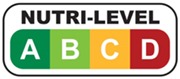
The requirements for sugar, salt, and fat content for each level are based on amounts per 100 milliliters of ready-to-eat processed food as follows:

Further requirements relating to nutrients reflected in the Nutri-Level labeling include:

  • Foods labeled as level A are not allowed to contain natural or artificial sweetening food additives, either through direct addition or carried over from other ingredients.
  • Foods labeled as level B may only contain natural sweetening food additives.
  • Foods labeled as level C or D may use natural and artificial sweetening food additives.
  • “Sugar” includes all monosaccharides and disaccharides, excluding lactose.
  • Processed plain liquid milk and plain milk powder are exempt from the requirement to declare total fat content on the Nutri-Level label.

Labeling Implementation

The implementation of Nutri-Level labeling must comply with the following requirements:

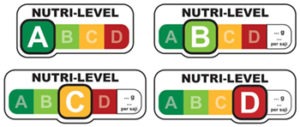
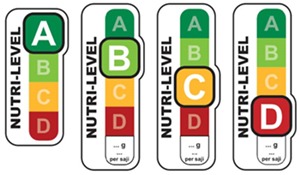
  • The Nutri-Level label must list all four letters (as shown in the examples below) unless the package meets the criteria for display of a simplified format label.
  • The Nutri-Level of the processed food must be indicated by enlarging the relevant letter, as shown in the examples below.
  • Processed foods at levels C and D must include a Nutri-Level label, while processed foods at levels A and B may do so on a voluntary basis.
  • The inclusion of a Nutri-Level label on processed foods at levels C and D must be accompanied by the sugar, salt, and fat content per serving (per saji in Indonesian, as shown in the examples below) or per package.

Nutri-Level Label Format

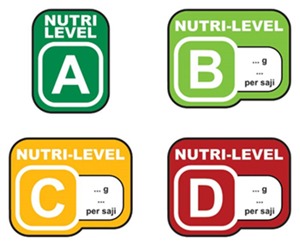
The draft regulation provides Nutri-Level label examples in both full and simplified formats. The simplified format applies to small packages of 30 square centimeters or less, while the full format must be used on other packages.

Full (horizontal)
Full (vertical)
Simplified
Timeline for Compliance

The draft regulation provides a grace period for existing product registrations:

  • Processed food that has obtained a product registration or for which a product registration application is pending before the regulation comes into effect must be amended within 30 months of the effective date of the regulation.
  • Ready-to-drink beverages, liquid concentrates, and powdered beverages must be amended within 18 months of the effective date of the regulation.

It is anticipated that the draft regulation will be finalized by the end of 2024.

For more details on this draft regulation, or on any aspect of food labeling requirements in Indonesia, please contact Tilleke & Gibbins at [email protected].

RELATED INSIGHTS​ 

April 19, 2022
New technologies and production processes in the food industry have led to novel foods becoming increasingly important to both food manufacturers and the consuming public worldwide. This is very much the case across a number of jurisdictions in Southeast Asia. “Novel foods” refer to new food production processes, foods, and ingredients that have not yet been commonly used for human consumption, so these innovative foods require safety assessments before companies can produce and market them. While rules for these safety assessments are already part of novel food regulations in several other jurisdictions—such as the novel food regulations in the United Kingdom and European Union adopted in 2003, and the major reform of food safety laws in the United States passed in 2011 under the Food Modernization Act—similar rules governing the assessment of novel foods are relatively new or yet to be introduced in many parts of Asia. Nevertheless, it is important to understand the laws and practices that apply to safety assessments and the process of bringing novel foods to market in jurisdictions in the region. This article provides some clarity in this regard by summarizing important practical information on novel foods and the relevant required safety assessments in Indonesia, Thailand, and Vietnam.   Indonesia Regulator National Agency for Drug and Food Control (NADFC); frequently referred to as BPOM (Badan Pengawas Obat dan Makanan). Relevant Measures BPOM Regulation No. 27 Year 2018 concerning Public Service Standards in BPOM; Decision of the Director of Processed Food Standardization No. HK.02.02.51.511.06.21.21 Year 2021 concerning Public Service Standard Directorate Processed Food Standardization Definitions General “food ingredients” are basic fresh or processed ingredients that can be used to produce food; novel food is any food ingredient not listed in BPOM’s positive list of ingredients. Official Fees None   Process and Timeline Before submitting an
March 31, 2022
Since the onset of the COVID-19 pandemic and the ensuing safety measures, many Thai retailers have shifted their sales toward online platforms. Unsurprisingly, counterfeiters have followed suit. The online sale of counterfeit healthcare and other life sciences products (e.g., food, cosmetics, and medical devices) is an area of significant concern, as it is particularly prevalent, damaging, and complex in relation to Thailand’s laws. This article outlines this type of counterfeiting activity in Thailand and explains some important tools brand owners have for fighting it. Counterfeiting Operations Although illicit operations seek to avoid being identified by authorities and brand owners, investigations by law enforcement and Tilleke & Gibbins on behalf of clients have yielded some insights into how these illegitimate sellers typically operate. Often, consumers are first exposed to these counterfeit life sciences products by paid social media advertisements that link to social media accounts set up by sellers impersonating brand owners. This brand impersonation may include unauthorized use of a trademark or trade name as part of the account name, and unauthorized reproduction of official advertisement artwork or product descriptions, taken directly from the official social media account. From the fake social media account, consumers are usually directed to a merchant website that contains consumer reviews, which are entirely fabricated. While not every counterfeiting operation follows this exact blueprint, employing some variation of these methods lends counterfeiting platforms the ability to proliferate through multiple iterations, as well as believability in the eyes of consumers. How Brand Owners Can Take Action Life sciences brand owners often discover that their products have been targeted by counterfeiters when a counterfeit item injures or negatively impacts a consumer. Thinking that the product is genuine, the consumer may then complain to the brand owner, or worse, file a complaint with the authorities. Many times
March 15, 2022
Indonesia’s National Agency of Drug and Food Control (BPOM) has recently issued several new regulations governing advertisements for cosmetic products in the country. The main regulation—BPOM Regulation No. 32 of 2021 concerning Cosmetics Advertising—took effect on December 13, 2021, and revokes previous regulations regarding cosmetics advertising from 2016. The key aspects of the new regulation are outlined below. Cosmetic Claims The list of prohibited claims for cosmetic products is no longer included with the regulation. Instead, BPOM issued a stand-alone regulation on cosmetic claims as Regulation No. 3 of 2022, which was enacted on January 7, 2022. This regulation on cosmetic claims contains nonexhaustive lists of prohibited and allowed claims for cosmetic products. The new regulation states that published cosmetics advertisements must correspond to the information on the cosmetic product notification. This differs from the previous regulation, which only stated that published cosmetics advertisements were acceptable as long as they were in accordance with the Technical Guidelines for Cosmetics Advertising. Nonetheless, advertisements for cosmetics still do not have to be approved by BPOM prior to their publication. Publication Media Unlike the previous regulation, which only listed electronic, printed, or outdoor media for publishing advertisements for cosmetic products, the new regulation details six main types of advertising media: Printed media: Gazettes, magazines, tabloids, newspapers, bulletins, posters or flyers, leaflets, stickers, booklets, pamphlets, yellow pages, catalogs, and any other printed media  targeting a limited audience in a certain sector, industry, entity, or profession (i.e., non-mass media). Broadcast media: Television (including running-text classifieds, superimposed ads, and “built-in” ads displayed during a television program), radio, and cinema. Online media: Activities (such as searches of websites and webpages), e-commerce, games, social media (e.g., Instagram, Facebook, Twitter), applications, publications, transportation on demand, display ads, video ads, and entertainment, in various possible formats (such as video,
March 8, 2022
Attorneys from Tilleke & Gibbins’ offices in Vietnam have contributed the Vietnam chapter to Pharmaceutical Advertising 2022 from Chambers & Partners. Pharmaceutical Advertising 2022—the fifth annual edition of this practice guide—provides information on pharmaceutical advertising regulations in 18 jurisdictions around the world. The guidance is especially useful for pharmaceutical manufacturers looking to share their products and innovations with the public in a responsible, transparent way that is compliant with local laws. The Vietnam chapter specifically the following topics: Regulatory Framework for pharmaceutical advertising Scope of advertising and general principles Advertising of unauthorized medicines or unauthorized indications Advertising pharmaceuticals to the general public Advertising to healthcare professionals Vetting requirements and internal verification compliance Advertising of medicinal products on the internet Inducement and antibribery Gifts, hospitality, congresses and related payments Transparency considerations for pharmaceutical companies Enforcement of pharmaceutical advertising rules Tilleke & Gibbins also provided the Thailand chapter to this guide. Chambers & Partners’ Global Practice Guides provide in-house counsel with expert legal commentary focusing on practical legal issues affecting business, and enable readers to compare legislation and relevant procedures across a range of key jurisdictions. The full Pharmaceutical Advertising 2022 guide—including the Vietnam chapter—is available for free on the Chambers and Partners website. The Vietnam chapter is also available as a PDF through the button below.