
You are using an outdated browser and your browsing experience will not be optimal. Please update to the latest version of Microsoft Edge, Google Chrome or Mozilla Firefox. Install Microsoft Edge

October 1, 2024

Indonesia Prepares to Require Nutritional Labeling for Sugar, Salt, and Fat Content

The Indonesian food and drug authority, also known as “BPOM,” issued a draft regulation on September 9, 2024, proposing standard labeling disclosing the sugar, salt, and fat content of packaged food products sold in the country.

The draft Regulation on Nutritional Value Information on Food Labels to implement Government Regulation No. 28 of 2024 on the Implementation of the Health Law seeks to mandate “Nutri-Level” front-of-pack nutrition labeling to indicate the amount of sugar, salt, and fat at four possible levels, with a modified stoplight-color system:

  • Level “A” (lowest amount) has a dark green background
  • Level “B” has a light green background
  • Level “C” has a yellow background
  • Level “D” (highest amount) has a red background

These levels are shown in the following sample image:
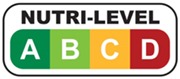
The requirements for sugar, salt, and fat content for each level are based on amounts per 100 milliliters of ready-to-eat processed food as follows:

Further requirements relating to nutrients reflected in the Nutri-Level labeling include:

  • Foods labeled as level A are not allowed to contain natural or artificial sweetening food additives, either through direct addition or carried over from other ingredients.
  • Foods labeled as level B may only contain natural sweetening food additives.
  • Foods labeled as level C or D may use natural and artificial sweetening food additives.
  • “Sugar” includes all monosaccharides and disaccharides, excluding lactose.
  • Processed plain liquid milk and plain milk powder are exempt from the requirement to declare total fat content on the Nutri-Level label.

Labeling Implementation

The implementation of Nutri-Level labeling must comply with the following requirements:

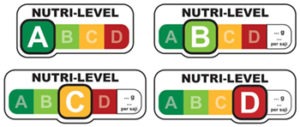
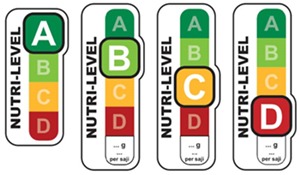
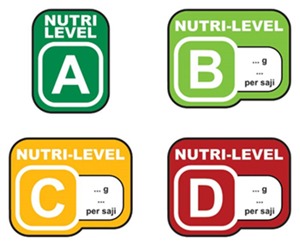
  • The Nutri-Level label must list all four letters (as shown in the examples below) unless the package meets the criteria for display of a simplified format label.
  • The Nutri-Level of the processed food must be indicated by enlarging the relevant letter, as shown in the examples below.
  • Processed foods at levels C and D must include a Nutri-Level label, while processed foods at levels A and B may do so on a voluntary basis.
  • The inclusion of a Nutri-Level label on processed foods at levels C and D must be accompanied by the sugar, salt, and fat content per serving (per saji in Indonesian, as shown in the examples below) or per package.

Nutri-Level Label Format

The draft regulation provides Nutri-Level label examples in both full and simplified formats. The simplified format applies to small packages of 30 square centimeters or less, while the full format must be used on other packages.

Full (horizontal)
Full (vertical)
Simplified
Timeline for Compliance

The draft regulation provides a grace period for existing product registrations:

  • Processed food that has obtained a product registration or for which a product registration application is pending before the regulation comes into effect must be amended within 30 months of the effective date of the regulation.
  • Ready-to-drink beverages, liquid concentrates, and powdered beverages must be amended within 18 months of the effective date of the regulation.

It is anticipated that the draft regulation will be finalized by the end of 2024.

For more details on this draft regulation, or on any aspect of food labeling requirements in Indonesia, please contact Tilleke & Gibbins at [email protected].

RELATED INSIGHTS​ 

August 25, 2022
On July 27, 2022, Myanmar’s Ministry of Commerce (MOC) issued Newsletter No. 8/2022 to effectively ban foreign companies and foreign joint ventures from exporting value-added beans, corn, and sesame. This newsletter repealed Newsletter No. 2/2020, which had prescribed the criteria for beans, corn, and sesame to be considered “value-added” crops. These criteria had to be fulfilled in order for these commodities to be exported in accordance with Notification No. 24/2019, which had permitted foreign companies and foreign joint ventures to purchase seven categories of commodities from local manufacturers for export, subject to certain terms and conditions. These include: Meat and fish; Value-added crops; Pulp and paper; Seeds; Refined metals; Semi-finished or finished valued-added fruit products; and Timber-based furniture. With the repeal of the conditions in Newsletter No. 2/2020, foreign exporters are left with no reference criteria for how to achieve “value-added” status for beans, corn, and sesame, and thus will not be able to submit a complete application for the necessary export license. However, exportation of the other items in the list above remains unaffected and open to foreign exporters who meet the applicable requirements. The MOC explained their decision to revoke the permitted criteria by noting that some foreign companies were not actually producing beans, corn, and sesame that fulfilled the criteria for value-added status as laid out in Newsletter No. 2/2020, but were falsely exporting their goods as “value-added crops.” The revocation of the export criteria for beans, corn, and sesame took immediate effect. For more details on these export restrictions, or on any aspect of importation and exportation regulations in Myanmar, please contact Tilleke & Gibbins at [email protected].
August 23, 2022
On July 13, 2022, the Vietnamese government issued Decree No. 46/2022/ND-CP amending and supplementing some articles of Decree No. 13/2020/ND-CP providing detailed guidance on the Law on Animal Husbandry (“Decree 46”). The new decree took effect on the issuance date. Among the changes introduced by Decree 46 are a number related to animal feed. Recognition of Testing Methods of Exporting Countries Decree 46 clarifies the steps to recognize animal feed testing methods of laboratories in exporting countries. Under the amended regulations, the Department of Livestock Production (DLP) will organize an assessment team to appraise each dossier for recognition of animal feed testing methods within 30 days of receipt of a complete dossier. If the dossier lacks required information or authenticity, the DLP will organize a practical assessment team at the exporting country’s testing laboratory. If the dossier passes the assessment, within five working days from the completion of the assessment, the DLP will issue a decision on recognition of the testing method. The validity of this decision has been lengthened from three years to five years. State Inspection of Animal Feed Quality Process of State Inspection Decree 46 specifies the process to conduct state inspection of the quality of imported animal feed by unifying the regulations stipulated in the related legal documents listed in Decree 13. The process includes the submission of a state inspection dossier, timelines to receive feedback from the inspection authority, and further steps that can be taken upon receiving acceptance or refusal decisions from the authority. For traditional animal feed and complete compound animal feed, imported shipments are customs-cleared as soon as the importer completes the customs procedures. Within 15 days from the customs clearance date, the importer must submit the conformity assessment results. The importer has complete responsibility for the conformity assessment results, and
August 18, 2022
Practical Law has published an updated online version of Agricultural Law in Thailand, a Q&A-style guide that provides detailed overviews of Thailand’s agriculture laws and regulations. The Thailand overview is one of approximately twenty such guides to jurisdictions worldwide, covering key practical issues related to the legal environment for agricultural operations. The Thailand section, which was written by lawyers at Tilleke & Gibbins, covers the following topics: Agricultural policy Acquisition of agricultural companies Acquisition of agricultural land Crop seed business Plant variety rights Genetically modified crops Animal and animal welfare issues Agricultural safety and product liability Practical Law, produced by Thomson Reuters, is a comprehensive global legal resource for business lawyers. The platform features a wide range of guides covering hundreds of jurisdictions and practice areas. The full Agricultural Law in Thailand chapter can be accessed on the Practical Law website.
August 9, 2022
In late 2021, the government of Vietnam issued Decree 98 on the management of medical devices (Decree No. 98/2021/ND-CP dated November 8, 2021), which came into force on January 1, 2022. This is the primary legislation on medical devices in Vietnam. To provide necessary guidance and elaboration on the implementation of Decree 98, the Ministry of Health recently issued Circular No. 05/2022/TT/BYT dated August 1, 2022 (“Circular 05”), which took effect on the same day. The most notable aspect of Circular 05 is that it unifies, in a single legislative document, previous regulations on medical devices that were scattered in multiple circulars issued by the Ministry of Health (Circular No. 39/2016/TT-BYT dated October 28, 2106; Circular No. 46/2017/TT-BYT dated December 15, 2017, as amended by Circular No. 23/2021/TT-BYT dated December 9, 2021; and Circular No. 33/2020/TT-BYT dated December 31, 2020). The effectiveness of these circulars was terminated when Circular 05 took effect. Circular 05 sets out regulations and principles for the classification of medical devices, and adds or supplements the following lists: List of in vitro diagnostic medical devices (IVD) not subject to quality assessment by Vietnamese competent authorities when registering under the quick registration procedure. List of class B, C and D medical devices allowed to be traded as normal goods. List of medical devices required to be accredited for safety and technical functions before use. List of medical devices requiring import permit licenses. While Circular 05 does not introduce major changes to the previous regulations, the consolidation and up-to-date guidance on Decree 98 will simplify the task of registration and circulation for medical device companies doing business in Vietnam.