
You are using an outdated browser and your browsing experience will not be optimal. Please update to the latest version of Microsoft Edge, Google Chrome or Mozilla Firefox. Install Microsoft Edge

October 1, 2024

Indonesia Prepares to Require Nutritional Labeling for Sugar, Salt, and Fat Content

The Indonesian food and drug authority, also known as “BPOM,” issued a draft regulation on September 9, 2024, proposing standard labeling disclosing the sugar, salt, and fat content of packaged food products sold in the country.

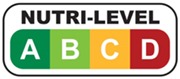
The draft Regulation on Nutritional Value Information on Food Labels to implement Government Regulation No. 28 of 2024 on the Implementation of the Health Law seeks to mandate “Nutri-Level” front-of-pack nutrition labeling to indicate the amount of sugar, salt, and fat at four possible levels, with a modified stoplight-color system:

  • Level “A” (lowest amount) has a dark green background
  • Level “B” has a light green background
  • Level “C” has a yellow background
  • Level “D” (highest amount) has a red background

These levels are shown in the following sample image:
The requirements for sugar, salt, and fat content for each level are based on amounts per 100 milliliters of ready-to-eat processed food as follows:

Further requirements relating to nutrients reflected in the Nutri-Level labeling include:

  • Foods labeled as level A are not allowed to contain natural or artificial sweetening food additives, either through direct addition or carried over from other ingredients.
  • Foods labeled as level B may only contain natural sweetening food additives.
  • Foods labeled as level C or D may use natural and artificial sweetening food additives.
  • “Sugar” includes all monosaccharides and disaccharides, excluding lactose.
  • Processed plain liquid milk and plain milk powder are exempt from the requirement to declare total fat content on the Nutri-Level label.

Labeling Implementation

The implementation of Nutri-Level labeling must comply with the following requirements:

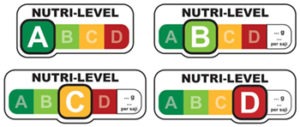
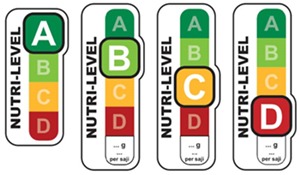
  • The Nutri-Level label must list all four letters (as shown in the examples below) unless the package meets the criteria for display of a simplified format label.
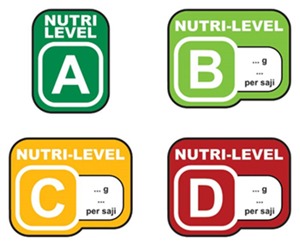
  • The Nutri-Level of the processed food must be indicated by enlarging the relevant letter, as shown in the examples below.
  • Processed foods at levels C and D must include a Nutri-Level label, while processed foods at levels A and B may do so on a voluntary basis.
  • The inclusion of a Nutri-Level label on processed foods at levels C and D must be accompanied by the sugar, salt, and fat content per serving (per saji in Indonesian, as shown in the examples below) or per package.

Nutri-Level Label Format

The draft regulation provides Nutri-Level label examples in both full and simplified formats. The simplified format applies to small packages of 30 square centimeters or less, while the full format must be used on other packages.

Full (horizontal)
Full (vertical)
Simplified
Timeline for Compliance

The draft regulation provides a grace period for existing product registrations:

  • Processed food that has obtained a product registration or for which a product registration application is pending before the regulation comes into effect must be amended within 30 months of the effective date of the regulation.
  • Ready-to-drink beverages, liquid concentrates, and powdered beverages must be amended within 18 months of the effective date of the regulation.

It is anticipated that the draft regulation will be finalized by the end of 2024.

For more details on this draft regulation, or on any aspect of food labeling requirements in Indonesia, please contact Tilleke & Gibbins at [email protected].

RELATED INSIGHTS​ 

August 29, 2023
Laos’ Ministry of Health (MOH) has promulgated a regulation detailing registration and notification protocols for medical devices. Decision on the Registration and Notification of Medical Devices No. 1470/MOH will come into force 60 days after both the signing of the regulation (which already occurred in July) and publication in the Official Gazette, which has not yet been specified by the government. Registration of medical devices in Laos is mentioned in the country’s Law on Drugs and Medical Products No. 07/NA, dated December 21, 2011, but a registration procedure has not been put in place. There was only a separate requirement to furnish certain required documents when importing medical devices. Now, the decision outlines the registration and notification process for medical devices through the Ministry of Health’s Food and Drug Department (FDD), in line with the regulatory principles in the ASEAN Medical Device Directive of 2015, which Laos has ratified. Medical Devices in Laos The decision defines medical devices as any instrument, apparatus, implement, machine, appliance, implant, in vitro reagent or calibrator, software, material, or other similar or related article intended for any of the following uses in humans: Diagnosis, prevention, monitoring, recovery from, or alleviation or treatment of a disease; Diagnosis, monitoring, recovery from, or alleviation of or compensation for an injury; Replacement, modification, or support of anatomy or a physiological process; Supporting and sustaining life; Controlling or assisting in conception; or Disinfection and sterilization of tools and medical devices. Medical devices in Laos are given one of four classifications based on their level of risk: Class A – Low risk (e.g., rubber belts, cotton for medical purposes, nonwoven swabs, adhesive bandages) Class B – Low-moderate risk (e.g., neonatal suction equipment, surgical gloves, gastro-catheters) Class C – Moderate-high risk (e.g., endoscopic surgical equipment, anesthesia equipment, peritoneal dialysis equipment) Class
August 29, 2023
Since the June 9, 2022, delisting of all parts of the cannabis plant according to the Narcotics Code, there has been an explosion of cannabis dispensaries operating in Thailand. The Department of Thai Traditional and Alternative Medicine (DTTAM) has issued more than 12,000 cannabis dispensary licenses to businesses in Thailand. A license allows a dispensary to sell cannabis flowers legally. In addition, the DTTAM requests the cooperation of dispensaries in submitting monthly reports about the sourcing, selling, and inventory of cannabis flowers. The DTTAM may suspend the selling license of dispensaries that fail to submit these reports. Apart from the enforcement duties and administrative acts of the DTTAM, the enactment of the laws and regulations pertaining to cannabis seemed to be drastically winding down. One of the reasons was that Thailand had delays in the process of forming a new government following the general election of May 14, 2023. These delays dampened Thailand’s thriving cannabis industry. In particular, the industry has concerns about the uncertainty of the nascent cannabis law. On August 11, 2023, the Narcotics Control Division of the Thai Food and Drug Administration (FDA) posted the Draft Regulation Re: Application for Approval and Approval for Manufacture, Importation, Exportation, Distribution or Possession of Narcotics under Category 5 (Extracts from Cannabis or Hemp Plants Only). This may be the first regulation that the newly formed government implements with regard to cannabis extracts. Unlike the DTTAM’s enforcement activities, the Thai FDA requests that a domestic manufacturer, importer, exporter, or seller of cannabis extracts apply for a license. The Thai FDA, as the authority, will consider granting a license only in the following cases: For medical benefits; For commercial or industrial benefits; For the benefit of medical or scientific analysis or research; and For use by the government for preventing and
July 11, 2023
Enacted in 2009, Indonesia’s current Law on Health (Law No. 36/2009) is due for a refresh. The government realized that the law has not maintained its relevance when it comes to health trends such as digital health, which refers to the provision of health services online (also commonly known as telemedicine). While regulations and policy blueprints, such as Ministry of Health (MOH) Regulation No. 46/2017 concerning National E-Health Strategies, have addressed these shifting trends, Indonesia’s main health legislation has proved inadequate in this regard. For this reason, the government began making plans for an update to the law, and the first draft Omnibus Health Law was published in March 2023. The law addresses digital health and other important issues in today’s health landscape, and it seeks to promote the use of locally made health supplies. The draft Omnibus Health Law represents a notable step forward, but in its attempt to govern and regulate all aspects of health, there are also some issues in the draft that may overlap with some existing government regulations, such as provisions on Halal certification, compulsory licensing of patents, and addictive substances. This article outlines some of the draft law’s key aspects as well as some potential issues. Digital Health In addressing the growing health trend of telemedicine, the draft law confirms, reinforces, and fills gaps left by Indonesia’s three main regulations concerning telemedicine. namely, MOHR No. 20/2019 concerning Telemedicine, MOHR No. 24/2022 concerning Medical Records, and Medical Council Regulation No. 74/2020 concerning Telemedicine (MCR No. 74/2020). One of these regulations, MOH Regulation No. 20/2019, allows health service facilities to provide telemedicine services to other health service facilities. This covers telemedicine services related to radiology, electrocardiography, ultrasonography, and telemedicine consultancy services—including those that reflect developments in science and technology. This is the only regulation concerning
July 10, 2023
One of the more positive outcomes of the COVID-19 pandemic is that telemedicine has become remarkably important as an interactive system between patients and healthcare professionals. Thailand, which ranks near the top as a world medical hub, is a highly favored destination in Asia for expat workers. Currently, the Thai market has both Thai-based and foreign-based platforms with information about healthcare providers and telemedicine readily available. “Doctor Locator,” “Weed Map,” and “Find a Teeth Aligner Dentist” are examples of online platforms connecting patients with medical and telemedicine services. These digital platforms provide information about the location of specialized clinics, cannabis dispensaries, pharmacy stores, and orthodontic practitioners in Thailand. These platforms act as intermediaries between medical care businesses and consumers. As actual medical services are not offered or provided, these digital platforms do not have to be regulated under the Medical Facility Act of Thailand. However, healthcare digital platform services that act as an intermediary or conduit managing information used to connect medical clinics or cannabis dispensaries with patients or customers via a computer network are now regulated under the soon-to-be-implemented Royal Decree on Digital Platforms, regardless of whether payment is actually made via the platform. The regulatory authority for this is the Electronic Transactions Development Agency (ETDA). Under this royal decree, digital platform providers that intend to operate a digital platform service must notify the ETDA prior to initiating operations. The extent of the details to be included in the notification to the ETDA will be more comprehensive if the digital platform: has annual revenue (before expenses) for digital platform services within Thailand exceeding THB 1.8 million (approx. USD 51,200) for an individual operator or THB 50 million (approx. USD 1.42 million) for a corporate or entity operator; or has more than 5,000 users (on average) per month. Apart