
You are using an outdated browser and your browsing experience will not be optimal. Please update to the latest version of Microsoft Edge, Google Chrome or Mozilla Firefox. Install Microsoft Edge

October 1, 2024

Indonesia Prepares to Require Nutritional Labeling for Sugar, Salt, and Fat Content

The Indonesian food and drug authority, also known as “BPOM,” issued a draft regulation on September 9, 2024, proposing standard labeling disclosing the sugar, salt, and fat content of packaged food products sold in the country.

The draft Regulation on Nutritional Value Information on Food Labels to implement Government Regulation No. 28 of 2024 on the Implementation of the Health Law seeks to mandate “Nutri-Level” front-of-pack nutrition labeling to indicate the amount of sugar, salt, and fat at four possible levels, with a modified stoplight-color system:

  • Level “A” (lowest amount) has a dark green background
  • Level “B” has a light green background
  • Level “C” has a yellow background
  • Level “D” (highest amount) has a red background

These levels are shown in the following sample image:
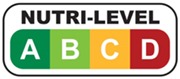
The requirements for sugar, salt, and fat content for each level are based on amounts per 100 milliliters of ready-to-eat processed food as follows:

Further requirements relating to nutrients reflected in the Nutri-Level labeling include:

  • Foods labeled as level A are not allowed to contain natural or artificial sweetening food additives, either through direct addition or carried over from other ingredients.
  • Foods labeled as level B may only contain natural sweetening food additives.
  • Foods labeled as level C or D may use natural and artificial sweetening food additives.
  • “Sugar” includes all monosaccharides and disaccharides, excluding lactose.
  • Processed plain liquid milk and plain milk powder are exempt from the requirement to declare total fat content on the Nutri-Level label.

Labeling Implementation

The implementation of Nutri-Level labeling must comply with the following requirements:

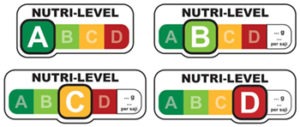
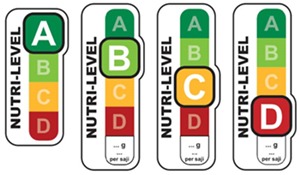
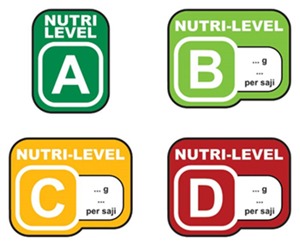
  • The Nutri-Level label must list all four letters (as shown in the examples below) unless the package meets the criteria for display of a simplified format label.
  • The Nutri-Level of the processed food must be indicated by enlarging the relevant letter, as shown in the examples below.
  • Processed foods at levels C and D must include a Nutri-Level label, while processed foods at levels A and B may do so on a voluntary basis.
  • The inclusion of a Nutri-Level label on processed foods at levels C and D must be accompanied by the sugar, salt, and fat content per serving (per saji in Indonesian, as shown in the examples below) or per package.

Nutri-Level Label Format

The draft regulation provides Nutri-Level label examples in both full and simplified formats. The simplified format applies to small packages of 30 square centimeters or less, while the full format must be used on other packages.

Full (horizontal)
Full (vertical)
Simplified
Timeline for Compliance

The draft regulation provides a grace period for existing product registrations:

  • Processed food that has obtained a product registration or for which a product registration application is pending before the regulation comes into effect must be amended within 30 months of the effective date of the regulation.
  • Ready-to-drink beverages, liquid concentrates, and powdered beverages must be amended within 18 months of the effective date of the regulation.

It is anticipated that the draft regulation will be finalized by the end of 2024.

For more details on this draft regulation, or on any aspect of food labeling requirements in Indonesia, please contact Tilleke & Gibbins at [email protected].

RELATED INSIGHTS​ 

July 10, 2023
On June 30, 2023, the Ministry of Health of Vietnam issued Circular No. 14/2023/TT-BYT stipulating the process and procedure for building bidding package prices for procurement of goods and services in the field of medical devices at public health facilities (“Circular 14”). Circular 14 took effect on July 1, 2023, and will be valid through the end of 2023. Circular 14 applies to the procurement of medical devices/equipment and their accessories, spare parts, and supplies, as well as related services of repair, maintenance, inspection, and calibration. Under Circular 14, there are three methods of determining the price of bidding packages: Collecting quotations provided by suppliers of goods and services in the field of medical devices. Surveying the winning bid prices of similar goods and services on the national bidding network system (https://muasamcong.gov.vn). Using the results of price appraisal of a competent state agency that conducts price appraisal, or a specialized price appraisal enterprise. Method (i) must be used first; the two remaining methods can be applied only after method (i) has been unsuccessful. If the investor/procuring entity uses two or more methods to determine the price of bidding packages, it can select the highest price that is suitable to its financial capacity and professional requirements. Circular 14 further sets out the specific step-by-step process to build prices for procuring products and services in the field of medical devices/equipment. Transitional Provision For bidding packages that have already approved a contractor selection plan before July 1, 2023, the approved contractor selection plan will be followed. For bidding packages for which a contractor selection plan has been submitted by the investor/procuring entity but the plan has not yet been approved, the competent person can decide on the approval of the submitted plan or can request the investor/procuring entity to rebuild the bidding
July 4, 2023
Practitioners from Tilleke & Gibbins’ Vietnam offices contributed content for the latest edition of the Practical Law Life Sciences Global Guide. The guide provides a comparative overview, in Q&A format, of laws and regulations on pharmaceuticals, medical devices, and other life sciences products in dozens of jurisdictions around the world. The Life Sciences Global Guide is divided into two sections: Regulation (see more details here) and Commercialization, which covers the following topics: Overview of the life sciences sector Pricing, government funding, and reimbursement: National health care system, price regulation and reimbursement Distribution and sale Cross-border trade and parallel imports Advertising to the public and engagement with patient organizations Advertising to healthcare professionals and organizations: Gifts and incentives and transparency and disclosure Patents: Conditions for patentability, registration, length of protection, infringement, international treaties Trademarks: Requirements, registration Competition law issues: Authorities and legislation, commercial contracts and competition law, licensing approvals and formalities Product liability: Regulators, medicinal product liability law, liable partners, defenses, product liability claims, remedies Practical Law, produced by Thomson Reuters, is the world’s leading legal know-how resource for business lawyers, publishing a huge range of guides covering hundreds of jurisdictions and practice areas. The full “Life Sciences Commercialization in Vietnam” section can be found on the Practical Law website.
July 4, 2023
Practitioners from Tilleke & Gibbins’ Vietnam offices contributed content for the latest edition of the Practical Law Life Sciences Global Guide. The guide provides a comparative overview, in Q&A format, of laws and regulations on pharmaceuticals, medical devices, and other life sciences products in dozens of jurisdictions around the world. The Life Sciences Global Guide is divided into two sections: Commercialization (see more details here) and Regulation, which covers the following topics: Pharmaceuticals: Laws and regulatory authorities Clinical trials: Legal, regulatory, and procedural requirements Manufacturing and distribution Marketing: Authorization for marketing medicinal products, monitoring compliance and penalties, pharmacovigilance and other commitments, foreign marketing authorizations Data privacy Packaging, labeling, and tracking Biological medicines Medical devices: Legislation and regulatory authorities, definition and classification Healthcare IT Combination products and borderlines Natural health products Recent developments and reform proposals Practical Law, produced by Thomson Reuters, is the world’s leading legal know-how resource for business lawyers, publishing a huge range of guides covering hundreds of jurisdictions and practice areas. The full “Life Sciences Regulation in Vietnam” section can be found on the Practical Law website.
June 1, 2023
Life sciences specialists from Tilleke & Gibbins have supplied the Thailand and Vietnam contributions to the International Bar Association (IBA) Healthcare and Life Sciences Law Committee’s global telemedicine survey. The survey, spanning 54 jurisdictions worldwide, functions as a comparative legal guide on the provision of telemedicine and related products and services. It offers practitioners and industry users access to relevant rules and regulations, addressing key aspects such as regulation, data privacy, liability, and recent developments in telemedicine. Telemedicine has emerged as a transformative force in healthcare, revolutionizing the way medical services are accessed and delivered. As in many other jurisdictions, telemedicine has gained prevalence in Thailand and Vietnam, as it enables patients to remotely consult with healthcare professionals, access diagnostic services, and receive timely medical advice while minimizing physical contact. As the global healthcare landscape continues to evolve, understanding the legal and regulatory aspects of telemedicine becomes paramount, making initiatives like the IBA’s telemedicine survey vital for practitioners and industry stakeholders. The IBA is a globally recognized organization that brings together legal professionals and bar associations from around the world, and its Healthcare and Life Sciences Law Committee plays a crucial role in addressing legal issues and developments in the healthcare industry. The complete surveys for Thailand and Vietnam­—and the 52 other participating jurisdictions—are available on the IBA website.