
You are using an outdated browser and your browsing experience will not be optimal. Please update to the latest version of Microsoft Edge, Google Chrome or Mozilla Firefox. Install Microsoft Edge

October 1, 2024

Indonesia Prepares to Require Nutritional Labeling for Sugar, Salt, and Fat Content

The Indonesian food and drug authority, also known as “BPOM,” issued a draft regulation on September 9, 2024, proposing standard labeling disclosing the sugar, salt, and fat content of packaged food products sold in the country.

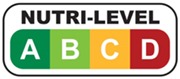
The draft Regulation on Nutritional Value Information on Food Labels to implement Government Regulation No. 28 of 2024 on the Implementation of the Health Law seeks to mandate “Nutri-Level” front-of-pack nutrition labeling to indicate the amount of sugar, salt, and fat at four possible levels, with a modified stoplight-color system:

  • Level “A” (lowest amount) has a dark green background
  • Level “B” has a light green background
  • Level “C” has a yellow background
  • Level “D” (highest amount) has a red background

These levels are shown in the following sample image:
The requirements for sugar, salt, and fat content for each level are based on amounts per 100 milliliters of ready-to-eat processed food as follows:

Further requirements relating to nutrients reflected in the Nutri-Level labeling include:

  • Foods labeled as level A are not allowed to contain natural or artificial sweetening food additives, either through direct addition or carried over from other ingredients.
  • Foods labeled as level B may only contain natural sweetening food additives.
  • Foods labeled as level C or D may use natural and artificial sweetening food additives.
  • “Sugar” includes all monosaccharides and disaccharides, excluding lactose.
  • Processed plain liquid milk and plain milk powder are exempt from the requirement to declare total fat content on the Nutri-Level label.

Labeling Implementation

The implementation of Nutri-Level labeling must comply with the following requirements:

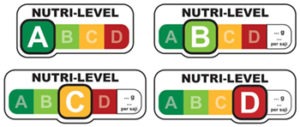
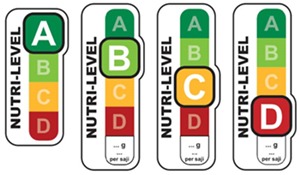
  • The Nutri-Level label must list all four letters (as shown in the examples below) unless the package meets the criteria for display of a simplified format label.
  • The Nutri-Level of the processed food must be indicated by enlarging the relevant letter, as shown in the examples below.
  • Processed foods at levels C and D must include a Nutri-Level label, while processed foods at levels A and B may do so on a voluntary basis.
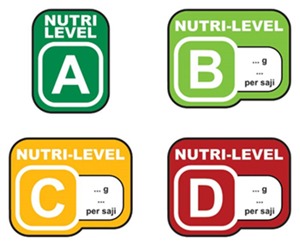
  • The inclusion of a Nutri-Level label on processed foods at levels C and D must be accompanied by the sugar, salt, and fat content per serving (per saji in Indonesian, as shown in the examples below) or per package.

Nutri-Level Label Format

The draft regulation provides Nutri-Level label examples in both full and simplified formats. The simplified format applies to small packages of 30 square centimeters or less, while the full format must be used on other packages.

Full (horizontal)
Full (vertical)
Simplified
Timeline for Compliance

The draft regulation provides a grace period for existing product registrations:

  • Processed food that has obtained a product registration or for which a product registration application is pending before the regulation comes into effect must be amended within 30 months of the effective date of the regulation.
  • Ready-to-drink beverages, liquid concentrates, and powdered beverages must be amended within 18 months of the effective date of the regulation.

It is anticipated that the draft regulation will be finalized by the end of 2024.

For more details on this draft regulation, or on any aspect of food labeling requirements in Indonesia, please contact Tilleke & Gibbins at [email protected].

RELATED INSIGHTS​ 

January 8, 2021
Across the globe, the demand for COVID-19 vaccinations has been understandably high, with many regulatory authorities (e.g., U.S. Food and Drug Administration, Medicines & Healthcare Products Regulatory Agency in the U.K., European Medicine Agency, Swissmedic, etc.) issuing emergency use authorizations for COVID-19 vaccines. Similarly, the Thai Food and Drug Administration (Thai FDA) has published the Notification Re: Conditional Approval for Emergency Use of Medical Products, which allows drug importers to register COVID-19 vaccines under the conditional approval scheme.  While as of the date of this article, the Thai FDA has yet to authorize any COVID-19 vaccines, this should follow shortly as clinical trials are completed and government procurement negotiations progress. Under the notification, it appears that the channel of distribution of a COVID-19 vaccine under the conditional approval scheme would be strictly controlled by the Thai FDA. This channel includes the vaccine’s distribution to relevant government agencies (e.g., Department of Disease Control of Thailand and public hospitals specified by the Thai FDA). However, questions have been raised regarding which private hospitals would be included in the distribution list and how the Thai FDA would distribute the vaccine to private hospitals. This confusion over the role of private hospitals was seen recently when one private hospital advertised that it could secure the COVID-19 vaccine from one developer whose product had already been approved elsewhere, until the Thai FDA then stepped in and claimed that the advertisement violated the Drug Act. The Thai FDA notification also enumerates several essential criteria that must be fulfilled in seeking approval for a COVID-19 vaccine, including the following: The available scientific data must substantiate both the efficacy and safety of vaccine. Further, the risk-benefit analysis must indicate that the medicine’s benefits outweigh its risks. A risk management plan, including risk minimization measures, must be submitted.
January 8, 2021
At a meeting on December 21, 2020, the Thai Board of Investment (BOI) approved a series of stimulus packages aimed at encouraging local and foreign investment, as the government seeks to boost Thailand’s economic recovery from the COVID-19 pandemic. The additional investment incentives, which will be promoted by the BOI in the upcoming year, include a number of sector- and project-specific stimulus measures.   Additional Tax Incentives for Large-Scale Projects Projects in target industries with investment of at least THB 1 billion (approx. USD 33 million) over a 12-month period, starting from the issuance of the BOI promotion certificate, will be entitled to an additional 50% corporate income tax (CIT) deduction for a period of five years, calculated on top of the standard 5–8 year CIT exemptions offered under the normal BOI tax-incentive scheme. To obtain this special tax incentive, eligible projects may apply to the BOI from January 4 to December 30, 2021.   Stimulus Package for Digital Economy and Software Industry Projects that support digital technology adoption, such as software integration, artificial intelligence, machine learning, or big data analytics, may benefit from 50% CIT exemptions on profits generated from their existing BOI projects for an additional three years. Applications for the exemption must be submitted by the end of 2022.   Application Deadline Extensions for Special Economic Zones and Five Southern Provinces Measures relating to special economic zones cover more than 300 investment promotion categories, with both tax and non-tax incentives, including an additional tax incentive for target industries such as textiles, agriculture, home furniture, jewelry, and others. These incentives are available to projects located in the border areas of Thailand (i.e., the 10 special economic zones in the provinces of Chiang Rai, Kanchanaburi, Mukdahan, Nakhon Phanom, Narathiwat, Nong Khai, Sa Kaeo, Songkhla, Tak, and Trat), with the
December 21, 2020
As we continue to await the Thai Food and Drug Administration (TFDA)’s promulgation of its medical cannabis application guidelines, the Thai Ministry of Public Health (TMoPH) has helpfully issued several notifications to further clarify the 2019 amendment to the Narcotics Act that initially paved the way for cannabis liberalization in the kingdom. Cannabis (both marijuana and hemp) has been classified as a Category 5 Narcotic since the enactment of the Narcotics Act in 1979. All activities related to the plants and their derivatives had been strictly restricted until the recent rise of the cannabis legalization movement, which began in Thailand with an amendment to the Narcotics Act in February 2019 to legalize medical marijuana. The Thai government has since been working to reclassify cannabis products and lay out the regulatory pathways to accommodate these new “economic plants.” A notification in August 2019 further carved modern drugs, cosmeceuticals, nutraceuticals, cosmetics, and food containing hemp or a certain amount of CBD out of the scope of Narcotics Act. The most recent TMoPH Notification was published in the Government Gazette on December 14, 2020, and has expanded the delisting of cannabis from the Narcotics Act to include nearly all parts of the cannabis plant, as set out below. Type of Plant Detailed Components Marijuana (plants in the cannabis family) Stalks, stems, fibers, branches, roots, leaves without the tip and inflorescence, extracts comprising CBD with less than 0.2% THC by weight. Hemp Stalks, stems, fibers, branches, roots, seeds, seed oils, seed extracts, leaves without the tip and inflorescence, extracts comprising CBD with less than 0.2% THC by weight, and residues from extraction with less than 0.2% THC by weight. The Narcotics Act and its notifications must be reviewed carefully by anyone seeking to take part in his industry, and items that are conspicuous