
You are using an outdated browser and your browsing experience will not be optimal. Please update to the latest version of Microsoft Edge, Google Chrome or Mozilla Firefox. Install Microsoft Edge

October 1, 2024

Indonesia Prepares to Require Nutritional Labeling for Sugar, Salt, and Fat Content

The Indonesian food and drug authority, also known as “BPOM,” issued a draft regulation on September 9, 2024, proposing standard labeling disclosing the sugar, salt, and fat content of packaged food products sold in the country.

The draft Regulation on Nutritional Value Information on Food Labels to implement Government Regulation No. 28 of 2024 on the Implementation of the Health Law seeks to mandate “Nutri-Level” front-of-pack nutrition labeling to indicate the amount of sugar, salt, and fat at four possible levels, with a modified stoplight-color system:

  • Level “A” (lowest amount) has a dark green background
  • Level “B” has a light green background
  • Level “C” has a yellow background
  • Level “D” (highest amount) has a red background

These levels are shown in the following sample image:
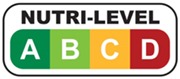
The requirements for sugar, salt, and fat content for each level are based on amounts per 100 milliliters of ready-to-eat processed food as follows:

Further requirements relating to nutrients reflected in the Nutri-Level labeling include:

  • Foods labeled as level A are not allowed to contain natural or artificial sweetening food additives, either through direct addition or carried over from other ingredients.
  • Foods labeled as level B may only contain natural sweetening food additives.
  • Foods labeled as level C or D may use natural and artificial sweetening food additives.
  • “Sugar” includes all monosaccharides and disaccharides, excluding lactose.
  • Processed plain liquid milk and plain milk powder are exempt from the requirement to declare total fat content on the Nutri-Level label.

Labeling Implementation

The implementation of Nutri-Level labeling must comply with the following requirements:

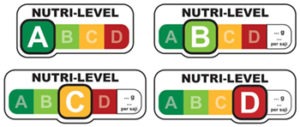
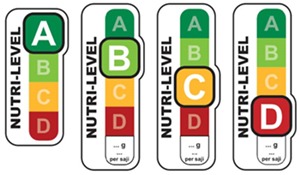
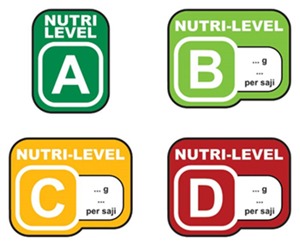
  • The Nutri-Level label must list all four letters (as shown in the examples below) unless the package meets the criteria for display of a simplified format label.
  • The Nutri-Level of the processed food must be indicated by enlarging the relevant letter, as shown in the examples below.
  • Processed foods at levels C and D must include a Nutri-Level label, while processed foods at levels A and B may do so on a voluntary basis.
  • The inclusion of a Nutri-Level label on processed foods at levels C and D must be accompanied by the sugar, salt, and fat content per serving (per saji in Indonesian, as shown in the examples below) or per package.

Nutri-Level Label Format

The draft regulation provides Nutri-Level label examples in both full and simplified formats. The simplified format applies to small packages of 30 square centimeters or less, while the full format must be used on other packages.

Full (horizontal)
Full (vertical)
Simplified
Timeline for Compliance

The draft regulation provides a grace period for existing product registrations:

  • Processed food that has obtained a product registration or for which a product registration application is pending before the regulation comes into effect must be amended within 30 months of the effective date of the regulation.
  • Ready-to-drink beverages, liquid concentrates, and powdered beverages must be amended within 18 months of the effective date of the regulation.

It is anticipated that the draft regulation will be finalized by the end of 2024.

For more details on this draft regulation, or on any aspect of food labeling requirements in Indonesia, please contact Tilleke & Gibbins at [email protected].

RELATED INSIGHTS​ 

December 7, 2020
It is strongly recommended that entities which are considering entering the Thai cannabis market file applications to protect their marks and patents in Thailand as soon as possible. Cannabis Trademarks Thailand operates under a first-to-file trademark system. The Thai Trademark Office has verbally confirmed that trademark applications which include goods or services relating to medical cannabis are registrable. That being said, recent developments indicate that the Trademark Office will require applicants who file specifically for medical cannabis goods or services to submit proof that the applicant has permission to produce drugs containing cannabis from the Thai Food and Drug Administration. In addition, the Trademark Office is taking a conservative approach when it comes to the words and images that are registrable as trademarks. The Trademark Office has advised that words or images relating to cannabis will be refused based on Section 8(9) of the Thai Trademark Act, which states that a trademark that is contrary to public order, morality, or public policy shall not be registered. Given the above, applicants should carefully consider the trademarks that they would like to protect in Thailand to avoid unnecessary refusals. If the applicant does not yet have such permission from the Thai Food and Drug Administration, it is recommended that the applicant’s mark make no reference to cannabis, either visually or verbally, and that the list of goods and/or services does not specifically refer to cannabis or related terminology. In short, we urge applicants to enter into the Thai market early, with carefully-chosen marks and deliberately-worded descriptions of goods and/or services. Cannabis Patents Cannabis-related products and processes are now eligible for patent protection in Thailand, with some restrictions. A cannabis plant, including its parts and crude extract, are considered mere products of nature and thus not patentable. Another important restriction applies to
December 7, 2020
Vietnam’s efforts against the outbreak of COVID-19 in the country have been largely successful, and despite two distinct spikes of local transmission, in both cases the spread was halted relatively quickly. As these complications from the COVID-19 pandemic have been playing out in Vietnam throughout 2020, it became clear that effective and strong enforcement of healthcare regulations, especially those related to disease control, was crucial. On September 28, 2020, the government of Vietnam took action on this by issuing Decree No. 117/2020/ND-CP (“Decree 117”), which provides penalties for administrative violations in the healthcare sector. Some provisions of Decree 117—mostly those related to disease control and epidemic situations—took effect immediately, with the remainder taking effect on November 15, 2020. The decree, which was based on a draft proposed by the Ministry of Health, replaced Decree No. 176/2013/ND-CP on the same matter. The main administrative penalties under Decree 117 are reprimands and fines. Depending on the severity of the violation, violators may also be subject to additional penalties such as suspension of a certificate of eligibility for pharmaceutical business (CEPB), a license for healthcare operation, or other licenses and practicing certificates for up to 24 months; confiscation of illegal items; suspension of operations for up to 24 months; or deportation. Furthermore, remedial measures such as forced return of illegal earnings, compulsory quarantine and medical examination, public correction, or compulsory payment of treatment fees may also be applied. Some key highlights of Decree 117 are discussed below. In relation to disease control, the maximum fine for failure to comply with quarantine is doubled to VND 20 million (USD 855) for infected people of type-A contagious diseases, and VND 10 million (USD 427) for those who are not infected but are asked to quarantine. Failure to declare one’s contagious disease to a doctor
November 30, 2020
Vietnamese cuisine has a growing reputation internationally, and a visit to Vietnam will quickly reveal that food plays a very important role in the country’s identity and culture, as well as its economy. More than 80% of the population makes a living through some form of agriculture, and approximately 35% of household income in Vietnam is spent on food and beverages. As food is the most essential of necessities, and thus the first priority in household spending, this percentage tends to be high in developing countries, declining as incomes rise.
November 17, 2020
The Thailand updates to Practical Law’s Life Sciences Global Guide  have been released online, with legal practitioners from Tilleke & Gibbins contributing the Pharmaceutical Intellectual Property and Competition Law section.The guide is a Q&A-style overview of the regulatory frameworks of the life sciences industries across multiple jurisdictions worldwide, with this chapter addressing the following issues as they relate to Thailand: