
You are using an outdated browser and your browsing experience will not be optimal. Please update to the latest version of Microsoft Edge, Google Chrome or Mozilla Firefox. Install Microsoft Edge

October 1, 2024

Indonesia Prepares to Require Nutritional Labeling for Sugar, Salt, and Fat Content

The Indonesian food and drug authority, also known as “BPOM,” issued a draft regulation on September 9, 2024, proposing standard labeling disclosing the sugar, salt, and fat content of packaged food products sold in the country.

The draft Regulation on Nutritional Value Information on Food Labels to implement Government Regulation No. 28 of 2024 on the Implementation of the Health Law seeks to mandate “Nutri-Level” front-of-pack nutrition labeling to indicate the amount of sugar, salt, and fat at four possible levels, with a modified stoplight-color system:

  • Level “A” (lowest amount) has a dark green background
  • Level “B” has a light green background
  • Level “C” has a yellow background
  • Level “D” (highest amount) has a red background

These levels are shown in the following sample image:
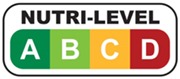
The requirements for sugar, salt, and fat content for each level are based on amounts per 100 milliliters of ready-to-eat processed food as follows:

Further requirements relating to nutrients reflected in the Nutri-Level labeling include:

  • Foods labeled as level A are not allowed to contain natural or artificial sweetening food additives, either through direct addition or carried over from other ingredients.
  • Foods labeled as level B may only contain natural sweetening food additives.
  • Foods labeled as level C or D may use natural and artificial sweetening food additives.
  • “Sugar” includes all monosaccharides and disaccharides, excluding lactose.
  • Processed plain liquid milk and plain milk powder are exempt from the requirement to declare total fat content on the Nutri-Level label.

Labeling Implementation

The implementation of Nutri-Level labeling must comply with the following requirements:

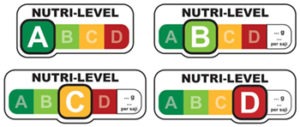
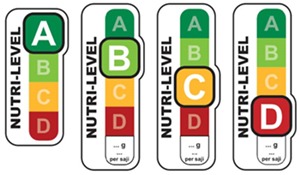
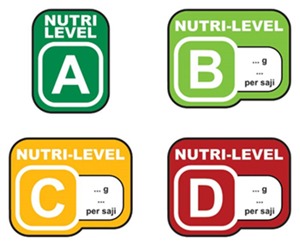
  • The Nutri-Level label must list all four letters (as shown in the examples below) unless the package meets the criteria for display of a simplified format label.
  • The Nutri-Level of the processed food must be indicated by enlarging the relevant letter, as shown in the examples below.
  • Processed foods at levels C and D must include a Nutri-Level label, while processed foods at levels A and B may do so on a voluntary basis.
  • The inclusion of a Nutri-Level label on processed foods at levels C and D must be accompanied by the sugar, salt, and fat content per serving (per saji in Indonesian, as shown in the examples below) or per package.

Nutri-Level Label Format

The draft regulation provides Nutri-Level label examples in both full and simplified formats. The simplified format applies to small packages of 30 square centimeters or less, while the full format must be used on other packages.

Full (horizontal)
Full (vertical)
Simplified
Timeline for Compliance

The draft regulation provides a grace period for existing product registrations:

  • Processed food that has obtained a product registration or for which a product registration application is pending before the regulation comes into effect must be amended within 30 months of the effective date of the regulation.
  • Ready-to-drink beverages, liquid concentrates, and powdered beverages must be amended within 18 months of the effective date of the regulation.

It is anticipated that the draft regulation will be finalized by the end of 2024.

For more details on this draft regulation, or on any aspect of food labeling requirements in Indonesia, please contact Tilleke & Gibbins at [email protected].

RELATED INSIGHTS​ 

January 10, 2023
On January 9, 2023, Vietnam’s National Assembly voted to approve a draft resolution on the continued implementation of policies for the prevention and control of the Covid-19 pandemic. Under this resolution, marketing authorizations (MAs) for the following drugs and medicinal ingredients will be extended to December 31, 2024, allowing continued use in Vietnam: Drugs and medicinal ingredients whose MAs expire from January 1, 2023, to December 12, 2024, and whose extension dossiers have been submitted but have not yet been approved in accordance with the Law on Pharmacy; and Drugs and medicinal ingredients whose MAs have been extended as per Resolution No. 12/2021/UBTVQH15 and have not been extended in accordance with the Law on Pharmacy. The extension does not apply to the following cases: Drugs and medicinal ingredients that have been recalled by the Law on Pharmacy; Drugs with signs of being unsafe for users that have been suspended from circulation/use and sealed for preservation in accordance with the Law on Pharmacy; and Drugs with MAs having a validity term of three years in accordance with the Law on Pharmacy. The Ministry of Health will announce the list of drugs and medicinal ingredients whose MAs are subject to be extended as described above.
November 23, 2022
The delisting of cannabis as a controlled narcotic in Thailand on June 9, 2022, was a breakthrough moment for the industry.  Not only are farmers and others in the industry elated that such a step was taken, it has triggered the establishment of an abundance of cannabis dispensaries in Bangkok and other popular domestic and international tourist destinations in Thailand, including Chiang Mai, Pattaya, Phuket, and many islands. Vulnerable populations, such as children, accessing cannabis has also become a hot-button issue. Thailand’s Ministry of Public Health (MOPH) was initially criticized by some for its policy of allowing cannabis to be sold with few restrictions. On June 17, 2022, the MOPH followed up with the Announcement Re: Controlled Herbs (Cannabis) under the Thai Traditional Medical Knowledge Act, which seemed to implement a viable mechanism to regulate cannabis dispensaries. This announcement contained prohibitions on selling cannabis to vulnerable populations (minors, expectant women, and breastfeeding mothers) and on smoking cannabis in public. Furthermore, the draft Cannabis and Hemp Act includes provisions related to sales and distribution channels and advertisements for particular dispensaries. However, the draft act has been delayed due to disagreements among some political parties during the reading of the legislation, and is unlikely to be implemented in 2022 as had been widely expected.  The tug-of-war among the political parties has caused concerns about whether the country’s recent liberalized cannabis policy will be revisited and cannabis relisted as a narcotic. With this uncertainty over when the draft Cannabis and Hemp Act will be implemented, the MOPH has focused on identifying gaps in current regulation that might allow the misuse of cannabis. The minister of the MOPH has announced that the MOPH announcement of June 17, 2022, will be repealed and replaced by the November 11, 2022, Announcement Re: Controlled Herbs (Cannabis).
November 14, 2022
Following the delisting of cannabis grown in Thailand as a narcotic substance on June 9, 2022, many have explored the applications of cannabis in various fields, including medicine, healthcare, food products, cosmetics, and animal feed. For example, a poultry farm in northern Thailand conducted an experiment jointly with Chiang Mai University, mixing crushed cannabis into poultry feed and water. The experiment showed several benefits of this cannabis feed. Birds that were fed cannabis had lower mortality rates and achieved superior body mass, with increased levels of protein, fat, and moisture in the meat, leading to this method of organic bird farming yielding higher profits. Despite the results of this experiment, the mechanisms and action of cannabis in animal feed are still not yet fully understood, and there are concerns about the possible effects on human health of consuming cannabis-fed poultry. Until recently, cannabis regulations focused solely on the safety of use by humans, and there were no regulations on the use of cannabis in animals. However, on October 11, 2022, the Department of Livestock Development (DLD) published Notification Re: Guidelines on the Use of Hemp and Marijuana as Especially Controlled Animal Feed or Their Use as Ingredients in Especially Controlled Animal Feed in the Government Gazette. In general, the DLD notification requires that animal feed containing cannabis be shown to benefit the animals without causing concern for their safety. According to the Animal Feed Quality Control Act B.E. 2558 (2015), especially controlled animal feed must be registered before it can be manufactured domestically or imported into Thailand. The DLD notification lays down the following evaluation criteria for registration of animal feed containing cannabis: It is prohibited to use cannabis (both hemp and marijuana) apexes (i.e., leaf tips), inflorescence, or seeds—including extracts from apexes, inflorescence, or seeds—as especially controlled animal
October 14, 2022
Interest in organic farming, soil health, and regenerative agriculture has increased rapidly in recent years, and the demand for biological and organic fertilizers has accordingly undergone dramatic growth. Biological fertilizers contain specific levels of microorganisms (such as nitrogen-fixing bacteria); organic fertilizers similarly contain microorganisms and typically come from animals and plants, such as livestock manure and crop residues. Although responsible fertilizer use is still necessary to prevent unintended effects, these “living fertilizers” can boost yields and promote plant productivity without many of the adverse environmental effects and safety concerns of chemical fertilizers. This makes them highly sought after for organic farming, and prized by agricultural operators looking to promote soil health as a bedrock of sustainable agricultural practices. As the global trade for organic and biological fertilizers has scaled up, producers and agribusiness companies have expanded organic and biological fertilizer offerings to new markets. Not only do different countries have their own regulations for fertilizers in general, but they also often have specific requirements and rules for biological and organic fertilizers. This guide provides fertilizer producers and traders with an overview of the legal landscape for these fertilizers in three major Southeast Asian markets so that businesses can make their fertilizers available and foster sustainable agricultural practices in the region. The full Biological and Organic Fertilizers in Indonesia, Thailand, and Vietnam guide can be downloaded through the button below.