
You are using an outdated browser and your browsing experience will not be optimal. Please update to the latest version of Microsoft Edge, Google Chrome or Mozilla Firefox. Install Microsoft Edge

May 12, 2022

Indonesia Introduces Shopping Center and Mall Certification Program to Fight Sale of Counterfeits

The presence of counterfeit goods in the Indonesian market is a stubbornly persistent challenge that has plagued the country for many years. The United States Trade Representative’s Special 301 Report, which is issued each year to assess intellectual property (IP) protection regimes around the world, has listed Indonesia on its “Priority Watch List” 23 times and on the “Watch List” 10 times. The 2021 report included the recommendation that Indonesia develop a specialized IP unit under the Indonesian National Police to focus on investigating domestic criminal syndicates behind counterfeiting and piracy. The police’s Special Crime Unit already handles IP matters and has been operating since long before 2021, but that year Indonesia also established its new IP Enforcement Task Force, which aims to improve intragovernmental coordination on enforcement. However, IP enforcement remains challenging in Indonesia.

The police and the Directorate General of Intellectual Property (DGIP) handled 346 total IP enforcement cases from 2020 through early 2022. While it is positive to see some enforcement activity, this is a rather low number, considering that the Indonesian market and its population are very large—and that counterfeiting is a widespread and persistent problem.

Shopping for a Solution

One way Indonesia’s Trademark Office is trying to address the country’s repeated problems with counterfeiting and piracy is by introducing a certification system for shopping centers and malls based on their support for intellectual property rights and standards. The certificates are intended to guarantee that the establishment hosts sellers of genuine products.

Both physical markets—such as Pasar Tanah Abang and Mangga Dua, two known markets for counterfeit goods—and online shopping venues are eligible to obtain a certificate. Specifically, this includes department stores, shopping streets, supermarkets, social media, online marketplaces, and crowdsourcing websites that digitally collects information, ideas, opinions, or work from a group of people. However, the certification procedure for online marketplaces has not yet been developed, as these present unique challenges to the certifying authorities.

For physical shopping centers and malls, applicants seeking certification must show evidence that at least 70% of their tenants are selling genuine products and goods—that is, those corresponding with the respective trademark registered with the DGIP.

The steps in obtaining a certificate for a shopping center or mall are outlined below.
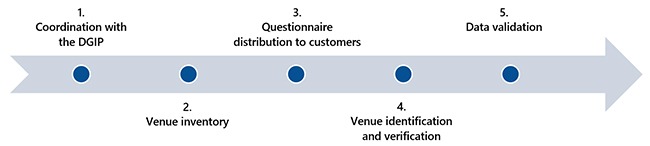
Once the landlord of a shopping center or mall contacts the DGIP to seek a certificate, the DGIP will begin an inventory of the shopping venue’s tenants. The data inventory covers tenants’ details and their business—including their relationship with the trademark owner, and the trademark registration related to the goods and services being sold. Next, the DGIP will distribute questionnaires to customers on whether the tenants are selling genuine products. However, no clear details on the form of the questionnaire or the required number of respondents has yet been provided. Depending on the results of the questionnaire, the DGIP will conduct identification and verification of sellers’ operations. This includes checking the relationship of the tenants and trademark owners and the validity of the trademark certificates. If the data validation meets with approval, the DGIP will issue a certificate to the shopping center. In case of rejection, the landlord should educate the tenants so they understand the risk of possible action against IP infringement.

These identification and verification steps are the main factor in why there is not yet a certification process for online marketplaces, as the much higher number of users makes these important steps impractical to carry out.

The certification program for shopping centers and malls also aligns with provisions in the Trademark Law and Copyright Law that specify landlord liability, with building management required to play a role in IP enforcement. The Indonesian Shopping Center Association, however, has pointed out that the situation is complex, as there are two types of shopping center ownership and this affects the involvement of the landlord. First, “strata title” mall ownership arrangements allow the tenants to own exclusive rights over their space or “lot,” as well as the right to use common space. In contrast to this, leased malls are those in which ownership of the lots remains with the landlord, who just grants temporary rights to use the space. For leased malls, the agreements between tenants and landlord include an obligation for tenants to obey the law. In regard to the sale of counterfeit goods, the landlord would be able to take action—such as an order to close the shop until the problem is resolved, or other measures requested by the complainant or authorities—against a tenant who is allegedly selling counterfeits. For strata-title malls, however, the building owner’s options are more limited, but possible measures might include periodically educating owners about IP infringement or posting notices in the premises not to buy infringing products.

On the online side, the Indonesian E-Commerce Association has noted that their members have been proactive in addressing complaints related to IP infringement. Actions they pursue include takedowns, blacklisting, and providing user data to the authorities when appropriate. For now, these efforts will continue apart from the Trademark Office’s certification program, which will remain on hold for sales venues on the internet until the DGIP can implement an efficient procedure for data verification of e-commerce users.

The certification program for malls and shopping centers has recently been launched, and the DGIP has started an informational outreach campaign for various malls in Indonesia. At this point, trademark owners should discuss with the landlord of their local stores in Indonesia to initiate coordination with the DGIP to obtain a certificate.

Conclusion

The shopping center and mall certification program may be of some assistance in helping Indonesia to make progress toward finally leaving the Priority Watch List—particularly if the DGIP focuses on the physical markets that are most notorious for selling counterfeit goods. Educating these markets (along with online marketplaces) about the certification program should be a priority in any publicity campaigns. The certification program has just launched and is not yet compulsory, but such a requirement for certification before sellers can begin physical or online operations could potentially increase the program’s effectiveness.

RELATED INSIGHTS​ 

August 15, 2025
Indonesia’s Directorate General of Intellectual Property (DGIP) has introduced a temporary feature in its online filing system to accommodate the submission of annual patent working statements. The requirement to submit these annual working statements was introduced under the amended Patent Law enacted on October 28, 2024, but the implementing regulation has still not been issued. Annual Working Statements Article 20A of the amended Patent Law requires all patentees to submit an annual statement regarding the implementation of their patents in Indonesia. This obligation applies to all active patents, regardless of when they were granted. The annual working statement declares the status of implementation of the patented invention within Indonesia. Acceptable forms of implementation include: Manufacturing the patented product (whether commercialized or not) Utilizing the patented process (whether commercialized or not) Importation Licensing If the patent has not yet been implemented in Indonesia, the DGIP provides an option to indicate: “The mentioned registered patent has not been implemented in Indonesia.” The statement must be made using the official template provided by the DGIP through the online filing system. Submission The working statement must be submitted annually no later than December 31 of each calendar year. No supporting documents are needed for the submission apart from the signed form itself. A color scanned copy will suffice; the original document is not required. There is currently no official fee for submitting the working statement. While the submission process may eventually align with annuity fee payments, the current process remains separate due to the pending implementing regulation. The submission process may be subject to change upon issuance of the implementing regulation, which is under discussion and expected in the coming months. In the interim, the DGIP accepts submissions of overdue working statements, allowing patentees to fulfill their obligations retroactively. This flexibility is expected
July 31, 2025
The Madrid System for international trademark registration provides the opportunity for a simplified and cost-effective way to register trademarks in multiple countries through a single application. Indonesia joined the Madrid System in 2018, and in 2024 alone, it received over 8,600 applications through this system. Despite the system’s effectiveness, it is important for trademark owners to be aware of the potential risks of refusal that can arise during the process of registration. Trademark applicants must pay close attention to these critical points when designating Indonesia. Appointing a Local Representative to Respond An applicant or representative of an international registration (IR) application that has been provisionally refused must appoint a local Indonesian representative in order to submit a response to the provisional refusal. This appointment is solely for the purpose of responding to the refusal in Indonesia; it is not necessary if the IR has not received any rejection. Furthermore, the local representative should not be registered with WIPO, as doing so would affect representation across all designated countries. Timing When it comes to calculating the deadline for responding to a provisional refusal, there is a discrepancy between the methods used by the DGIP and WIPO. Under the Indonesian Trademark Law, trademark owners can file a response within 30 working days, excluding weekends and national holidays. However, the WIPO cover letter accompanying the DGIP’s provisional refusal notice specifies both the start date and the deadline for responding to the notification, which is calculated as 30 calendar days, including weekends and national holidays. Therefore, a response to the provisional refusal of IR should be submitted in accordance with the WIPO cover letter to prevent any formality issue. Grounds for Refusal After an IR application is published in Indonesia’s Trademark Gazette, it undergoes substantive examination by the Directorate General of Intellectual Property (DGIP) examiners. The
July 30, 2025
Artificial intelligence (AI) model training and data scraping are essential processes in the development of modern AI systems. AI model training involves using large datasets to teach machine learning algorithms to recognize patterns, make predictions, or generate new content. Data scraping refers to the automated extraction of information from websites or digital sources, often to assemble the vast datasets required for effective AI training. As these practices become more widespread, questions about the legality of using third-party content—especially copyrighted works—have become increasingly important. In Thailand, the legal landscape for AI developers is shaped primarily by the Copyright Act, which presents unique challenges due to the absence of a fair-use exception. This article examines the copyright-related risks and legal uncertainties facing AI developers under Thailand’s current copyright law and practices, offering strategic guidance for navigating this complex environment. Copyright Risks in AI Scraping and Training Thailand’s Copyright Act does not provide a broad fair use or fair dealing exception, unlike some other jurisdictions, such as the United States. This absence has significant consequences for AI developers: No general defense for AI training: Any use of copyrighted material for AI model training is presumed to be infringing unless a specific, narrow statutory exception applies or explicit permission is obtained from the rights holder. There is no general legal basis for using copyrighted works in AI training without authorization. Increased rights clearance burden: Developers must identify and secure licenses for every copyrighted work included in their training datasets. Given the scale and diversity of data required for effective AI models, this process can be both impractical and costly. Legal ambiguity and litigation risk: The lack of clear statutory guidance or case law leaves developers in a legal gray area. There is no established precedent clarifying whether certain uses of copyrighted material for
July 25, 2025
Over the first half of 2025, the government of Vietnam has implemented a comprehensive suite of legislative reforms that significantly impact the country’s intellectual property (IP) framework. These amendments, most of which took effect on 1 July 2025, span the criminal, civil, administrative, and judicial sectors, and are part of a broader initiative to modernize Vietnam’s legal infrastructure, strengthen enforcement mechanisms, and harmonize domestic regulations with international standards. A summary of the key legislative changes and their potential implications for IP protection and enforcement across Vietnam is provided below. Criminal Code: Stricter penalties Under the 2025 amendments to Vietnam’s Criminal Code, penalties for offenses involving the manufacturing and trading of counterfeit goods have been significantly escalated. Individuals convicted of such violations now face fines ranging from VND 200 million to VND 2 billion (approximately USD 7,700 to USD 77,000; up from VND 100 million to VND 1 billion). For corporate entities, the penalties are even more severe, with fines ranging from VND 2 billion to VND 40 billion (roughly USD 77,000 to USD 1.54 million; up from VND 1 billion to VND 20 billion). These heightened penalties reflect the government’s intensified efforts to deter counterfeit-related crimes and protect consumer rights. Law on Handling Administrative Violations: Extended statute of limitations and application of electronic procedure The statute of limitations for addressing administrative violations in the IP sector is still two years. However, in cases where such violations are referred by procedural authorities, this period is extended by one year. The time taken by these authorities to process the case is now included within the overall limitation period. In addition, the Law on Handling Administrative Violations facilitates the use of electronic procedures, provided that the necessary infrastructure, technical systems, and information conditions are in place. Specifically, enforcement authorities are now permitted