
You are using an outdated browser and your browsing experience will not be optimal. Please update to the latest version of Microsoft Edge, Google Chrome or Mozilla Firefox. Install Microsoft Edge

May 12, 2022

Indonesia Introduces Shopping Center and Mall Certification Program to Fight Sale of Counterfeits

The presence of counterfeit goods in the Indonesian market is a stubbornly persistent challenge that has plagued the country for many years. The United States Trade Representative’s Special 301 Report, which is issued each year to assess intellectual property (IP) protection regimes around the world, has listed Indonesia on its “Priority Watch List” 23 times and on the “Watch List” 10 times. The 2021 report included the recommendation that Indonesia develop a specialized IP unit under the Indonesian National Police to focus on investigating domestic criminal syndicates behind counterfeiting and piracy. The police’s Special Crime Unit already handles IP matters and has been operating since long before 2021, but that year Indonesia also established its new IP Enforcement Task Force, which aims to improve intragovernmental coordination on enforcement. However, IP enforcement remains challenging in Indonesia.

The police and the Directorate General of Intellectual Property (DGIP) handled 346 total IP enforcement cases from 2020 through early 2022. While it is positive to see some enforcement activity, this is a rather low number, considering that the Indonesian market and its population are very large—and that counterfeiting is a widespread and persistent problem.

Shopping for a Solution

One way Indonesia’s Trademark Office is trying to address the country’s repeated problems with counterfeiting and piracy is by introducing a certification system for shopping centers and malls based on their support for intellectual property rights and standards. The certificates are intended to guarantee that the establishment hosts sellers of genuine products.

Both physical markets—such as Pasar Tanah Abang and Mangga Dua, two known markets for counterfeit goods—and online shopping venues are eligible to obtain a certificate. Specifically, this includes department stores, shopping streets, supermarkets, social media, online marketplaces, and crowdsourcing websites that digitally collects information, ideas, opinions, or work from a group of people. However, the certification procedure for online marketplaces has not yet been developed, as these present unique challenges to the certifying authorities.

For physical shopping centers and malls, applicants seeking certification must show evidence that at least 70% of their tenants are selling genuine products and goods—that is, those corresponding with the respective trademark registered with the DGIP.

The steps in obtaining a certificate for a shopping center or mall are outlined below.
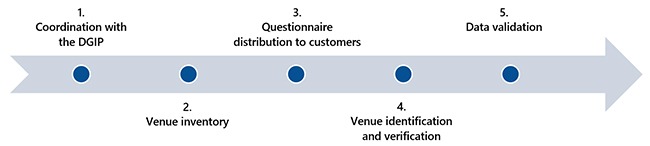
Once the landlord of a shopping center or mall contacts the DGIP to seek a certificate, the DGIP will begin an inventory of the shopping venue’s tenants. The data inventory covers tenants’ details and their business—including their relationship with the trademark owner, and the trademark registration related to the goods and services being sold. Next, the DGIP will distribute questionnaires to customers on whether the tenants are selling genuine products. However, no clear details on the form of the questionnaire or the required number of respondents has yet been provided. Depending on the results of the questionnaire, the DGIP will conduct identification and verification of sellers’ operations. This includes checking the relationship of the tenants and trademark owners and the validity of the trademark certificates. If the data validation meets with approval, the DGIP will issue a certificate to the shopping center. In case of rejection, the landlord should educate the tenants so they understand the risk of possible action against IP infringement.

These identification and verification steps are the main factor in why there is not yet a certification process for online marketplaces, as the much higher number of users makes these important steps impractical to carry out.

The certification program for shopping centers and malls also aligns with provisions in the Trademark Law and Copyright Law that specify landlord liability, with building management required to play a role in IP enforcement. The Indonesian Shopping Center Association, however, has pointed out that the situation is complex, as there are two types of shopping center ownership and this affects the involvement of the landlord. First, “strata title” mall ownership arrangements allow the tenants to own exclusive rights over their space or “lot,” as well as the right to use common space. In contrast to this, leased malls are those in which ownership of the lots remains with the landlord, who just grants temporary rights to use the space. For leased malls, the agreements between tenants and landlord include an obligation for tenants to obey the law. In regard to the sale of counterfeit goods, the landlord would be able to take action—such as an order to close the shop until the problem is resolved, or other measures requested by the complainant or authorities—against a tenant who is allegedly selling counterfeits. For strata-title malls, however, the building owner’s options are more limited, but possible measures might include periodically educating owners about IP infringement or posting notices in the premises not to buy infringing products.

On the online side, the Indonesian E-Commerce Association has noted that their members have been proactive in addressing complaints related to IP infringement. Actions they pursue include takedowns, blacklisting, and providing user data to the authorities when appropriate. For now, these efforts will continue apart from the Trademark Office’s certification program, which will remain on hold for sales venues on the internet until the DGIP can implement an efficient procedure for data verification of e-commerce users.

The certification program for malls and shopping centers has recently been launched, and the DGIP has started an informational outreach campaign for various malls in Indonesia. At this point, trademark owners should discuss with the landlord of their local stores in Indonesia to initiate coordination with the DGIP to obtain a certificate.

Conclusion

The shopping center and mall certification program may be of some assistance in helping Indonesia to make progress toward finally leaving the Priority Watch List—particularly if the DGIP focuses on the physical markets that are most notorious for selling counterfeit goods. Educating these markets (along with online marketplaces) about the certification program should be a priority in any publicity campaigns. The certification program has just launched and is not yet compulsory, but such a requirement for certification before sellers can begin physical or online operations could potentially increase the program’s effectiveness.

RELATED INSIGHTS​ 

July 21, 2025
Distinctiveness is a fundamental requirement for a trademark’s registration and protection under Thai law. The Thai courts typically assess distinctiveness based on a mark’s inherent characteristics rather than its use, as proving acquired distinctiveness through use requires substantial evidence, including the duration of use, extent of distribution and promotional efforts. However, the Intellectual Property and International Trade Court (IP & IT Court) has recently ruled that the figurative mark WEPLAY had acquired distinctiveness through use – an uncommon ruling under Thai trademark law. Subsequently, the Court of Appeal for Specialised Cases affirmed the mark’s inherent distinctiveness based on a holistic assessment of its components. This article discusses the criteria for proving both inherent and acquired distinctiveness, offering examples from both courts to provide valuable insights into case preparation and understanding of how the courts assess distinctiveness. Background In 2017 the plaintiff filed a trademark application for the mark depicted below for goods in Class 28, including toy building blocks: The registrar rejected the application on the grounds of non-distinctiveness under Section 7 of the Trademark Act. The plaintiff appealed to the Board of Trademarks, which considered that, when the term ‘weplay’ is used for goods in Class 28, it is descriptive of the nature of the goods applied for as “playthings”. Therefore, ‘weplay’ was deemed nondistinctive under Section 7, Paragraph 2(2) of the Trademark Act. IP & IT Court decision In 2024 the IP & IT Court ruled that the term ‘weplay’ is not a coined or invented word; instead, it is a combination of ‘we’ and ‘play’, conveying the meaning of ‘we play’. When the term is used for goods in Class 28, it describes the nature of the goods as “playthings”. Consequently, the mark was deemed non-distinctive. However, the court considered the evidence presented by the plaintiff,
July 14, 2025
Life sciences specialists from Tilleke & Gibbins have updated the firm’s guide to pharmaceutical data exclusivity regulations and practices in Southeast Asia. This guide contains quick-reference information on the availability of data exclusivity protections and limitations in Cambodia, Indonesia, Laos, Malaysia, Myanmar, Thailand, and Vietnam. Developing and launching a new drug on a commercial scale requires an enormous amount of time and investment in research and development (R&D), including pre-clinical testing and clinical trials. When considering the aggregate amount of drug development costs, it is important to recognize that this includes not only the investment in developing new drugs that get approved by a government food and drug regulator and are successfully brought to market, but also the R&D expenditures on a large number of potential pharmaceutical compounds and products that never actually make it to market. In particular, considerable investment is required in order to conduct and produce clinical trial data—to prove safety, efficacy and effectiveness of a new drug—that would warrant marketing approval by the regulatory authority. Such data is proprietary in nature and highly valuable for a research-based pharmaceutical company that develops an original drug. On the other hand, patent law typically confers generic drug manufacturers with the ability to engage in various preparatory activities with a view to obtaining marketing approval for a generic product before the patent for the original drug expires (commonly known as a “Bolar provision”). Since a generic drug maker may submit an application for marketing approval of a generic product before the relevant patent expires, the extent to which the drug originator’s data submitted to the regulatory authority is protected—or in other words, the extent to which the generic company may rely on the drug originator’s previously filed data, which underpins the safety and efficacy of the drug, to support
June 30, 2025
Vietnam is making notable strides in decentralization, aiming to grant greater autonomy to local government entities to streamline administrative procedures. As part of this effort, the government issued Decree No. 133/2025/ND-CP on decentralization of state management of the Ministry of Science and Technology dated June 12, 2025 (Decree 133). Effective from July 1, 2025, Decree 133 decentralizes and delegates numerous state management functions—including in intellectual property (IP) and technology transfer—to provincial-level People’s Committees (PCs). This reform signals a profound shift in how IP rights are administered and enforced across Vietnam. While this offers new opportunities for IP owners, agents, and innovators, it also introduces additional operational complexities. Impact on IP and Technology Transfer Decree 133 significantly reallocates responsibilities in IP and technology transfer, primarily to provincial-level PCs. Provincial PCs and other provincial authorities are now empowered to handle a wide range of tasks, including but not limited to the following: Issuance of duplicates and reissuance of certificates of registration. Registration of license agreements for the transfer of usage rights for industrial property objects (e.g., trademarks, patents) and recording amendments, extensions, or early terminations of such agreements. Enforcing decisions on compulsory licensing of patent use rights. Evaluation and approval of technology transfer contracts—a key step in facilitating localized technological advancements. Permitting the establishment of foreign-invested scientific organizations and their branches, to encourage foreign direct investment in local R&D and technology development. Approval of provincial-level R&D tasks, aligning with local socio-economic development priorities. Legal Implications The decentralization and delegation brought forth by Decree 133 carry several significant legal implications: Echoing Decree 133, the Intellectual Property Office of Vietnam issued Notification No. 2351/TB-SHTT on June 26, 2025, announcing the cessation of 19 administrative procedures at the national level. Specifically, from July 1, 2025, the IP Office will no longer accept requests related
June 27, 2025
Three American giants are actively protecting their intellectual property rights against generative AI, as two legal battles commence on both sides of the Atlantic. In the UK, Seattle-based media company Getty Images accuses UK-based Stability AI of multiple IP infringements. In the US, The Walt Disney Company and Universal Studios are teaming up against Midjourney, an AI startup, with their main ground being copyright infringement. Both cases are centered around questions legal minds have been posing since the introduction of generative AI: Is the output of generative AI an infringement? And who is ultimately responsible for the output, the platform or the user? Getty Images v. Stability AI Getty initially filed a claim in the High Court in 2023, which resulted in Stability applying for reverse summary judgment on the grounds that Getty had no real prospect of success, arguing that their operations took place outside the UK. However, the High Court judge hearing the case decided that the claims brought by Getty did have a real prospect of succeeding in court. Despite this, Stability saw a small victory when the court ruled that the representative action brought by Getty would not succeed due to the difficulties in identifying who qualified for the class. The proposed class was comprised of 50,000 rightsholders who alleged their rights were also infringed. Stability was successful in arguing that identifying these individuals would be challenging due to the unclear definition of the class. This current trial is centered around four main grounds: Copyright infringement. Getty accuses Stability of using content that Getty owns or has an exclusive license for when training their model, Stable Diffusion, resulting in the generated output containing substantial parts of that content. Getty is also alleging secondary copyright infringement, arguing that Stability is importing an article into the UK