
You are using an outdated browser and your browsing experience will not be optimal. Please update to the latest version of Microsoft Edge, Google Chrome or Mozilla Firefox. Install Microsoft Edge

May 12, 2022

Indonesia Introduces Shopping Center and Mall Certification Program to Fight Sale of Counterfeits

The presence of counterfeit goods in the Indonesian market is a stubbornly persistent challenge that has plagued the country for many years. The United States Trade Representative’s Special 301 Report, which is issued each year to assess intellectual property (IP) protection regimes around the world, has listed Indonesia on its “Priority Watch List” 23 times and on the “Watch List” 10 times. The 2021 report included the recommendation that Indonesia develop a specialized IP unit under the Indonesian National Police to focus on investigating domestic criminal syndicates behind counterfeiting and piracy. The police’s Special Crime Unit already handles IP matters and has been operating since long before 2021, but that year Indonesia also established its new IP Enforcement Task Force, which aims to improve intragovernmental coordination on enforcement. However, IP enforcement remains challenging in Indonesia.

The police and the Directorate General of Intellectual Property (DGIP) handled 346 total IP enforcement cases from 2020 through early 2022. While it is positive to see some enforcement activity, this is a rather low number, considering that the Indonesian market and its population are very large—and that counterfeiting is a widespread and persistent problem.

Shopping for a Solution

One way Indonesia’s Trademark Office is trying to address the country’s repeated problems with counterfeiting and piracy is by introducing a certification system for shopping centers and malls based on their support for intellectual property rights and standards. The certificates are intended to guarantee that the establishment hosts sellers of genuine products.

Both physical markets—such as Pasar Tanah Abang and Mangga Dua, two known markets for counterfeit goods—and online shopping venues are eligible to obtain a certificate. Specifically, this includes department stores, shopping streets, supermarkets, social media, online marketplaces, and crowdsourcing websites that digitally collects information, ideas, opinions, or work from a group of people. However, the certification procedure for online marketplaces has not yet been developed, as these present unique challenges to the certifying authorities.

For physical shopping centers and malls, applicants seeking certification must show evidence that at least 70% of their tenants are selling genuine products and goods—that is, those corresponding with the respective trademark registered with the DGIP.

The steps in obtaining a certificate for a shopping center or mall are outlined below.
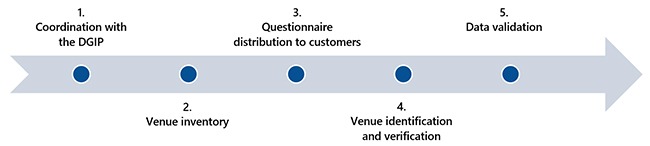
Once the landlord of a shopping center or mall contacts the DGIP to seek a certificate, the DGIP will begin an inventory of the shopping venue’s tenants. The data inventory covers tenants’ details and their business—including their relationship with the trademark owner, and the trademark registration related to the goods and services being sold. Next, the DGIP will distribute questionnaires to customers on whether the tenants are selling genuine products. However, no clear details on the form of the questionnaire or the required number of respondents has yet been provided. Depending on the results of the questionnaire, the DGIP will conduct identification and verification of sellers’ operations. This includes checking the relationship of the tenants and trademark owners and the validity of the trademark certificates. If the data validation meets with approval, the DGIP will issue a certificate to the shopping center. In case of rejection, the landlord should educate the tenants so they understand the risk of possible action against IP infringement.

These identification and verification steps are the main factor in why there is not yet a certification process for online marketplaces, as the much higher number of users makes these important steps impractical to carry out.

The certification program for shopping centers and malls also aligns with provisions in the Trademark Law and Copyright Law that specify landlord liability, with building management required to play a role in IP enforcement. The Indonesian Shopping Center Association, however, has pointed out that the situation is complex, as there are two types of shopping center ownership and this affects the involvement of the landlord. First, “strata title” mall ownership arrangements allow the tenants to own exclusive rights over their space or “lot,” as well as the right to use common space. In contrast to this, leased malls are those in which ownership of the lots remains with the landlord, who just grants temporary rights to use the space. For leased malls, the agreements between tenants and landlord include an obligation for tenants to obey the law. In regard to the sale of counterfeit goods, the landlord would be able to take action—such as an order to close the shop until the problem is resolved, or other measures requested by the complainant or authorities—against a tenant who is allegedly selling counterfeits. For strata-title malls, however, the building owner’s options are more limited, but possible measures might include periodically educating owners about IP infringement or posting notices in the premises not to buy infringing products.

On the online side, the Indonesian E-Commerce Association has noted that their members have been proactive in addressing complaints related to IP infringement. Actions they pursue include takedowns, blacklisting, and providing user data to the authorities when appropriate. For now, these efforts will continue apart from the Trademark Office’s certification program, which will remain on hold for sales venues on the internet until the DGIP can implement an efficient procedure for data verification of e-commerce users.

The certification program for malls and shopping centers has recently been launched, and the DGIP has started an informational outreach campaign for various malls in Indonesia. At this point, trademark owners should discuss with the landlord of their local stores in Indonesia to initiate coordination with the DGIP to obtain a certificate.

Conclusion

The shopping center and mall certification program may be of some assistance in helping Indonesia to make progress toward finally leaving the Priority Watch List—particularly if the DGIP focuses on the physical markets that are most notorious for selling counterfeit goods. Educating these markets (along with online marketplaces) about the certification program should be a priority in any publicity campaigns. The certification program has just launched and is not yet compulsory, but such a requirement for certification before sellers can begin physical or online operations could potentially increase the program’s effectiveness.

RELATED INSIGHTS​ 

September 24, 2025
Online shopping in Thailand is more accessible than ever, with global platforms, local social media shops, and entertainment-driven social commerce enabling instant purchases. However, this convenience comes with rising concerns over digital intellectual property (IP) infringement, including counterfeit goods, pirated content, and unauthorized brand usage. At first glance, online platforms appear to offer quick solutions. Most major e-commerce sites, social media channels, and social commerce platforms provide “notice and takedown” systems, where IP owners can file complaints and request the removal of listings that infringe IP rights, such as trademarks and copyrights. These tools are certainly useful, as seeing a fake product vanish from a platform feels like progress. But the reality is less reassuring. The counterfeit goods themselves remain in warehouses, markets, or shops, ready to be resold. Sellers whose accounts are taken down often return within days under new names or accounts. In other words, a takedown is like cutting weeds without pulling out the roots: they always grow back. While notice and takedown tools are widely available and can be managed internally by most IP owners, their impact is often short-lived. IP owners seeking more effective, lasting protection need to take a more strategic and multilayered approach. The same applies to online piracy. Unauthorized streaming websites that offer free access to movies, TV shows, or sports broadcasts have become widespread in Thailand. To combat this, rightsholders can request website blocking under the Computer Crime Act, through the Ministry of Digital Economy and Society and the courts. Once requests are approved, internet service providers are ordered to block access to infringing sites. Blocking orders can be effective in disrupting large-scale piracy operations, but they also face limitations—pirate sites frequently reappear under new domains. Strategic Protection Whether the infringing material is physical counterfeit goods or intangible streaming content,
September 4, 2025
On June 6, 2025, the Superior People’s Court in Hanoi overturned a non-use cancellation decision by the Intellectual Property Office of Vietnam, a rare and impactful occurrence. In a ruling that may help clarify the enforcement of Vietnam’s IP Law, the court held that valid trademark use can be established through commercial arrangements where the brand owner maintains actual control over the use of the mark, and is not confined to relationships governed by a so-called “formal license agreement. Background: Cross-Border Use, Local Challenge A Singapore company owns a well-known brand of consumer products that has gained recognition across Southeast Asia. In recent years, the brand has been targeted by several unauthorized trademark filings in Vietnam. In one such instance, a local Vietnamese trading company—previously linked to the production and export of counterfeit goods to neighboring countries—filed a non-use cancellation against the Singapore company’s mark and sought to register it under its own name. If the cancellation had been upheld, it would have enabled a complete hijacking of the brand. The IP holder operates in Vietnam through a structured cross-border supply chain. Under an agreement between two related foreign entities, one of which managed regional operations, production orders were placed through a designated Vietnamese company. While the Vietnamese manufacturer was not a party to the agreement, its role in using the mark was recognized and governed by internal and commercial documentation. The Vietnamese manufacturer lawfully obtained the necessary permits, regulatory approvals, and customs clearances for producing the goods in Vietnam. These activities were supported by banking records and internal communications, evidencing active, continuous use of the mark in Vietnam. However, the IP Office concluded that this use did not meet the statutory criteria because the Vietnamese manufacturer did not have a direct license agreement with the brand owner, as
August 25, 2025
Indonesia’s current regulations on franchises, as stipulated under Government Regulation No. 35/2024 on Franchising and its implementing regulation, Ministry of Trade (MOT) Regulation No. 71/2019 regarding Implementation of Franchising, highlight fundamental changes in franchise registration. These changes have introduced additional complexities and challenges in the franchise registration procedure, making it more difficult for franchise owners to navigate the process. New procedure Franchise applications are still submitted through the Online Single Submission (OSS) portal of the Capital Investment Coordinating Board (BKPM). However, the new procedure requires each applicant, including foreign franchisors, to have an OSS account and a business registration number (NIB) issued by BKPM. An application for franchise registration must be submitted under the applicant’s own account—submissions can no longer be made through the account of a consultant. Once a franchise application is submitted, the authority will distribute the submission to the MOT—the authorized ministry for franchise registration. Any notification or decision upon the registration made by the MOT will be available in the OSS system. Applicants should regularly monitor the status of the franchise application because no notifications will be sent to applicants to alert them of any deficiency. Here is the summary of the new procedure for franchisors: Notable Requirements The disclosure document, or prospectus, is the key focus for the MOT in examining a franchise registration for a franchisor. This document is subject to thorough scrutiny by the MOT to ensure that all mandatory information meets the requirements set in the franchise regulations. The current regulations specifically require that the mandatory clause “business system” in the prospectus cover operational standards and procedures, which should include human resource management, administration, operational management, standard operating methods, business location selection, business premises design, employee requirements, and marketing strategies. Other clauses that are equally important to pay attention to are:
August 21, 2025
Although the “passing off” principle has sometimes faced criticism for potentially broadening trademark protection—particularly in cases involving unregistered or unconventional marks like shapes, scents, or sounds—it serves an essential purpose. It safeguards the rights of business owners and shields consumers from deception, ensuring fair competition and reflecting the realities of modern commerce. What is passing off, and why is registrability not required? The passing-off principle is a legal concept rooted in English law, aimed at preventing a person from falsely representing or using a mark similar to another’s in a way that causes consumers to mistakenly believe the goods or services come from the same source. Under Thai law, the passing-off principle is provided under Section 46 of the Thai Trademark Act, which states: No person shall be entitled to bring legal proceedings to prevent or to recover damages for the infringement of an unregistered trademark. The provisions of this Section shall not affect the right of the owner of an unregistered trademark to bring legal proceedings against any person for passing off goods as those of the owner of the trademark. The passing-off principle can be interpreted as a practical legal concept. It does not require proof that the mark is registrable or meets the registrability criteria under trademark law. It is sufficient to show that the mark has established goodwill and that the other party’s use of a similar mark is likely to confuse consumers, making it a straightforward and effective tool for protecting brand assets. Requiring a claimant to prove that an unregistered mark could have been registered would undermine the very function of passing off. The doctrine was conceived precisely to fill the gaps left by the registration system. Imposing registrability criteria would nullify its function and leave many commercially valuable identifiers unprotected. If the