
You are using an outdated browser and your browsing experience will not be optimal. Please update to the latest version of Microsoft Edge, Google Chrome or Mozilla Firefox. Install Microsoft Edge

November 9, 2016

Indonesia: Increases to Official Fees Raising for IP and Enactment of New Trademark Law

The Indonesian government has announced two major developments relating to patents and trademarks in the country: (1) increases to the official fees for a range of IP prosecution tasks; and (2) the enactment of an amended Trademark Law.

New Official Fees

Government Regulation No. 45 of 2016 on Non-Taxable State Revenue introduces a number of increases to the official fees for many IP prosecution-related actions in Indonesia, although not all of the fees have changed. Government Regulation No. 45 will become effective on November 10, 2016. The key changes to the official fees are as follows:
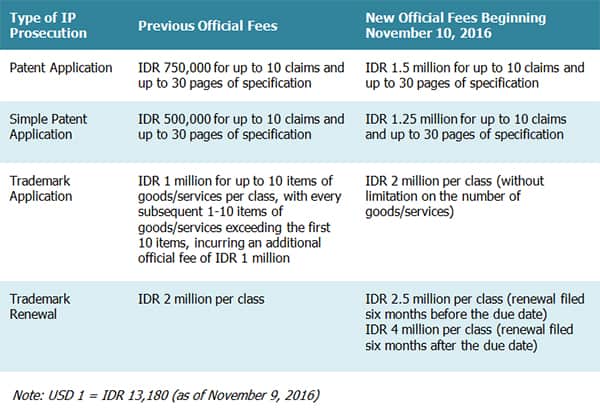
Significantly, the official filing fee for trademark applications is now calculated based on the number of classes, regardless of whether the application is filed on a single-class or multiple-class basis.

New Trademark Law

The Indonesian Parliament approved Indonesia’s new Trademark Law on October 27 this year, and it will come into effect on or before November 26, 2016. The new Trademark Law introduces a number of significant changes to the registration, protection, and enforcement of trademarks in Indonesia. This includes the following key changes:

  • In an opposition, the two-month publication stage will take place before the substantive examination stage, unlike before, where it took place after substantive examination. All trademarks that pass an initial formality examination will proceed directly to the publication stage. There will be no further publication after the substantive examination.
  • A pending trademark application will be assignable, whereas previously only registered trademarks could be assigned.
  • A renewal application can be filed either 6 months before the renewal due date or 6 months after the due date (with a penalty fee). Past practice only allowed the renewal to be filed within 12 months before the due date.
  • Nontraditional trademarks, including three-dimensional trademarks, sound marks, and holograms, will be introduced.
  • The criminal penalty for trademark infringement will be increased.

We will provide a more detailed analysis of the new Trademark Law in our upcoming issue of Informed Counsel, Tilleke & Gibbins’ quarterly law journal.

If you have any questions about Indonesia’s new official fees or the amended Trademark Law, please contact us at [email protected] or +6221 2971 8088.


RELATED INSIGHTS​ 

December 9, 2024
Cambodia’s Law on Seed Management and Plant Breeder’s Rights was enacted in 2008, but it was not until recently that new plant varieties could successfully be registered for protection in the country. Although the law has been in place for some time, recent developments confirmed the application process and a schedule of charges for the registration of new plant varieties. With these developments, breeders have been able to register their new plant varieties in Cambodia since March 1, 2024. Applicants for new plant variety protection must be Cambodian nationals, foreign nationals domiciled in Cambodia, or permanent residents of either a country that is a contracting party to the International Union for the Protection of New Varieties of Plants (UPOV) Convention or a country with which Cambodia has signed a memorandum of understanding on plant variety protection. Applicants can also claim a priority date from the first application for the same plant variety filed in any contracting party of the UPOV Convention within 12 months of the earliest application’s filing date. To be eligible for protection, new plant varieties must satisfy the following criteria: Novelty: A variety is considered “new” if, at the date of filing the application for new plant variety protection, it has not been sold, marketed, or otherwise disposed of others—by or with the consent of the breeder—for more than: One year for any plant variety in Cambodia; Six years for trees and vines or four years for all other plant varieties in countries besides Cambodia. Distinctiveness: A variety must be clearly distinguishable from any other existing varieties. Uniformity: A variety must be sufficiently uniform in its relevant characteristics. Stability: A variety must remain unchanged in its essential characteristics at the end of each cycle of propagation and in each generation. The last three criteria are often
December 4, 2024
On December 1, 2024, Myanmar’s Intellectual Property Department (IPD) issued the first group of trademark certificates of registration for marks registered under the Trademark Law of 2019. This is the first registration announcement since the start of the IPD’s soft opening period in 2020. With the registration of marks now in place, registered owners will benefit from stronger legal protections. These protections include the exclusive right to prevent unauthorized use of identical or similar marks by third parties and the ability to take enforcement and administrative actions. Myanmar’s implementation of the “first-to-file” system further emphasizes the importance of early registration. Marks registered at an early stage will be in a stronger position when filing oppositions against subsequent applications for identical or confusingly similar marks. The IPD issues certificates of registration in an electronic format to owners who have filed their applications via the IPD’s online filing system. For applicants who submitted their marks via physical applications, the IPD will issue physical certificates of registration. The initial registration term for a mark is 10 years from the filing date and is renewable for additional periods of 10 years each time. The IPD publicly discloses the details of marks registered under Myanmar’s Trademark Law via their official website. The IPD’s issuance of mark registrations under the Trademark Law of 2019 is a decisive step forward in intellectual property protection in Myanmar. It enhances legal safeguards for mark owners and any other authorized persons, and affirms Myanmar’s commitment to aligning its practices with global standards. For more information on protecting intellectual property rights in Myanmar, please contact Tilleke & Gibbins at [email protected].
December 4, 2024
On October 28, 2024, Indonesia officially amended its existing Patent Law when the president ratified Law Number 65 of 2024. This comprehensive update—the third such amendment in the history of Indonesia’s Patent Law—introduces several key changes that will significantly impact patent protection and application processes in Indonesia. Key highlights and changes are outlined below. Definition of Invention The new law broadens the definition of “invention” to explicitly include systems, methods, and uses. Additionally, the law introduces formal definitions for traditional knowledge and genetic resources. Patentability Criteria Notable changes include: Computer programs are now excluded, with an exception for computer-implemented inventions. Theories and methods in science and mathematics are added to the list of excluded inventions. Previous restrictions on new uses of existing products are removed. Grace Periods The grace periods for some patent-related actions have been adjusted: The grace period for disclosures has been extended to 12 months (from 6 months previously), providing inventors with more flexibility in filing patent applications after initial disclosure. A newly introduced item is the grace period for a conventional patent application claiming priority rights, which is 4 months after the 12-month filing deadline under the Paris Convention. The grace period for annuity payments is 6 months (from 12 months previously) with a fine for late payments of 100% of the annual fee payable. Patent Holder Rights and Obligations Patent holders can now grant permissions to enforce patents. There is a new requirement for patent holders to submit annual statements on patent implementation in Indonesia. Compulsory Licensing Significant changes to compulsory licensing include: Establishment of licenses based on the principle of expediency. Limitations on license scope and transferability. Prioritization of domestic market needs. New provisions for technical improvements and economic significance. Government Patent Exploitation The new law contains specific provisions for the government’s implementation
December 4, 2024
Thailand Legal Basics, a valuable primer for foreign investors, explores all aspects of living and doing business in Thailand. Written by specialists at Tilleke & Gibbins in Bangkok, it is the only comprehensive English-language guide to the Thai legal system with a focus on the concerns of foreign business and investment.